x




join forces in the fight against Corona
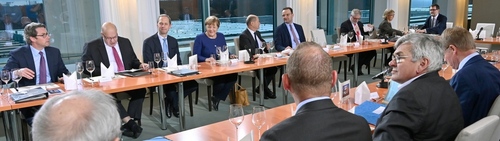
In view of the "unique" Corona crisis, unions and employers have shown themselves to be unfamiliar after a meeting in the Chancellery. There was much praise for the federal government's package of measures.
There has not been so much agreement between unions and employers for a long time. The top representatives of both sides were completely satisfied with what the Bundestag had decided and the Federal Government had announced to combat the economic consequences of the Corona crisis. This means easier access to short-time work, unlimited loan support for companies and the possibility of deferring upcoming tax payments so that companies remain liquid.
"The short-time working arrangement is the most important part of the package of measures because it is simply important not to have to release workers in the current situation just because you are temporarily underemployed." So said Dieter Kempf, President of the Federal Association of Industry (BDI). Industry associations have been demanding state aid for days, most recently Lufthansa manager Carsten Spohr in a video message to all employees. The airline has suffered massive revenue losses due to the entry ban for Schengen citizens to the United States.
But you shouldn't just look at the big companies, said industrial president Kempf. Small and medium-sized businesses and small family businesses could also be in need. "Think of trade fairs, stand construction, catering, hotels, which suffer very directly from the fact that customers simply do not appear." On the other hand, in many industrial sectors there is more of a problem with value chains that are not being served at the moment - "we could still hope that we can catch up in the second half of the year."
The BDI President also praised the promised financial aid for companies. Of course, one could always wish for more - but it was particularly important that the federal government acted.
Reiner Hoffmann, the chairman of the German Confederation of Trade Unions, practiced verbally close cooperation with the employers. The different interests of employers and employees did not play a major role now - rather the shared responsibility that business would continue: "The concern is that people are now afraid of losing their jobs in such a situation. We have to deal with and show this clearly that we are able to act even in such a crisis situation, can give them security. "
The head of the DGB also welcomed the decisions of the federal government - and also reminded those affected who are precariously employed, operate as a one-person company or are members of the liberal professions: "Here we have to think about specific measures, because some of them not to be reached by the aid measures that have now been decided. We must not leave these people out in the rain either - bridging measures must be created. "
For example, through long-term, interest-free loans that can be used to compensate for an order gap. At the meeting, the Chancellor emphasized that there was "enough money for the announced federal aid programs". The coalition had operated so sensibly that the financial reserves for this, literally, "unique crisis" were now sufficient.