Shares continue on the way down
Despite the large price drops in recent days, there are no signs that the matter will soon be over. Since their respective highs on February 19, the DAX has lost 17 percent and the S&P 500 11 percent. The futures markets suggest that the U.S. will go down about 2.5 percent this afternoon. It looks like we're facing one of the biggest setbacks in the past two decades. After the turn of the century, there had been a total of five major price drops on the German market, with losses of between 23 and 73 percent. We seem to be in phase # 6. Next "shares continue on the way down"
by Dieter Wermuth , 0 comments
February 12, 2020 at 2:13 pm Clock
 Exclusively from the business service:Interest rates are lower than they have been for a long time, and savers and banks in particular are complaining about them in this country. The ECB's low interest rate policy has repeatedly come under criticism: it is “artificially” lowering the interest rate level and, in addition to highly indebted countries, also favors companies that would not be viable if interest rates rose. The latter, also called zombification, in turn affects the productivity of the economy and leads to weak economic growth. With its expansionary measures, the ECB would also cause bubbles on the real estate markets and on the stock exchanges. Others blame the stability pact of the monetary union and in particular the German government's austerity policy, the adherence to the “black zero”, for low interest rates. However, empirically that interest rates have been falling for several decades and that this is a global phenomenon. So more fundamental developments such as demographic change, the shift in income distribution towards high-income earners and changes in private wealth accumulation and capital requirements could also play a role. In the talk of the January edition of theWirtschaftsdienst discusses the causes and effects of low interest rates in five articles: Next "Low interest rates - causes and effects"
by Uwe Richter , 2 comments
January 2, 2020 at 5:03 pm Clock
Exclusively from the Wirtschaftsdienst: The December edition of the Wirtschaftsdienst answers the question of who will benefit from the basic pension agreed in the grand coalition. The compromise improves the situation of more than a million pensioners and increases their pension on average by a third. As a result of the agreed income test, the group of people affected has been more than halved. Scientists Charlotte Fechter, Marlene Haupt, Sandra Hofmann, Andrea Laukhuf, Werner Stuhlmeier, Sabrina Spies and Aysel Yollu-Tok have investigated how the compromise pension affects different groups of potential beneficiaries. Next "Basic pension compromise: who benefits?"
by Uwe Richter , 2 comments
November 25, 2019 at 3:45 pm Clock
The stock market cannot be broken down. The boom is now ten and a half years old. There were some setbacks during this period, but they didn't last long because optimism was unbroken and declining prices were seen primarily as cheap buying opportunities, not as a harbinger of worse.
Next "high dividends, low bond yields - the decision is easy"
by Dieter Wermuth , 1 comment
October 15, 2019 at 12:38 pm Clock
Exclusively from the business service: Companies in Germany are economically intertwined with the United Kingdom in different ways and Brexit is likely to have an impact on their staffing needs. At the same time, the UK's immigration policy will become more restrictive as it leaves the EU, which will not remain without effects on the migratory flows of workers within the EU. How does both affect the German labor market? In the October issue of WirtschaftsdienstMario Bossler, Johann Fuchs and Alexander Kubis from the Institute for Labor Market and Vocational Research (IAB), together with Lutz Schneider from the Coburg University of Applied Sciences, are analyzing the possible consequences of Brexit for job offers and job demand in Germany.
Exclusively from the business service: A system to effectively tax multinational companies internationally is to be negotiated by the end of 2020. The chances of success are not bad, say Johannes Becker and Joachim Englisch. In the September issue of Wirtschaftsdienst, the two finance scientists from Münster outline the background and progress of the negotiations and give an outlook on how the system could be designed.
Next "Minimum taxation of multinational companies in sight"
by Uwe Richter , 3 comments
September 5, 2019 at 6:42 pm Clock
The yield curves of twelve or 13 European countries and Japan are currently in negative territory, from overnight money to yields on ten-year government bonds. The markets have lost touch with the factors that usually determine how high interest rates are. These are above all the longer-term inflation expectations, the trend rate of productivity or real social product and a premium for the risk that inflation or key interest rates will rise sharply from one day to the due date, or that the issuer will experience payment problems. According to this rule of thumb, a “normal” interest rate of 2.2 percent results for ten-year federal bonds. However, these papers are traded on the market with a yield of -0.6 percent. I do not remember that there has ever been such a large discrepancy.
Continue "Bonds are far too expensive"
by Dieter Wermuth , 5 comments
September 3, 2019 at 1:50 pm Clock
Exclusively from business services: In times of growing challenges for public budgets, which arise from future tasks such as old-age provision, modernization of the infrastructure, ecological transformation or climate policy, the question of how to finance them arises more and more. With a view to the success story of the Norwegian sovereign wealth fund, Germany is also considering a sovereign wealth fund as an alternative financing instrument to take advantage of the creditworthiness of the German sovereign. The proposals as to the means from which such a fund should be fed range from public borrowing and taxes to private investments. In the conversation of the August edition of the Wirtschaftsdienstthe authors discuss the possibilities and the usefulness of a sovereign wealth fund for Germany.
Next "A future fund for Germany?"
by Uwe Richter , 2 comments
August 26, 2019 at 6:13 pm Clock
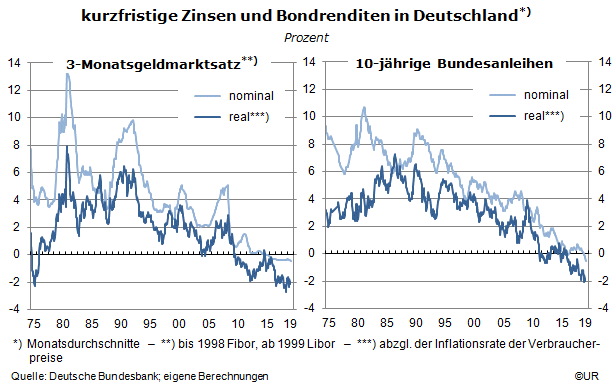
No question, I am one of the unsuspecting people who until a few years ago could not imagine that the entire German yield curve, from overnight money to 30-year federal bonds, would one day be permanently below zero. This had never happened in the past 40 years, not even with real interest rates, i.e. inflation-adjusted interest rates.
Next "bubble in the bond market will burst - only a matter of time"
by Dieter Wermuth , 2 comments
August 19, 2019 at 12:22 Clock
The CO 2 tax is coming. Nationally, there is increasing pressure on politicians to act more resolutely against greenhouse gas emissions. It's an international trend : the World Bank and
International Monetary Fund and more than 3,500 American economists have recently asked for such a tax. They have already been introduced in 26 countries - almost nobody seems to be against it anymore.
How high should it be? The simple but operationally unsatisfactory answer is: so high that the amount of CO 2 that is released annually, primarily through combustion processes, is reduced in accordance with the political targets . For this to happen, the prices of fossil fuels must rise appreciably. So much is clear, but what is the entry level?
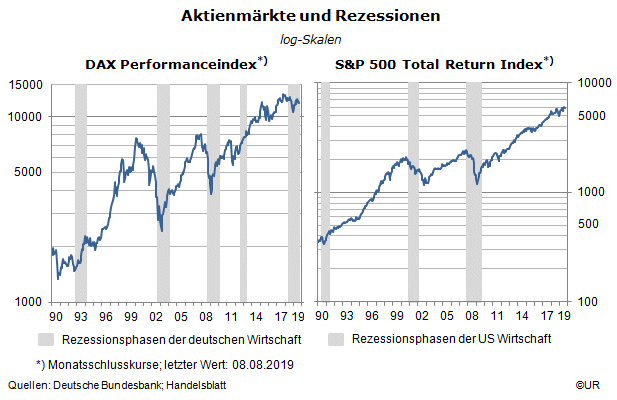
So far, the setback on the German stock market has been severe, namely about five percent from the last high in early July, but not yet particularly large compared to some crashes in the past. It can practically not be seen in the following graphic. The market corrections from 2018, 2015, 2011, 2008 or March 2000 to March 2003 were each quite a bit larger. However, as in 2008, we are facing a recession at the same time, probably with a sharp decline in profits and soon also with cuts in dividends. It will not be easy this time to find reasons for a rapid recovery in prices.