x




That is the car tire of the future
Itis the moment every driver fears: suddenly there is a buzzing in the wheel arches on the highway, the steering becomes spongy, the car pulls to the side. If you then - as recommended - go straight to the hard shoulder, you will quickly see what the problem is: a flat tire. The drivers of tomorrow will only know such emergency stops from stories, because the tires on which they roll are almost indestructible. This is not science fiction: last year the Michelin manufacturer introduced a tire that never runs out of air - because it no longer needs one.
The Uptis (which stands for Unique Puncture-proof Tire System) doesn't mind even a vertical nail. This is due to its innovative design: the rim consists of an aluminum part that docks to the axle, then the load-bearing structure of the tire is made of patented composite materials - the air filling in conventional tires - and finally a rubber tread on the outside, which is used in construction and manufacture resembles the tread of conventional pneumatic tires. Even if the nail pierces it, the Uptis maintains its shape. Despite the lack of air cushion, the ride is not more uncomfortable because the composite structure absorbs unevenness. Driving tests are currently running on public roads. The market launch of the Uptis is planned for 2024. Then the airless tire should be used as standard.
THE UPTIS CAN MAKE A SIGNIFICANT CONTRIBUTION TO INCREASING ROAD SAFETYPROF. DR. STEFAN BRATZEL,director of the Center of Automotive Management
At the last “Golden Steering Wheel”, Michelin won the innovation award with the tire concept. "The Uptis can make a significant contribution to increasing road safety," said jury member Stefan Bratzel, the well-known auto professor. Saying goodbye to air filling is just one of many innovations on the way to the future: tomorrow's tires may be produced from organic waste and only printed out ten minutes before the journey.
A look back shows how far the tire industry has come: anyone who got into a Ford Model T one of the first mass-produced cars a hundred years ago had to expect to end the journey at any time. Flat tires were part of everyday life, partly because the streets were littered with horseshoe nails, partly because of the fragile material.

From a statistical point of view, today's drivers only have to count on a flat tire every ten years. Overall, the tire product has made tremendous progress over the past 100 years. "We are dealing with a highly complex construction that consists of around 200 different materials - rubber, steel, fabric," explains Dr. Christian Bachmann, tire expert at fka GmbH in Aachen, who supports manufacturers from all over the world in developing new tires. What makes this job so demanding is that the performance of a tire always depends on several factors. "If you change one variable, others always change too," reports Bachmann. The high art is to develop a tire that is good and balanced in all properties. This work is made more difficult by that the external conditions influence the properties of the tire. How high is its pressure, how warm or grippy is the road?
IN THIS WAY, YOU CAN CREATE VERY COMFORTABLE TIRES THAT SWALLOW OBSTACLES AND AT THE SAME TIME ARE STIFFER IN THE TRANSVERSE DIRECTIONDR. CHRISTIAN BACHMANN,tire expert at fka GmbH, Aachen
Airless constructions are the trend for the coming years for many reasons. A model like the Uptis is almost indestructible and does not require any maintenance - checking the air pressure regularly at the gas station will soon be a thing of the past. In addition, these tires open up further scope for design, as the inflation pressure no longer has any influence on the behavior. "This way, you can create very comfortable tires that swallow obstacles and at the same time are stiffer in the transverse direction," explains Bachmann. In other words, the old contradiction “either sporty or comfortable” can be largely resolved.

Perhaps the best argument to let air out of the tire forever is sustainability. A tire like the Uptis creates better mileage than a standard tire and does not have to be replaced due to a tire. For comparison: Today, every year 200 million tires land on the garbage that have actually not yet reached the end of their service life. They have to be withdrawn from traffic due to damage - for example through a hole. Incorrectly set air pressure also shortens the life of the tires. If the air pressure is too low, the tire is excessively stressed at the edge. If it is too high, however, the center of the tire will wear out faster. This fate does not threaten airless tires, which will help to save oil.
But natural rubber also continues to play a role, with a share of between ten and 30 percent in the finished tire. It is still obtained today as it was 100 years ago by scratching the bark of a rubber construction and collecting the escaping latex in a bucket. Most of the plantations with the "rubber trees" are in Thailand, Indonesia and Malaysia, but African and South American countries are also among the producers.
WE ARE DEALING WITH A HIGHLY COMPLEX CONSTRUCTION THAT CONSISTS OF AROUND 200 DIFFERENT MATERIALS - RUBBER, STEEL, FABRICDR. CHRISTIAN BACHMANN,tire expert at fka GmbH, Aachen
Overall, the natural product has a highly complex supply chain with around six million small farmers, 100,000 middlemen and more than 500 processing companies. In order to ensure, given these figures, that all parties involved act in an environmentally friendly and responsible manner, the market leaders Continental and Michelin founded an alliance called Rubberway last year. Together they want to create a database that makes transparent which market participants are on the go.
The manufacturers are also looking for alternative raw materials. Michelin, for example, invented a method for making tires from straw, wood chips and agricultural waste. For this purpose, the biomass is first converted into alcohol (ethanol) in a special plant. Finally, synthetic rubber is obtained in an intermediate step. Michelin is already operating a test facility in Bassens, France, which produces 20 to 30 tons of raw tire materials purely from plants. Together with an industrial partner, production is to be increased to 100,000 tons per year. The tire of the future would still be black, but at least green in terms of content. Plus: Because only waste from agriculture and forestry is used, the production of organic tires is not at the expense of food production.

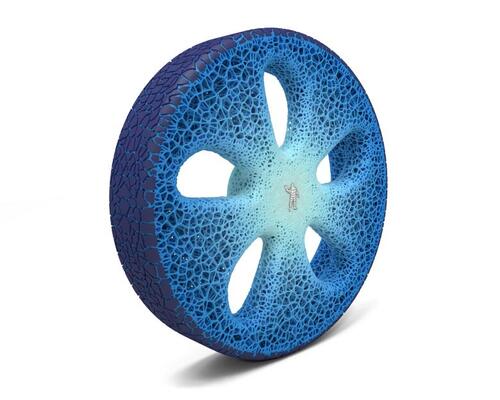
Incidentally, Michelin is already testing the airless, completely recyclable Pneu Uptis in some US states. It is only slowed down by lawmakers since there are no national standards for airless tires in the USA. Of course, this innovation will follow at the interface between car and road. The tires of the day after tomorrow are already being created in the laboratories. Michelin, for example, already presented its so-called Visionary Concept three years ago: wheels and tires form a unit in this concept, too, with the appearance almost reminiscent of alien technology. Instead of straight spokes, the inside of the tire consists of a highly complex network of struts. It is based on a model from nature: honeycombs.

The actual rubber profile could also be printed in the future, to match the planned trips, almost as tires on order: if the driver plans a trip to the snowy mountains, for example, he can drive to a so-called Print & Go Center and get there have a tread with a greater tread depth printed on it in a few minutes. Similarly, winter bikes could be converted into summer bikes in the future. This benefits the environment in two ways: Since only the tire tread is exchanged, fewer raw materials are required. In addition, a 3-D printer saves material per se because it only applies what is needed; unlike milling or cutting, there is no waste.
The personal tire - that sounds like a distant vision. However, expert Bachmann can imagine that this technology will “conquer the broad market from a niche in a few years”. Overall, he expects the future world of mobility to become more colorful - and thus also that of tires. A self-driving taxi, for example, may need tires that are optimized for city traffic up to 80 km / h, the e-sedan, on the other hand, tires that roll particularly quietly (since there are no more engine noises that drown out everything). Only one property of tomorrow's tires seems certain, says Bachmann sly: "It's round".