x





Affiliate Marketing, Business Development, Home-based business, Make Money, Technologies
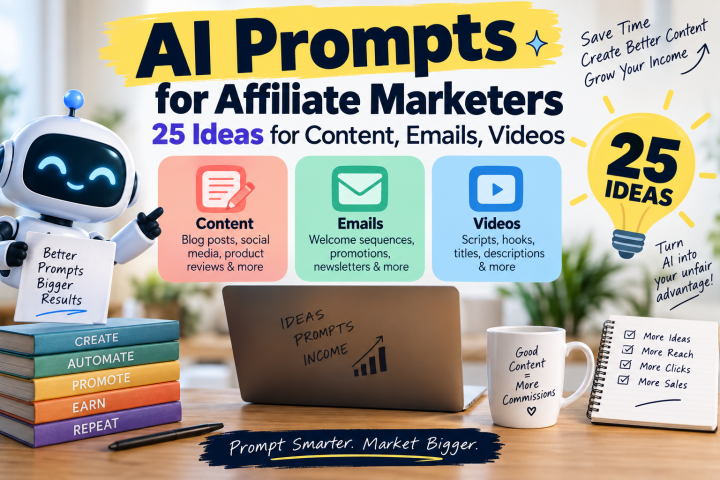
Some days, your best campaign idea arrives just after you close your laptop. You know your readers need help, yet turning that thought into useful content can feel like a second job. This guide gives you a clearer path by sharing AI Prompts for Affiliate Marketers. It also outlines a seven-part prompt framework and emphasizes…
11–16 minutes
AI prompts for affiliate marketers, Content creation ideas, Email Marketing Strategies
Some days, your best campaign idea arrives just after you close your laptop. You know your readers need help, yet turning that thought into useful content can feel like a second job. This guide gives you a clearer path by sharing AI Prompts for Affiliate Marketers.
It also outlines a seven-part prompt framework and emphasizes fact-checking, firsthand testing, transparent disclosures, and human judgment. Marketers can use AI to speed research and content production while measuring clicks, conversions, revenue, and customer response.
Some days, your best campaign idea arrives just after you close your laptop. You know your readers need help, yet turning that thought into useful content can feel like a second job. This guide gives you a clearer path.
You will explore 25 practical prompts suited to research, SEO, product reviews, email campaigns, short-form videos, social posts, ads, testing, retention, plus community growth. Add your target audience, niche, product details, tone, plus campaign goal to create work that feels focused rather than generic.
Use these tools to support your judgment, not replace it. Glean’s 2026 Work AI Index reports that users save about 11 hours each week. That time can help you refine a message, study buyer needs, or build trust with readers.
Each idea includes a clear example you can adapt to your next affiliate campaign. You will gain a repeatable marketing process that helps turn scattered thoughts into useful assets.
AI Prompts for Affiliate Marketers
Strong instructions give your workflow direction. They help you move from broad ideas to useful assets that match a niche, customer need, or campaign goal.
AI Prompts for Affiliate Marketers
Modern tools can speed research, copy development, content planning, product comparisons, plus routine marketing work. ChatGPT 5, Claude 3.5 Sonnet, Gemini 2.5 Flash, Claude 4.5 Sonnet, and Jasper suit different tasks.
“Employees using AI save roughly 11 hours per week on research, drafting, and data-analysis tasks.”
Glean Assistant can connect documents, Slack threads, CRM records, plus permission-aware company knowledge. Its Enterprise Graph grounds answers in relevant business data. That context can produce sharper insights than a generic request.
Your audience knowledge still matters most. Review each result against customer questions, industry standards, product facts, current trends, plus firsthand testing.
The best results combine machine efficiency with human analysis.
A focused brief turns a vague request into useful campaign material. Start with the seven-part structure: role, context, task, tone, constraints, format, plus quality bar. This method helps your tool match the target audience, product, buyer stage, and desired action.
State who the writer should be, what the customer needs, which product you promote, and what success means. A clear target keeps the copy relevant to your marketing plan.
Specify voice, channel, word count, structure, claims, plus review rules. For example, request a 100-word product announcement email with two subject-line options. Ask for three variations when you need material for testing.
“Clear limits create useful choices without removing your judgment.”
Share research, customer language, brand examples, competitor details, and verified product facts. Glean Assistant can use permissioned company knowledge with cited answers. Check every result against current SEO needs, accuracy, and trust.
This practical collection turns market research into useful campaign assets. You can move from niche discovery to product selection, search planning, promotion, email copy, plus video production with less guesswork.
Begin with buyer needs, product gaps, search demand, plus trusted brands. Add your audience pain points, disclosure rules, product facts, target, plus campaign goal. This detail helps each request produce focused results.
Request 30 hooks under 90 characters. Mix curiosity, transformation, listicle, contrarian, problem-agitate, plus testimonial styles. This range gives you fresh angles for each traffic platform.
Turn one article, webinar, email, or video into social posts, ad copy, search snippets, plus a 30- or 60-second script. Include features, benefits, proof, plus a clear call to action.
| Starting asset | New format | Main purpose |
|---|---|---|
| Article | Social post series | Reach new readers |
| Webinar | Short video script | Explain product value |
| Ad variation | Test conversion copy |
Good market decisions begin with evidence, not guesswork. Use research prompts to clarify your audience, uncover demand, plus guide smarter marketing choices.
Ask a tool to define your ideal customer by age, interests, challenges, product needs, plus buying barriers. Then connect those problems to the solution your recommendation offers. This creates useful insights for a focused niche.
Request a review of the top three competitors. Compare their content strategy, website design, social presence, positioning, plus gaps. Note trends that reveal opportunities to make your message distinct.
Deep Research can produce five detailed reports plus one action plan in about 10–15 minutes. Check original sources before using the results. Review search data, pricing, objections, products, plus target terms to judge demand.
Combine customer feedback with sales data to spot buyer intent, recurring complaints, proof points, plus product performance. Use prompts to group testimonials by theme, but treat summaries as leads, not evidence.
| Source | What to find | Best use |
|---|---|---|
| Sales data | Demand signals | Prioritize products |
| Reviews | Objections | Improve messaging |
| Competitor research | Market gaps | Shape positioning |
Search-focused pages need a clear purpose, useful structure, plus verified product details. Start with the target audience, niche, search intent, primary term, supporting questions, tone, length, plus desired action.
Request logical H2 and H3 headings that answer real audience questions. A B2B blogger may spend four hours on a 1,460-word article. Jasper offers over 65 templates, while Perplexity, Surfer SEO, Clearscope, plus Ahrefs support research.
Ask for specifications, benefits, drawbacks, user experience, alternatives, buyer advice, plus a balanced affiliate CTA. Match length to intent: 2,000 words suit a review, while 2,500 words suit a buying guide.
Use a table that compares four or five products across eight to ten features. Require current prices, accurate specifications, source checks, plus clear differences.
Link helpful information to relevant products without forcing sales copy. Your testing, screenshots, case studies, plus editorial review add trust that automated results cannot provide.
A thoughtful inbox sequence can turn a quiet subscriber into an informed buyer. Build each email around one need, one product, plus one clear next step. This approach keeps your marketing useful rather than overly sales-driven.

AI Prompts for Affiliate Marketers
Start with a welcome message, then share practical tips, product benefits, customer concerns, plus helpful information. A three-email onboarding sequence works well: introduce the offer, explain its value, then invite action. Add disclosure details when your recommendation uses an affiliate link.
Ask for several opening hooks, calls to action, plus copy variations suited to each audience segment. Adjust length, tone, links, and timing to match the platform. Test one change at a time so your results reveal which message earns attention.
Useful education makes a recommendation feel more trustworthy.
| Sequence stage | Message focus | Next action |
|---|---|---|
| Welcome | Set expectations | Read a helpful guide |
| Education | Show product benefits | View product details |
| Retention | Share tips and proof | Complete a purchase |
Visual channels reward a clear message, quick pacing, plus a strong reason to act. Shape each request around the platform, audience, product, goal, plus disclosure needs.
Ask your tools to create a 20- to 30-second script with this structure: hook, problem, proof, call to action. Request several hooks that use curiosity, transformation, contrarian, or testimonial angles. Add caption text, scene changes, pacing, plus spoken copy.
Turn one article, webinar, or video outline into an email, carousel captions, tweets, a YouTube description, plus podcast show notes. A useful request can produce five short scripts from one source. Keep each version tied to the same data, message, plus target action.
Use a ProDentim example aimed at health-conscious adults with bad breath, bleeding gums, or cavities. Ask for a curiosity-led ad that explains the concern without making unsupported health claims. Then request platform-specific copy, disclosure language, headline variations, plus a brief performance analysis.
Test one change at a time. This makes campaign results easier to read.
Conversion gains often begin with a sharper connection between customer needs, product value, proof, objections, plus the next step. Use focused prompts to shape landing-page content, email copy, articles, ads, or video scripts for one target audience.

AI Prompts for Affiliate Marketers
Try this ProDentim example: “Write three ad variations about brushing daily while still facing bad breath, bleeding gums, or cavities.” Ask each version to use a different headline, call to action, or value claim. Require careful wording that avoids unsupported health claims.
Keep your strongest ad or email as the control. Test one change at a time, such as the offer, hook, creative angle, link placement, or CTA. This step makes performance easier to read across campaigns.
Clicks show interest; sales show business value. Use data analysis to find useful opportunities, then refine your marketing ideas.
| Measure | What it reveals | Useful action |
|---|---|---|
| Click-through rate | Hook strength | Refine headlines |
| Cost per click | Traffic efficiency | Adjust targeting |
| Conversions | Offer appeal | Improve landing pages |
| Total sales | Revenue impact | Scale winning campaigns |
Before publication, inspect every claim, source, link, and recommendation. A polished draft still needs human judgment, original research, plus clear limits.
E-E-A-T means Experience, Expertise, Authoritativeness, and Trustworthiness. Add firsthand testing, expert interpretation, reliable citations, and personal insights. Verify product details, prices, statistics, customer feedback, competitor claims, and SEO information against original sources.
Use a tool to find patterns, not to replace your review.
Glean reports roughly 11 hours saved each week. Still, Deep Research creates a synthesis, not primary evidence. Check the cited references before you publish an article or email.
Keep one control version, then test copy, headlines, video hooks, calls to action, email options, and product recommendations. Compare click-through rate, cost per click, conversions, total sales, plus customer feedback. This analysis shows whether your campaigns create meaningful results.
| Measure | What it shows | Review step |
|---|---|---|
| Click-through rate | Message appeal | Compare hooks |
| Cost per click | Traffic efficiency | Check targeting |
| Conversions | Offer strength | Inspect page clarity |
| Total sales | Business value | Scale proven variations |
Your workflow now has a clear path from audience research to useful content, product promotion, email copy, video scripts, plus campaign review.
Use the seven-part framework as a repeatable starting point, not a final publishing decision. The 25-item list can spark an example, yet you retain responsibility over accuracy, usefulness, tone, compliance.
Ground each important claim in reliable data, original information, customer evidence, firsthand testing, plus transparent affiliate disclosures. Use AI to speed research, drafting, SEO structure, repurposing, plus variation work. Your judgment remains essential.
Measure clicks, conversions, revenue, subscriber response. Edit weak sections. Learn what your audience needs.
Steady testing builds sustainable affiliate marketing results. Trust grows when useful guidance meets honest review.
AI Prompts for Affiliate Marketers
AI can speed up research, copy creation, audience analysis, SEO planning, plus campaign structure. You still need to check each output for accuracy, value, tone, and brand fit.
State your role, target audience, product, goal, tone, format, length, and quality rules. Add trusted data or brand information to guide the result.
Yes. Ask a tool to compare demand, buyer intent, trends, competitors, commission options, and customer pain points within a niche.
Provide your SEO terms, audience profile, product details, search goal, plus preferred article structure. Request several angles, titles, outlines, and internal link suggestions.
Share verified product facts, customer feedback, use cases, limits, pricing, and your own experience. Request a balanced review with clear benefits, drawbacks, proof, and a suitable call to action.
It can build a comparison structure using features, price, use cases, customer needs, and alternatives. Check every claim against current product pages before publishing.
Give the tool your audience stage, offer, key benefit, tone, subject line limit, plus call-to-action goal. Request welcome, nurture, education, reminder, and follow-up variations.
Include a quick hook, one clear problem, useful steps, visual notes, natural speech, proof, plus a direct next action. Adapt the script to each platform’s length and style.
Ask for platform-specific versions of the same message. Set limits for format, tone, character count, hashtags, visual style, audience intent, and conversion goal.
Use it to suggest headline variations, calls to action, landing page sections, offer angles, trust points, and campaign tests. Measure results with analytics rather than relying on opinion.
Compare claims with official product pages, trusted reviews, current data, plus your own tests. Remove unsupported statements, outdated details, false results, and unclear disclosures.
Show real experience, balanced reviews, clear evidence, useful comparisons, honest limits, plus an easy-to-see commission disclosure. Your personal insights add value that software cannot provide.
Writing tools like ChatGPT, Claude, or Gemini can help create drafts. Pair them with Google Trends, Google Analytics, Ahrefs, Semrush, plus a link-tracking platform.
Track impressions, clicks, click-through rate, conversions, earnings per click, revenue, refund rate, plus email engagement. Review results by platform, product, audience segment, and campaign.