x




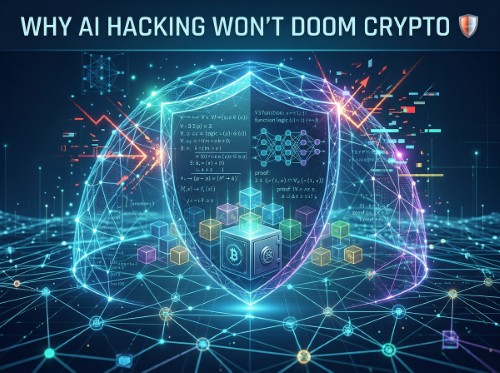
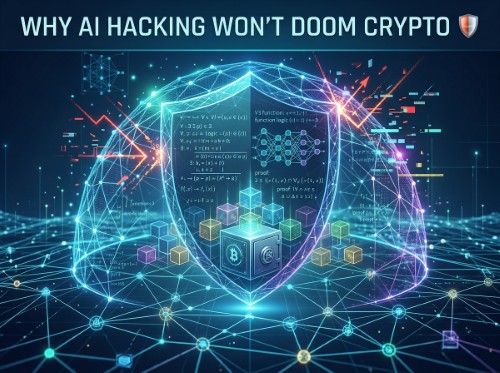
As artificial intelligence capabilities surge, a troubling question has begun to echo across the Web3 ecosystem: Will AI-powered hacking render cryptocurrency security obsolete?
With automated agents capable of scanning millions of lines of code in seconds, fears have mounted that malicious actors will exploit vulnerabilities faster than human developers can patch them.
However, Ethereum co-founder Vitalik Buterin strongly rejects this apocalyptic outlook. Far from dooming cybersecurity, Buterin argues that advanced AI models will fundamentally tip the scales in favour of defence, empowering developers to mathematically verify entire software systems and build unshakeable blockchain infrastructure.
The narrative that AI gives cybercriminals an insurmountable edge is gaining traction, but Buterin believes this perspective misses how defensive systems actually evolve.
Responding to growing anxiety across the tech sector, Buterin asserted that cybersecurity naturally favours defensive measures—provided the industry actively leverages the right tools. With approximately 90% of his own net worth held in cryptocurrency, Buterin’s optimistic stance is backed by a personal stake in the resilience of decentralised networks.
The core of his argument rests on a shift from reactive bug hunting to proactive, absolute mathematical proof.
Historically, securing software has meant playing a perpetual game of whack-a-mole: developers write code, auditors search for flaws, hackers discover what was missed, and patches are rushed out post-exploit.
AI changes this paradigm through formal verification—a technique that uses mathematical proofs to demonstrate that a program behaves only as intended, leaving zero room for unexpected exploits.
Until recently, formally verifying an entire, complex software architecture was practically impossible due to the sheer volume of manual logic required. Buterin believes AI breaks this bottleneck.
"If AI can prove Navier-Stokes and Fermat's Last Theorem, then AI can prove the statement 'this program is secure' as a mathematical theorem—even if the program is very complicated."
By elevating software security to the rigour of high-level mathematics, AI allows developers to build systems where security isn't just probable, but provable.
The battle between AI-assisted attackers and defenders is already underway, serving as a real-time testing ground for Buterin’s thesis.
1. The Zcash Counterfeiting Flaw
In May, security researcher Taylor Hornby utilised Anthropic’s Claude Opus model to audit zero-knowledge code. The AI uncovered a four-year-old critical flaw in Zcash’s Orchard privacy pool that could have permitted unlimited, undetectable token counterfeiting. Thanks to early detection, developers patched the vulnerability in June before any exploit occurred in the wild.
2. Infrastructure Vulnerabilities & Wallet Exploits
By July, researchers at the Ethereum Foundation reported that AI agents were successfully highlighting bugs within critical network infrastructure. However, the month also demonstrated the destructive potential of AI in hostile hands: attackers used a years-old firmware flaw to drain approximately $130 million in Bitcoin from Coldcard wallets, with hardware maker Coinkite acknowledging that AI likely aided in identifying the weakness.
3. The Bitcoin Ecosystem Under Audit
The speed of AI-driven exploits prompted cross-chain protocol Boltz to temporarily pause its swap services after automated attacks overwhelmed its development team. Core Lightning similarly confirmed multiple vulnerabilities flagged by automated AI reports.
In response, the volunteer Bitcoin Red Team launched an aggressive defensive campaign, deploying AI-assisted auditing tools across 390 projects to flag and address 4,962 potential security vulnerabilities.
While AI can mathematically prove that software matches its specification, Buterin highlighted a crucial caveat: the hardest part of modern security is defining what "secure" means in the first place.
An AI can verify that code faithfully executes its written specification, but if human developers write flawed logic or incomplete definitions, the system remains vulnerable.
The primary task for developers is shifting from searching for syntax bugs to crafting precise, flawless specifications for AI to enforce.
For Ethereum and the broader blockchain space, AI-driven formal verification isn't an optional luxury—it is an absolute necessity.
As networks push toward advanced scaling solutions, zero-knowledge proofs (STARKs), privacy layer integration, and quantum-resistant cryptography, the underlying codebase becomes exponentially more intricate.
Ethereum plans to integrate full-program AI verification into its core development pipeline over the coming years. In Buterin's view, achieving true scalability and privacy is impossible without software that is verified from top to bottom.
The rise of artificial intelligence undoubtedly accelerates threat vectors, but it simultaneously provides defenders with unprecedented verification power. Rather than ushering in the downfall of Web3 security, AI may finally allow developers to transition from constant damage control to building mathematically bulletproof systems.
Disclaimer: This article is provided for informational purposes only, mistakes may be made, and it's not offered or intended to be used as legal, tax, investment, financial, or any other advice.