x




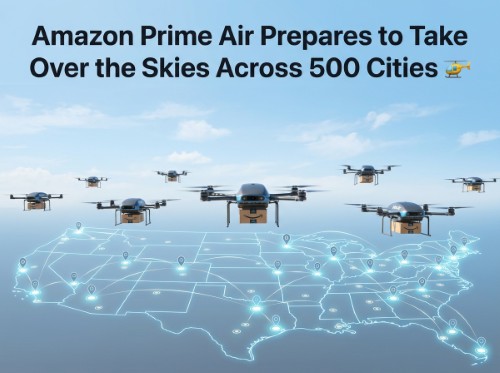
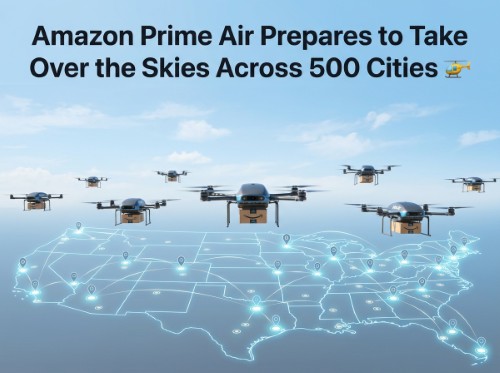
The landscape of retail logistics is undergoing one of the most radical transformations since the advent of online shopping. Amazon has formally announced plans to scale its Prime Air autonomous drone delivery service to nearly 500 cities and towns across the United States by the end of 2026. Representing a six-fold expansion of its existing operational footprint, this ambitious initiative aims to place doorstep drone deliveries within reach of tens of millions of households.
Rather than relying on human operators for every single flight, Amazon’s strategy relies heavily on cutting-edge autonomy, sophisticated sensor networks, and robust regulatory approvals. As automated aerial distribution moves from experimental pilot schemes to everyday commercial reality, the implications for retail, suburban infrastructure, and environmental sustainability are profound.
At the core of Prime Air’s rapid scalability is its reliance on "highly autonomous" flight software. Traditional drone logistics often require dedicated remote pilots to monitor individual aircraft in real time. In contrast, Amazon’s system empowers the drone itself to make critical navigational decisions mid-flight without requiring a remote operator to step in.
Central to this capability is an advanced Detect-and-Avoid (DAA) system. Acting much like a human pilot constantly scanning the surrounding airspace, onboard sensors continuously monitor the environment for dynamic obstacles, such as low-flying aircraft, birds, trees, and power lines. If an unexpected hazard appears, the drone autonomously recalculates its trajectory safely and predictably.
Privacy concerns are a frequent topic of discussion surrounding aerial delivery systems. Amazon has addressed this directly, confirming that onboard cameras and sensors are strictly utilised for navigation, obstacle detection, and landing spot evaluation. The system does not track individuals or record personal movements, nor does it broadcast a live video feed back to ground personnel.
Scaling an aerial fleet across hundreds of municipalities requires more than just innovative hardware; it demands unprecedented regulatory approval. Amazon operates under the Federal Aviation Administration (FAA) Part 135 certification—the stringent regulatory standard reserved for commercial air carriers.
Holding Part 135 certification grants Prime Air a distinct operational advantage. Rather than seeking individual, site-specific exemptions or waivers for every new town or city, Amazon can deploy its fleet into new metropolitan areas under a unified, highly scrutinised safety framework. This commercial air carrier status underscores the maturity of the underlying safety protocols and autonomous flight systems.
To integrate seamlessly into residential neighbourhoods, autonomous delivery drones must overcome key environmental challenges: noise pollution, weather sensitivity, and carbon impact.
Prime Air is specifically designed to handle high-frequency, small-item purchases. The platform targets the most common everyday retail demands:
Before releasing a package, the drone performs a final scan of the designated landing zone to ensure the drop point remains clear of people, pets, or vehicles.
Prime Air is not intended to replace existing ground transport, but rather to serve as a high-speed aerial layer within a broader, multi-tiered logistics ecosystem.
Amazon’s fulfilment infrastructure currently balances several overlapping speed tiers:
By deploying drone sites primarily in suburban zones—where lower building density provides ideal flight paths—Amazon can offload light, urgent deliveries from road networks, freeing up ground vans for heavier bulk goods.
As of mid-2026, Prime Air operates across 11 dedicated sites serving 10 metropolitan regions in seven US states: Arizona (Tolleson/Phoenix), Florida (Ruskin/Tampa), Kansas (Kansas City), Louisiana (Baton Rouge), Michigan (Hazel Park and Pontiac/Detroit), Nebraska (Papillion/Omaha), and Texas (Richmond/Houston, Richardson/Dallas, San Antonio, and Waco). Each site services a radius of roughly 175 square miles.
Amazon reports that its Prime Air stations already record the highest average delivery volumes of any commercial drone operation in the United States, having successfully delivered hundreds of thousands of parcels to date.
Looking ahead, expansion plans include upcoming launches in major metropolitan regions such as Chicago (Illinois), Syracuse (New York), Cleveland (Ohio), Atlanta (Georgia), and Boise (Idaho).
Furthermore, the technology has officially gone global. Amazon’s Prime Air facility in Darlington, UK, represents the company’s first operational drone site outside the United States. This overseas expansion serves as a major proving ground for testing autonomous navigation and Detect-and-Avoid systems under Civil Aviation Authority (CAA) oversight and distinct European weather patterns.
The planned expansion to nearly 500 locations by the end of 2026 marks a decisive transition for drone technology. By marrying fully electric autonomous flight with FAA Part 135 regulatory approval and deep integration into an established fulfilment network, Amazon is positioning aerial delivery as a standard consumer expectation rather than a novelty. As regulatory frameworks evolve and public familiarity grows, autonomous skies may soon become a defining feature of modern suburban life.
Disclaimer: This article is provided for informational purposes only, mistakes may be made, and it's not offered or intended to be used as legal, tax, investment, financial, or any other advice.