x




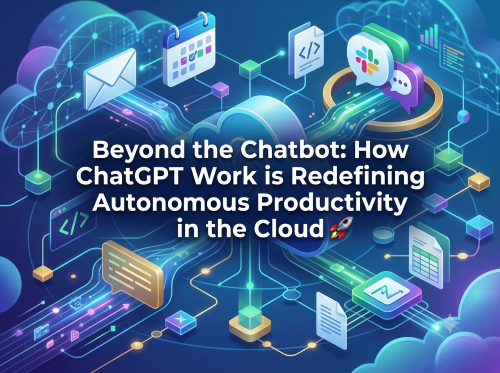
The evolution of artificial intelligence is shifting gears. For the past few years, tools like ChatGPT have functioned primarily as advanced question-and-answer engines—brilliant at drafting copy or explaining complex coding concepts, but ultimately reactive. That boundary has now been broken. OpenAI has officially launched ChatGPT Work, an autonomous, cloud-based AI agent designed to execute intricate, multi-step workflows across an organisation's digital ecosystem.
Powered by OpenAI’s latest flagship model, GPT-5.6, this platform aims to transition ChatGPT from a conversational assistant into an independent workforce platform. By integrating directly with core workplace tools such as email, calendars, code repositories, and messaging apps, ChatGPT Work handles complex projects over hours, breaking down high-level objectives into independent, executable actions.
This strategic rollout arrives at a pivotal financial crossroads for OpenAI. Having recently submitted a confidential draft S-1 registration statement to the SEC, the company is positioning itself for a historic initial public offering (IPO), with valuations estimated between $730 billion and $852 billion. With annualised revenue surpassing $25 billion, ChatGPT Work represents OpenAI's definitive play to cement its dominance in the lucrative enterprise market.
A distinct architectural choice separates ChatGPT Work from its immediate competitors. Rather than relying on a user's local hardware to remain powered on and connected, ChatGPT Work runs within a persistent, cloud-based virtual machine hosted entirely on OpenAI’s servers.
This infrastructure ensures that the AI agent remains active and handling tasks in the background, completely detached from whether the user is actively logged in or even has their computer turned on. It introduces a truly mobile-first capability to high-level automation. For instance, a user can initiate the creation of a collaborative project or an interactive website from a mobile phone whilst away from their desk, leaving the agent to construct, host, and share the asset independently.
OpenAI is democratising this technology by bypassing exclusive premium tier gating. ChatGPT Work is being rolled out across all paid tiers, meaning Plus subscribers paying $20 a month will gain access alongside Pro, Team, Enterprise, and Edu users.
To operate seamlessly across fragmented workplace software, ChatGPT Work utilises plugins built on the Model Context Protocol (MCP) standard. This framework allows the agent to safely connect with, read from, and write to external platforms including Gmail, Google Calendar, Slack, and GitHub.
Rather than waiting for manual inputs, the user experience is structured around immediate action. During onboarding, the platform tailors its suggested workflows based on the user's professional role. For a product manager, it might instantly suggest managing calendar conflicts or synthesising research artifacts.
The agent can autonomously scan a user’s calendar, identify overlapping commitments, flag meetings that require preparation, and directly send invitations, acceptances, or polite cancellations based on high-level instructions. Furthermore, users can train the agent to mirror their unique writing style and organise outputs into dedicated projects. The platform even introduces a hosted website feature, allowing the agent to turn static data into interactive, collaborative web pages rather than traditional slide decks.
The practical implications of this technology stretch far beyond minor administrative chores. In pre-launch testing, OpenAI's product teams used the tool to orchestrate complex "bug bashes"—large-scale software testing sessions involving multiple features and cross-functional teams. By cross-referencing communication channels on Slack, code commits on GitHub, and internal documents, the agent identified the primary contributors for ten distinct features, found mutually available meeting blocks, and coordinated the calendar invites automatically—a process that normally demands hours of tedious manual scheduling.
Crucially, the capabilities of GPT-5.6 allow the agent to tackle analytically heavy tasks. Instead of just automating data entry, ChatGPT Work has been utilised to analyse user churn curves for specific features and formulate strategic product solutions.
By offloading both the execution of repetitive software testing and the heavy lifting of data synthesis, weeks of deep analytical work can be compressed into a single afternoon. GPT-5.6 operates via three specific model variants optimised for different operational demands:
Because ChatGPT Work requires deep visibility into sensitive corporate networks—actively reading Slack threads, scanning private calendars, and parsing code repositories—enterprise security is understandably a primary focus. Unlike standard chat interfaces where users explicitly choose what information to paste, an autonomous agent commands a significantly larger data surface area.
OpenAI addresses these concerns by anchoring the tool within its established enterprise security framework. Enterprise tier accounts benefit from Zero Data Retention (ZDR) policies. Additionally, users across paid tiers retain strict control over their data, with the ability to opt out of allowing their interactions and workflows to be used for future model training. OpenAI maintains its strict stance that business data and private conversations are not utilised to train its public models.
The launch of ChatGPT Work intensifies a fierce three-way competitive battleground for the future of enterprise software. The market has quickly evolved into an arms race between three major players:
The financial pressure to prove that generative AI can generate sustainable enterprise revenue is immense. While OpenAI's monthly revenue has climbed to $2 billion, the immense cost of infrastructure means the company projects operational losses of around $14 billion in 2026, aiming for profitability by 2030.
With Anthropic simultaneously pursuing its own public listing at a multi-billion dollar valuation, the ultimate success of these companies will depend on how effectively tools like ChatGPT Work translate into measurable, undeniable productivity gains for the businesses paying for them. By embedding these capabilities directly into the familiar ChatGPT interface—consolidating the agent technologies developed through its previous "Operator" framework—OpenAI is making a major bet that the future of corporate productivity will be managed entirely from the cloud.
To read the original report and explore more details on this launch, visit the full article on VentureBeat:
Disclaimer: This article is provided for informational purposes only, mistakes may be made, and it's not offered or intended to be used as legal, tax, investment, financial, or any other advice.