x




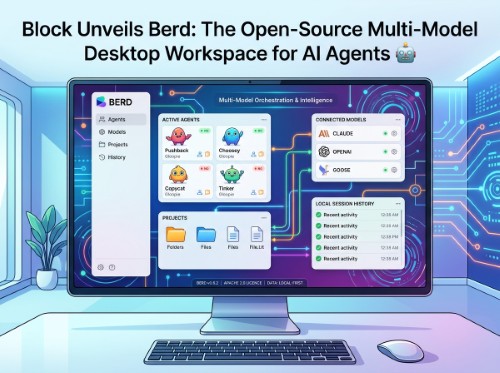
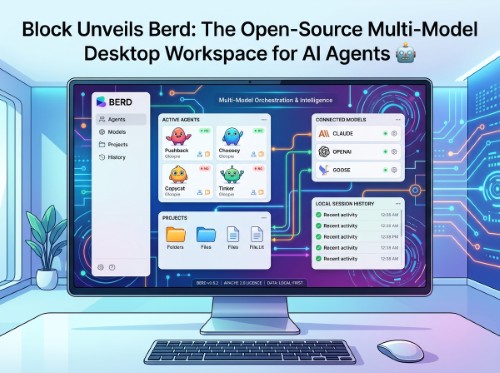
Block has open-sourced Berd, a local-first desktop application engineered to streamline how professionals interact with autonomous AI agents across different models, frameworks, and projects. Released under the permissive Apache 2.0 licence, Berd provides a unified workspace for macOS, Windows, and Linux. By running natively on the desktop rather than inside a web browser, the application connects directly with local files, code repositories, terminal tools, and on-device agent runtimes.
As modern organisations adopt specialised AI tools—ranging from OpenAI’s Codex to Anthropic’s Claude Code and Block’s own Goose framework—managing multiple agents often results in fragmented context and scattered configurations. Berd addresses this challenge by serving as an orchestration layer that keeps operational state clear and visible.
Rather than hiding settings in administrative menus, Berd explicitly displays which project, local files, active tools, and provider models are shaping a given conversation.
To solve the common issue of navigating generic, identical chat windows, Berd introduces distinct visual identities for different agent configurations. Using animated characters known as "Gloopies", the platform translates invisible background instructions, permissions, and tool access into recognisable personas.
Predefined personas showcase how these visual roles support specialised tasks:
These visual identities ensure users can instantly identify an agent's capabilities and assigned guardrails before initiating a workspace session.
Berd operates purely as an orchestration layer rather than a custom foundation model or execution engine. The desktop interface is built using Tauri 2 and React 19, delivering a lightweight footprint.
Behind the scenes, Berd communicates via the Agent Client Protocol (ACP) with Goose, the open-source agent framework Block contributed to the Agentic AI Foundation. Goose runs quietly alongside Berd as a bundled sidecar process, managing the underlying execution loop between models, files, and external systems via open standards like the Model Context Protocol (MCP).
To maintain technical stability, Berd’s build process pins specific Goose backend versions using a lockfile and verifies binary integrity. This strict boundary prevents unexpected backend changes while still allowing developers to substitute custom builds for testing.
Data governance and endpoint security are central to Berd's architectural design. The application prioritises user control through several structural safeguards:
Because Berd functions as an endpoint application rather than a cloud-hosted service, organisations maintain full oversight regarding which external AI models are authorised for data transmission.
While Berd optimises the single-player desktop experience, Block is simultaneously advancing Buzz, an open-source collaboration platform built on the decentralized Nostr protocol.
Where Berd provides high-privilege access to a single user’s local environment, Buzz enables humans and cryptographic AI agents to collaborate in shared multiplayer rooms. Block plans to integrate Berd’s desktop capabilities into the Buzz ecosystem over time, allowing individual work to move seamlessly into shared team workflows.
By decoupling the agent interface from specific model vendors, Berd presents a flexible approach to managing digital AI assistants directly from the desktop.
Disclaimer: This article is provided for informational purposes only, mistakes may be made, and it's not offered or intended to be used as legal, tax, investment, financial, or any other advice.