x




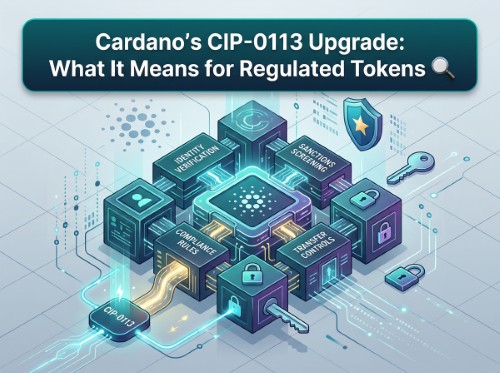
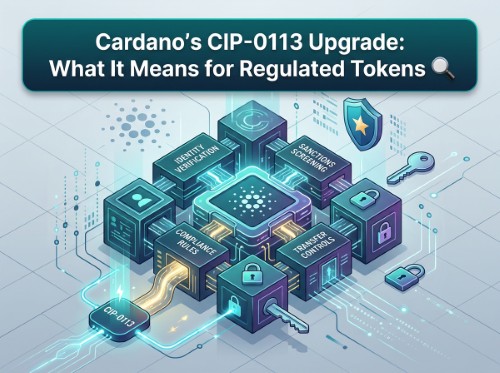
The landscape of blockchain technology is shifting rapidly as decentralised networks increasingly intersect with traditional finance. A major development in this evolution comes from the Cardano Foundation, which has officially launched the CIP-0113 standard on the mainnet. This upgrade marks a pivotal moment for institutional adoption, introducing built-in capabilities for regulated stablecoins, bonds, and tokenised funds. By allowing issuers to embed identity checks, sanctions screening, and transfer controls directly into token logic, Cardano is positioning itself as a serious contender for enterprise-grade blockchain infrastructure.
For years, the vast majority of crypto tokens operated on a permissionless model, meaning any holder could transfer assets to any wallet without restriction. While this aligns with the core ethos of decentralisation, it creates significant hurdles for institutional players like banks, asset managers, and fund issuers who must comply with strict regulatory frameworks.
The CIP-0113 standard bridges this gap. Going live following rigorous independent security audits and bypassing the need for a disruptive hard fork, the upgrade introduces a mechanism where rules travel directly with the asset. Under this framework, tokens are managed within a shared smart contract that checks transactions and enforces predefined conditions before any transfer is accepted.
Whether an issuer wants to block transactions to sanctioned addresses, enforce mandatory identity verification (KYC/AML), or retain the ability to freeze assets under regulatory instruction, CIP-0113 makes it technically achievable on the Cardano network.
The introduction of programmable compliance changes how digital assets interact with both ownership rights and institutional custody systems. In traditional finance, moving a regulated asset often requires intermediaries to manually vet transactions. With CIP-0113, these checks are automated at the protocol level.
For instance, a tokenised fund can automatically reject a transfer attempt if the recipient has not completed the required identity checks. Similarly, a stablecoin issuer can prevent tokens from entering sanctioned wallets, ensuring that compliance is maintained continuously as assets move across different wallets, services, and secondary markets.
Importantly, this functionality extends far beyond simple stablecoins. Tokenised bonds and real-world assets (RWAs) rely heavily on eligibility, custody compliance, and legal rights attached to the underlying property. By baking these considerations into the token design, Cardano offers issuers a clearer pathway to meeting legal obligations without sacrificing blockchain efficiency.
A technical standard is only as good as its supporting infrastructure. Fortunately, the rollout of CIP-0113 is already backed by a robust suite of tools within the Cardano ecosystem. Wallet providers and explorers such as Eternl, GeroWallet, CardanoScan, and BloxBean have integrated support for the standard, giving early users and issuers a foundational framework to work with.
When viewed within the broader blockchain ecosystem, Cardano is not alone in offering permissioned token controls. Ethereum features standards like ERC-3643, Solana provides similar functionality through its token extensions, and the XRP Ledger allows issuers to restrict holders and claw back balances. However, the arrival of CIP-0113 ensures that Cardano now possesses a native, competitive solution for institutions seeking compliance-ready infrastructure.
Furthermore, the Cardano Foundation has secured recognition under the certification framework of the Capital Markets and Technology Association (CMTA), a Swiss industry body whose standards guide the issuance of tokenised shares. This milestone adds a formal layer of credibility, aligning the network with established financial norms.
While compliance features unlock institutional participation, they introduce a distinct trade-off regarding holder autonomy. Because issuers retain the power to freeze, seize, or forcibly move tokens under specific regulatory or contractual conditions, these assets do not carry the same uncompromised ownership profile as traditional, unrestricted cryptocurrencies.
This reality has a direct impact on Decentralised Finance (DeFi) and lending protocols. Technical specifications require lending services to carefully evaluate an issuer's retained powers before accepting a regulated token as collateral. A token subject to sudden seizure or forced transfers carries a different risk profile compared to standard ADA or permissionless tokens, even if it is traded and stored using familiar Cardano tools.
The launch of CIP-0113 represents a structural evolution for the Cardano network. While short-term market fluctuations and ADA price movements naturally capture headlines, the underlying engineering of the network continues to mature. By offering a secure, auditable, and flexible framework for institutional tokenisation, Cardano is actively building the bridges needed to connect everyday blockchain users with the trillion-dollar world of traditional finance.
Disclaimer: This article is provided for informational purposes only, mistakes may be made, and it's not offered or intended to be used as legal, tax, investment, financial, or any other advice.