x




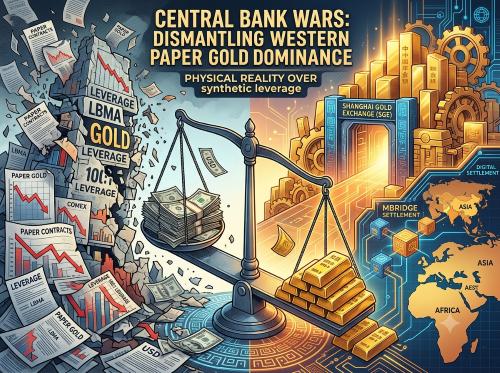
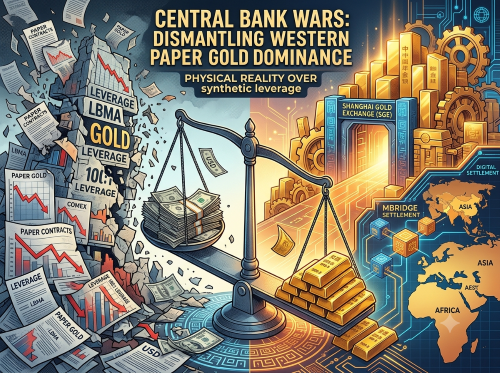
The global gold market is quietly undergoing its most significant structural shift in modern history. While mainstream financial media remains obsessed with short-term price fluctuations, technical chart patterns, and interest rate speculation, a massive geopolitical chess match is playing out behind the scenes.
In the latest episode of Kinesis Money’s Live from the Vault, precious metals expert and industry whistle-blower Andrew Maguire breaks down how the People’s Bank of China (PBOC) is systematically targeting the traditional Western paper gold pricing regime. By shifting the centre of gravity from the leverage-heavy systems of New York and London to a physical-first model in Asia, China is preparing the plumbing for a new, gold-backed financial architecture.
Here is a detailed breakdown of how this central bank war is unfolding and what it means for the future of global finance.
For decades, the global price of gold has been dictated by the London Bullion Market Association (LBMA) and the New York Comex. However, these markets do not primarily trade physical metal. Instead, they rely on highly leveraged paper derivatives — often exceeding a ratio of 100-to-1 of paper contracts to actual physical bullion. This synthetic dilution allows Western institutions to effectively manage and suppress gold prices, keeping the optics of the debt-backed US dollar strong.
We recently witnessed a classic example of this "wash-and-rinse" cycle. Leveraged paper selling manufactured a technical "death cross" on the charts — a scenario where the 50-day moving average crossed below the 200-day moving average. Mainstream analysts immediately retrofitted their narratives to explain this as a bearish sign. In reality, the price weakness was a policy-driven flush orchestrated by the PBOC, which forced domestic Chinese speculators into a sell-only mode to clear out speculative open interest.
While Western derivative traders were wrong-footed into adding unbacked shorts, physical buyers saw a massive buying opportunity. Beneath the synthetic price cap, physical liquidity remains incredibly tight, and the underlying drain of physical gold from London vaults continues unabated.
China’s strategic accumulation of gold is not merely an investment; it is a defensive shield. Beijing has studied the financial sanctions imposed on nations like Russia and Iran, concluding that the only way to achieve true national resilience is to decouple from the US dollar hegemony.
Taking control of the global gold and silver markets is the bedrock of what is known as "Fortress China." This comprehensive system is designed to allow the country to function through prolonged geopolitical crises, trade blockades, supply chain collapses, and potential conflicts.
To achieve this, the PBOC has been accumulating gold in an incredibly disciplined manner, withdrawing an estimated 3 to 5 tonnes of physical gold per day from global markets. When accounting for unreported sovereign and institutional purchases, liquidity providers estimate that actual monetary accumulation could be up to ten times the officially published figures.
The transition from Western paper-based pricing to Eastern physical-based pricing is accelerating. The critical date to watch is 24 July, which marks the full launch of the Shanghai Gold Exchange (SGE) connected Hong Kong gold clearing system.
By linking Hong Kong directly with the SGE and massively expanding regional vaulting capacity, China is launching a regional, physically determined gold price reference (the HAU price). Unlike the paper-centric London fixes, the HAU price will be settled in physically deliverable Renminbi (RMB) contracts.
This creates a highly liquid, global-facing corridor where gold can flow freely between Shanghai and Hong Kong. Because this physical exchange is Basel III Net Stable Funding Ratio (NSFR) compliant and offers T+1 physical delivery, the arbitrage between the physical HAU price and the diluted Western paper price will close the paper-to-physical gap far quicker than most analysts anticipate. Once this infrastructure is fully operational, the traditional LBMA and Comex pricing regimes will lose their ability to dilute the market with unbacked paper contracts.
China’s monetary strategy does not require the Renminbi to immediately replace the US dollar as the world's primary reserve currency. Instead, Beijing is focusing on trade settlement.
The trial and rollout of the Mbridge initiative — a multi-central bank digital currency platform — is a monumental step forward. When paired with the SGE's physically backed gold corridor, Mbridge serves as the plumbing for a parallel trade network. It allows central banks and sovereign states to bypass the SWIFT network and settle cross-border transactions directly, cheaply, and securely.
By integrating gold as internationalised, collateralisable liquid assets into this network, exporters and reserve managers are provided with a hard-asset alternative to debt-saturated US Treasuries. This framework is already expanding, with groundwork underway to connect Singapore, the Middle East, Africa, and Latin America into the clearing gateway.
As the physical drain of 400-ounce gold bars shifts liquidity from West to East, the Western financial system faces a severe structural threat. The Federal Reserve and allied bullion banks have continuously doubled down on paper short positions to maintain price control. However, they are running out of physical metal to back these claims.
When physical delivery demands inevitably overrun the available supply of physical bullion, the paper market will face a disorderly failure to deliver. To prevent a systemic collapse, the US Federal Reserve will ultimately have to defend dollar credibility by revaluing its own sovereign gold reserves.
Currently, US Treasury gold is valued on the books at an archaic historical rate of $42.22 per ounce. To balance its debt-riddled balance sheet and restore confidence, the US would be forced to revalue this gold to true market-clearing prices. Industry experts estimate that an absolute minimum required revaluation would place gold somewhere between $6,000 and $8,000 per ounce, if not higher.
Once this competitive remonetisation between the US and China begins, both superpowers will compete to demonstrate gold credibility, driving precious metals prices to unprecedented heights.
With the launch of the physical Hong Kong gateway, first-tier physical liquidity providers are already positioning for a massive shift in the second half of 2026.
For long-term investors, the message from the physical market is clear: the paper suppression era is reaching its endgame. Dips in the current cap-price environment should be viewed as strategic accumulation opportunities before the structural revaluation of precious metals becomes impossible to ignore.
Live From The Vault - Episode: 281. Central bank Wars: Fortress China Targets LBMA
In this week’s Live from the Vault, Andrew Maguire details how China's launch of the Hong Kong SGE gold gateway marks a historic shift in global gold pricing, as Beijing moves to challenge London and New York's long-held grip on the market.
With the PBOC systematically draining Western gold reserves and central banks accelerating their shift away from dollar holdings, the precious metals expert outlines why he sees a US Treasury gold revaluation as no longer a distant prospect.
Timestamps:
00:00 Start
02:34 Will July 24th mark a turning point for global gold price discovery?
06:11 How China is putting the yuan on a gold standard through Hong Kong
10:01 Why Western traders are misreading the recent gold price weakness
14:19 How China's Fortress strategy is reshaping global gold and silver markets
20:06 Why the $4,000 gold level is a structural bid, not a chart coincidence
25:05 The Enbridge platform and its role in de-dollarising global settlement
30:14 How the Fed's final push against gold is leaving it increasingly exposed
36:40 Silver's setup - why shorts are running out of room
Source 👉 https://www.youtube.com/watch?v=6Zu_roIHpGU
Disclaimer: This article is provided for informational purposes only, mistakes may be made, and it's not offered or intended to be used as legal, tax, investment, financial, or any other advice.