



x
Black Bar Banner 1
x

New: AI Blog Autopilot — free for the next 30 days. Switch it on by November 15th »

A+ A−
Ads by Markethive - View All
Blogs
The Blog Feed
Write a New Blog Post
Search Blog Status
Most Viewed
Most Recent
Most Shared
Alphabetical
Blog Main Menu
Markethive Blog (default)
All Blogs
My Blog Posts
Friends' Blogs
Blog Categories
All
Advertising
Blockchain & Cryptocurrency
Business Development
Diet & Weight Loss
Environmental
Health and Wellness
History and Culture
Home and Garden
Marketing
Mentoring & Training
Money & Finance
Other
Political
Prayer & Religion
Programming & Technical
Real Estate
Search Engine Optimization
Social Media
Spirituality
Sports & Recreation
Transport
Travel & Events
Website Design
Blogging Tools & Assets
My Blog Info
Members Subscribed to You
Blogs You Are Subscribed To
Website Widget
Wordpress Plugin
Subscribe for Greater Services
Subscribe to one of many subscriptions, each one includes the previous ones.. Unlock powerful tools, advance features, to build a powerful reach.

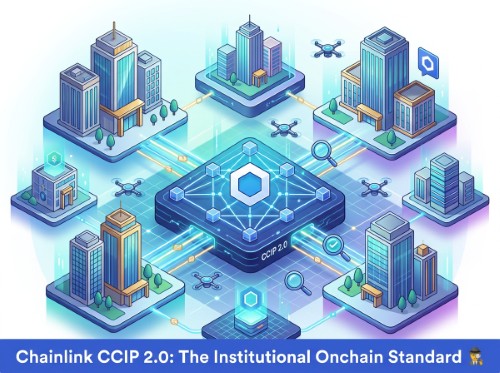
Chainlink CCIP 2.0: The Institutional Onchain Standard 🕵️‍♂️

Posted by Simon Keighley on October 07, 2026 - 6:50am Edited 10/7 at 6:51am


Chainlink CCIP 2.0: The Institutional Onchain Standard 🕵️‍♂️

Chainlink CCIP 2.0: The Institutional Onchain Standard

The global financial system is undergoing a generational shift. With tokenisation transitioning from experimental pilot projects into revenue-generating live deployments, institutions and asset issuers are racing to bring traditional assets—such as equities, exchange-traded funds (ETFs), commodities, and sovereign currencies—onto the blockchain.

However, as asset issuance expands across public and private blockchain environments, liquidity and operational workflows remain deeply fragmented. To fully unlock the value of digital assets across global markets, financial institutions require secure, compliant, and scalable cross-chain infrastructure.

Chainlink has officially launched CCIP 2.0 (Cross-Chain Interoperability Protocol), establishing a new milestone for institutional-grade interoperability. Designed to bridge the gap between legacy financial infrastructure and multi-chain ecosystems, CCIP 2.0 provides the security, speed, and regulatory compliance needed for hundreds of trillions of dollars in global capital to flow seamlessly onchain.


The Cross-Chain Dilemma Facing Institutional Capital

As regulatory clarity sharpens across major jurisdictions—highlighted by the European Union’s MiCA framework, the GENIUS Act in the United States, and joint guidance from the US SEC and CFTC—the path forward for tokenised real-world assets (RWAs) is clearer than ever. Yet, institutions moving across blockchains encounter three formidable barriers:

  1. Compounding Costs and Engineering Complexity: Building and maintaining in-house cross-chain bridges requires specialised engineering expertise, taking upwards of six months and six-figure budgets per blockchain. Each chain presents distinct RPC standards, gas fee dynamics, finality rules, and hard-fork governance risks.
  2. Strategic Dependencies: Relying on proprietary cross-chain bridges developed by industry competitors introduces strategic risk. Financial institutions are reluctant to route core workflows through rival infrastructure, which can create asymmetrical market advantages.
  3. Security Vulnerabilities: Legacy bridging models remain plagued by exploit vectors, having historically accounted for billions of dollars in lost digital assets. Institutional capital demands infrastructure built on proven, zero-trust security architecture.

Chainlink CCIP addresses these challenges by serving as a credibly neutral, unified cross-chain standard. Institutions establish their security, operational, and regulatory parameters once within CCIP and immediately extend them across every public and private chain they deploy on.


The Three Core Innovations of Chainlink CCIP 2.0

Chainlink CCIP is already the most value-securing cross-chain protocol in the industry, securing over $84 billion in total token value. In a widespread flight to safety, over $15 billion in token value migrated to CCIP in recent months—including high-profile assets such as BitGo’s WBTC ($7.4B+), Coinbase’s cbBTC ($6.1B+), Kraken’s kBTC, and the State of Wyoming’s official stable token (FRNT).

CCIP 2.0 elevates this foundation through three major technological advances.

1. Advanced Institutional Risk Controls and Additive Security
Every financial institution operates under distinct risk mandates and operational guidelines. While CCIP relies by default on a decentralised network of 16 security-reviewed node operators—the Chainlink Committee Verifier—CCIP 2.0 introduces unprecedented levels of customisable, additive security.

  • Cross-Chain Verifiers (CCVs): Institutions and asset issuers can now operate their own Cross-Chain Verifiers (CCVs) or select independent enterprise providers to run them. In this dual-verification model, both the default Chainlink Committee Verifier and the custom CCV must cryptographically sign a transaction before it executes on the destination chain.
  • Customisable Threshold Enforcement: Organisations can program specific security rules based on risk parameters. For instance, an institution can mandate additional CCV sign-offs exclusively for transactions exceeding a specific monetary value (e.g., transfers over $1 million).
  • Open CCV Marketplace: Third-party verification providers can establish custom verification fees above CCIP's base rate. This fosters an open, competitive marketplace for specialised verification services, allowing enterprise infrastructure firms to monetise their technical expertise while giving asset issuers greater choice.
  • Turnkey Deployment: Developers and institutions can easily deploy CCVs on bare metal or cloud platforms such as Amazon Web Services (AWS) and Google Cloud using pre-built starter kits. Digital service leaders including Infosys, Nethermind, and Further Asset Management are already building and managing CCV infrastructure for corporate clients, while platforms like Lombard are integrating custom CCV logic into cross-chain tokens.


2. Configurable Finality Speeds and Instant Execution
Settlement speed requirements vary drastically depending on the transaction type. A retail payment requires near-instant execution, whereas a wholesale interbank settlement prioritises full source-chain finality and rigorous sign-off.

CCIP 2.0 introduces configurable settlement models that allow issuers to fine-tune execution speeds based on risk appetite:

  • Ethereum Fast Confirmation Rule (FCR) Integration: Developed in collaboration with Ethlabs, CCIP 2.0 is among the first protocols to support Ethereum’s FCR. This unlocks transaction confirmations in seconds, drastically speeding up payment flows involving the Ethereum network.
  • Tailored Confirmation Thresholds: Asset issuers can define custom block-confirmation thresholds for both arbitrary messaging and token transfers. High-frequency, low-value transactions can utilise fast-path execution, while higher-value institutional transfers can wait for full source-chain finality.
  • Risk-Adjusted Execution: Issuers retain the ability to set value limits for fast-path transfers and adjust fee structures to compensate for fast-confirmation risk. Leading DeFi protocols such as Aave, Re, and Maple have adopted CCIP 2.0 to power fast-path cross-chain asset transfers.


3. Automated Compliance Enforcement (ACE)
A central drawback of legacy cross-chain bridges is their inability to enforce regulatory compliance, preventing regulated institutions from distributing digital assets broadly across decentralized markets.

CCIP 2.0 resolves this by natively integrating with the Chainlink Automated Compliance Engine (ACE). ACE transforms complex, manual regulatory requirements into automated, programmatic rules applied directly to cross-chain transfers:

  • Programmable Identity & Screening: Integrates real-time Know Your Customer (KYC), Anti-Money Laundering (AML), and sanctions screening into every transaction.
  • Transaction Limits & Exposure Controls: Enables issuers to set rate limits, single-transaction caps, and custom collateral rules aligned with internal policy constraints.
  • Issuer-Owned Token Pools: Supports private, allowlisted token pools and policy checks, ensuring that only verified counterparties can transfer or receive assets across chains.

With an ecosystem of over 20 identity, risk, and regulatory infrastructure partners, ACE allows financial institutions to configure compliance policies once and enforce them automatically across every network.


Why In-House Infrastructure Fails to Scale

Attempting to build cross-chain connections in-house presents a continuous operational burden. Organisations must continuously monitor RPC endpoints, manage reorgs and chain halts, secure signing keys, and synchronise compliance systems across disparate ledgers. Furthermore, proprietary bridges fail to achieve network effects because competitor institutions are unwilling to rely on rival infrastructure.

In contrast, Chainlink CCIP provides a credibly neutral, multi-chain gateway that connects institutions to global liquidity instantly. Major financial infrastructures and institutions are already building on CCIP:

  • Swift: Partnered with Chainlink to connect global banking institutions to public and private blockchains using existing Swift messaging standards (ISO 20022).
  • DTCC & Major Global Banks: 24 leading financial institutions—including DTCC, Euroclear, UBS, and Wellington Management—utilised CCIP to distribute validated corporate actions data across public and private blockchain environments.
  • ANZ Bank & Fidelity International: Deployed CCIP to facilitate secure cross-border messaging and value settlement for tokenised currency (e-HKD).
  • SBI Digital Markets: Adopted CCIP as its exclusive cross-chain infrastructure to transfer compliant tokenised real-world assets across its digital asset architecture.


A Streamlined Developer Experience for the Next Era of Finance

To accelerate adoption, CCIP 2.0 features a completely redesigned developer experience. A modernised API, Software Development Kit (SDK), and Command Line Interface (CLI) reduce integration friction, enabling development teams to deploy cross-chain applications in minutes rather than months.

With unified interfaces for standard transfers and fast-path execution, CCIP 2.0 provides developers, fintechs, and global capital markets with the tools required to power the next generation of onchain finance.


Disclaimer: This article is provided for informational purposes only, mistakes may be made, and it's not offered or intended to be used as legal, tax, investment, financial, or any other advice.




ecosystem for entrepreneurs











