x




As Bitcoin mining hardware approaches the physical limits of traditional silicon microchips, hardware developers are hunting for the next major shift in energy efficiency. Surprisingly, the secret might not lie in smaller semiconductors, but inside the neural wiring of tiny insects.
Recent experiments utilising digital neural models of fruit fly brains have demonstrated that biological architecture could radically alter how proof-of-work algorithms operate. But can simulated insect neural networks really mine cryptocurrency, and what does this mean for the future of green crypto mining?
At the heart of Bitcoin’s security mechanism is SHA-256, a computationally intensive mathematical algorithm. Current industrial mining relies on specialised Application-Specific Integrated Circuits (ASICs) built on cutting-edge 3-nanometre process nodes. While these silicon chips perform trillions of calculations per second, they consume massive amounts of electricity and produce substantial thermal waste.
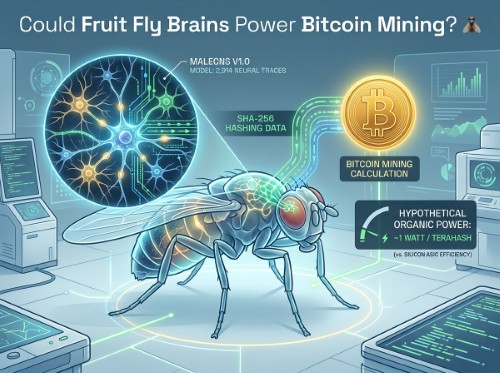
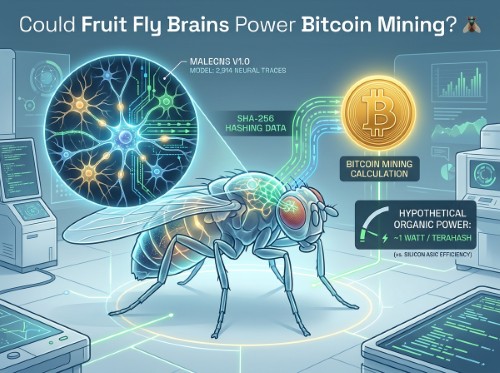
Hardware manufacturer FutureBit recently unveiled an experimental project called HashFly, which explores an entirely different paradigm. Running directly inside a web browser, HashFly simulates 2,914 neural traces taken from MaleCNS v1.0—a comprehensive digital wiring diagram mapping the brain and central nerve cord of an adult male fruit fly (Drosophila melanogaster).
By routing simplified cryptographic calculations through this simulated biological architecture, researchers are testing how neural pathways process hashing tasks.
According to FutureBit, if these computational principles were scaled using real organic neurons rather than silicon software simulations, an organic mining system could achieve an efficiency rate of approximately 1 watt per terahash. That represents an astounding 10-fold improvement in energy efficiency compared to today's best commercial 3nm ASIC miners.
FutureBit’s HashFly is not the only project looking to biological systems for inspiration. A separate initiative known as FlyMiner takes a different approach to biological integration.
Rather than attempting to perform the raw mathematical calculations directly within neural traces, FlyMiner uses a complete digital map of a fruit fly's brain—encompassing 139,255 individual neurons and 16.8 million synaptic connections—as an intelligent control system.
In the FlyMiner system, simulated electrical signals originating from movement-control neurons act as a trigger. When these biological signals pass a designated threshold, they command a standard hashing engine to test potential block solutions supplied by the solo mining pool CKPool. During initial tests, this neural-driven setup executed up to 700,000 hashing attempts per second.
While these experiments offer a fascinating glimpse into neuromorphic computing, it is essential to distinguish between digital simulations and actual living tissue:
To actually achieve the theoretical 10x energy advantage, miners would need to transition from software simulations to genuine "wetware"—bio-engineered computing platforms that utilise actual living organic cells. While biocomputing research is progressing rapidly in academic laboratories, commercial organic Bitcoin miners remain a long way off.
The fruit fly experiments join a long line of creative, unorthodox attempts to reimagining cryptocurrency infrastructure. Over the years, miners and security researchers have consistently pushed the boundaries of hardware:
The HashFly and FlyMiner experiments highlight an intriguing intersection between synthetic biology, neuromorphic engineering, and blockchain architecture. As traditional silicon miniaturisation hits thermodynamic limits, biological systems present an enticing blueprint: millions of years of natural evolution have optimised organic brains to solve complex spatial, sensory, and logical problems on just milliwatts of power.
While you will not see biological fruit fly miners in commercial data centres anytime soon, these projects prove that the future of energy-efficient computing may require thinking far outside traditional silicon limits.
Disclaimer: This article is provided for informational purposes only, mistakes may be made, and it's not offered or intended to be used as legal, tax, investment, financial, or any other advice.