x




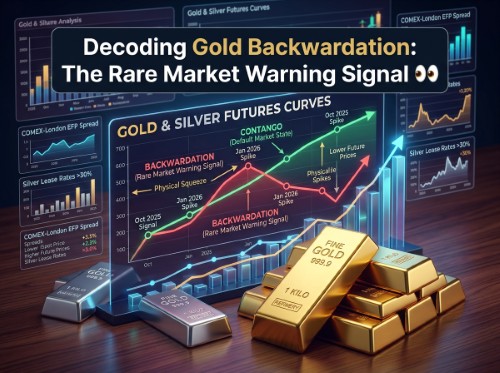
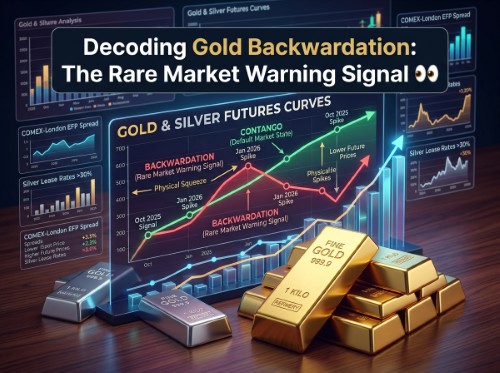
Most precious metal investors focus almost exclusively on daily spot prices, watching live tickers to gauge the health of gold and silver. However, beneath the headline price lies a complex futures market where contracts trade across months and years. Normally, this market follows a predictable upward slope. But occasionally, the entire curve bends in reverse—creating a financial anomaly known as backwardation.
When backwardation occurs, physical metal delivered today becomes more valuable than a contractual promise for delivery in the future. It is a rare market condition that signals acute physical stress in the supply chain.
In precious metals trading, gold backwardation occurs when the spot price—or the nearest futures contract—trades higher than contracts expiring further down the road.
Under standard market conditions, futures prices increase the further into the future you look. Holding physical bullion incurs real world expenses, including storage, insurance, and interest charges on capital. This normal, upward-sloping price structure is known as contango.
Contango is the default state for gold and silver. The price difference between spot metal and a future contract is called the basis. Under contango, arbitrage desks profit by purchasing physical metal on the spot market and selling futures contracts, earning a modest return that covers financing and vaulting costs.
Backwardation completely upends this relationship:
When backwardation appears, it indicates that buyers are willing to pay an immediate premium to take physical possession of metal today rather than waiting for future delivery.
Gold and silver rarely enter backwardation without severe underlying friction in the delivery pipeline. Three primary factors usually trigger this phenomenon:
1. Delivery and Refining Bottlenecks
Gold is stored in vaulting hubs around the world, but exchange standards differ. For example, the London Bullion Market Association (LBMA) deals primarily in 400-ounce bars, whereas the New York COMEX exchange mandates 100-ounce or 1-kilogram bars. If demand surges in New York, metal must be flown to Swiss refineries, melted down, recast into required sizes, and re-vaulted in the US. This process takes time, creating location-based supply shortages.
2. Regulatory Fears and Tariff Anxieties
Sudden trade restrictions, customs duties, or geopolitical policy shifts can disrupt international metal flows. When market participants fear that cross-border shipping might soon incur tariffs or legal hurdles, they race to import physical bullion immediately before restrictions take effect.
3. Spikes in Lease Rates
To cover short positions or meet immediate delivery obligations, institutions often borrow bullion from central banks or commercial vaults. When available vault stock shrinks, the cost to borrow metal—known as the lease rate—skyrockets. High lease rates make holding paper positions prohibitively expensive, further squeezing the spot market.
Recent market history provides three vivid examples of how rapidly backwardation and exchange imbalances can develop.
The First Tariff Scare (December 2024 – February 2025)
Fears surrounding prospective US tariffs sparked an intense rush to move physical gold onto American soil. This caused the spread between COMEX futures and London spot prices—known as the Exchange for Physical (EFP) spread—to blow out to roughly $50 to $60 per ounce.
To satisfy New York demand, 400-ounce London bars were shipped to Swiss refineries to be recast into COMEX-approved bars. LBMA records showed an unprecedented net outflow of 151 tonnes of gold from London vaults in January 2025 alone—the largest single-month decline on record. The EFP gap only deflated in April 2025 when explicit tariff exemptions were granted, prompting hundreds of tonnes of bullion to migrate back out of US vaults.
The Customs Reclassification Shock (August 2025)
Just months later, confusion struck again when US Customs and Border Protection temporarily reclassified Swiss gold bars under a tariff-liable code. The reaction was instantaneous: New York gold futures surged above $3,530 per ounce, pushing the premium over London spot past $125 per ounce within hours. Although a White House clarification quickly deflated the premium, it highlighted how vulnerable paper markets are to sudden physical logistical hurdles.
Silver’s Historic Squeeze (October 2025)
Silver experienced an even more dramatic dislocation in October 2025. Front-month COMEX silver traded nearly $2.88 above longer-dated contracts—the steepest backwardation observed in over four decades. Meanwhile, London silver lease rates surged to an extraordinary 39% (compared to a typical baseline below 1%).
This extreme physical tightness preceded a massive rally, with silver eventually climbing to a record high of $121.62 per ounce by late January 2026. While backwardation itself is not a direct price target, it confirmed severe underlying supply tension months before the peak occurred.
A common misconception is that backwardation guarantees an immediate price rally. In reality, backwardation is a stress signal, not a directional price crystal ball.
It tells investors that physical liquidity is tightly constrained and that paper claims on metal are decoupling from available physical supply. While severe backwardation often coincides with strong bull markets (as seen in silver’s run-up into early 2026), its primary insight is structural: it reveals that the delivery infrastructure is under immense strain.
For the average investor, monitoring backwardation provides a critical health check on global financial systems:
What does contango mean compared to backwardation?
Contango is the normal market state where future prices are higher than current spot prices to account for storage, insurance, and financing costs. Backwardation is the opposite, where current spot prices exceed future contract prices due to high immediate physical demand.
Does gold backwardation mean there is a total global shortage?
Not necessarily a global lack of gold, but rather a localised delivery or refining bottleneck. It indicates that metal is not in the right form or right place quickly enough to satisfy immediate market demand.
How often does gold go into backwardation?
Very rarely. Because gold has enormous above-ground stockpiles relative to annual mine production, backwardation occurs far less frequently in gold than in industrial commodities like crude oil or copper. When it does occur, it commands immediate institutional attention.
Disclaimer: This article is provided for informational purposes only, mistakes may be made, and it's not offered or intended to be used as legal, tax, investment, financial, or any other advice.