x




For millennia, precious metals have stood as the ultimate symbols of wealth, stability, and financial security. Yet, to the untrained eye, the daily price fluctuations of gold and silver can seem entirely unpredictable. One day prices are soaring amidst global turmoil; the next, they are retreating in the face of a central bank announcement.
The truth is that precious metal prices do not move at random. They react to a highly interconnected matrix of global macroeconomic forces. By learning to identify and understand these drivers, you can better plan ahead, position your financial portfolio appropriately, and read the underlying currents of the global economy.
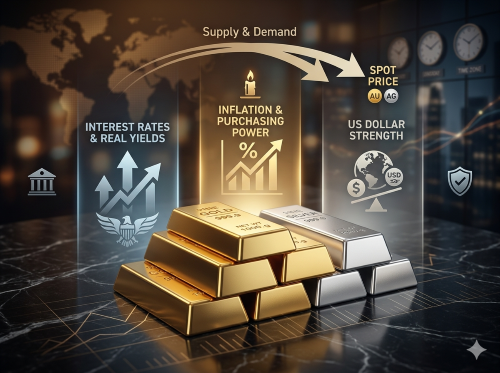
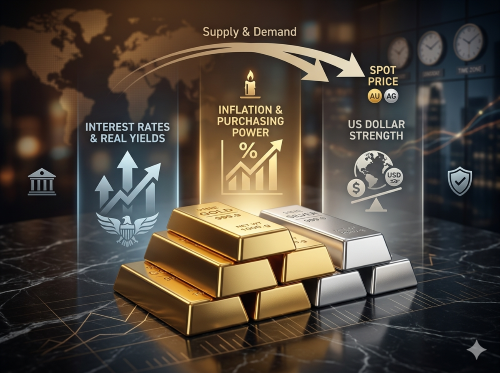
While the fundamental laws of supply and demand ultimately dictate the final spot price, several critical macroeconomic pillars actively shape that balance. Here is a detailed look into the economic forces that govern the bullion market.
When discussing gold, the word 'inflation' is rarely far behind. Inflation represents the steady erosion of a fiat currency's purchasing power over time—effectively meaning that the same amount of cash buys fewer goods and services as living costs rise.
Gold has historically served as one of the most dependable hedges against this systemic devaluing of paper money. Because gold cannot be printed out of thin air by central governments, its scarcity allows it to preserve real wealth. When looking at the data over the last half-century, the contrast is stark. The US dollar has lost roughly 83% of its purchasing power over the past fifty years due to compounding inflation. In sharp contrast, the price of gold has surged by approximately 3,500% over the exact same period, drastically outperforming currency debasement and protecting the wealth of those who held it.
However, a vital nuance for investors to grasp is that this relationship manifests most reliably over extended timeframes. On a week-to-week or month-to-month basis, gold can easily fluctuate independently of inflation rates. Short-term price movements are frequently dominated by swift shifts in interest rates or sudden currency swings. Over decades, however, gold’s track record as an immutable store of value is firmly established.
Silver’s relationship with inflation is somewhat more complex. While it frequently performs exceptionally well during inflationary cycles, its structural makeup differs from gold. Roughly half of the global annual demand for silver stems from industrial applications. Consequently, if an inflationary period coincides with a broader slowdown in manufacturing and industrial output, silver's price path can temporarily diverge from gold's upward trajectory.
If inflation establishes the long-term floor for precious metals, interest rates act as the most powerful lever for short-term and medium-term price direction. This influence operates through two distinct economic channels: opportunity cost and currency valuation.
1. The Opportunity Cost Framework
Gold and silver are non-yielding assets. Unlike government bonds, corporate equities, or traditional bank accounts, a bar of bullion will never pay an annual dividend or a monthly interest coupon. Therefore, when central banks raise interest rates, the 'opportunity cost' of choosing to hold precious metals increases. Investors realise they could instead allocate their capital into yield-bearing assets to earn a predictable return, which often creates downward pressure on metal prices. Conversely, when interest rates drop, this opportunity cost vanishes, making the safety of gold far more alluring.
Crucially, astute market observers do not look at nominal interest rates alone; they focus on the real yield. The real yield is calculated by taking the nominal interest rate and subtracting the current rate of inflation.
2. The US Dollar Transmission Channel
The second way interest rates govern the metals market is through their direct impact on fiat currencies. When the US Federal Reserve raises interest rates higher than those of other global central banks, it attracts international capital seeking higher yields. This influx of capital naturally strengthens the US dollar. Because precious metals are globally denominated in greenbacks, a stronger dollar exerts a textbook bearish effect on gold, which leads directly into the next major macroeconomic driver.
To anticipate major shifts in bullion pricing, investors must keep a close watch on central bank monetary policies, headline inflation data releases, and shifts in the yields of Treasury Inflation-Protected Securities (TIPS).
Because gold and silver are globally priced and traded in US dollars, the Greenback functions like an inverse gravitational force on precious metals.
When the US dollar strengthens against a basket of other major global currencies, gold automatically becomes more expensive for international buyers using foreign currencies. This price inflation dampens global physical demand, dragging the dollar-denominated price downward. On the flip side, when the US dollar weakens, gold instantly becomes cheaper for overseas buyers. This boosts international demand and coaxes the spot price upward.
Because of this rigid structural relationship, any broader macroeconomic factor that influences the health of the US dollar will indirectly dictate the movement of gold. This includes shifting interest rate differentials between nations, domestic economic growth metrics, ballooning national debt levels, and sweeping geopolitical realignments.
For individuals investing outside the United States, currency dynamics introduce an extra layer of complexity. If your domestic currency weakens against the US dollar while the global spot price of gold remains completely flat, the local price of gold in your home currency will actually rise. For overseas investors, a fluctuating domestic currency can frequently amplify gains or cushion losses in their bullion portfolios.
History shows that gold regularly thrives during periods of economic contraction. As corporate earnings falter and stock markets experience volatility, investors systematically rotate out of high-risk equities and into the historic safety of safe-haven assets.
This protective pattern has played out clearly across the major economic crises of the modern era:
It is worth noting that a recession does not mean gold prices will instantly shoot upward on day one. During the chaotic opening chapters of a market liquidity crisis, investors often face margin calls across their broader portfolios. To raise quick cash, institutional investors will frequently liquidate their most liquid assets first—including gold. This can cause brief, sharp dips in the price of bullion. However, gold’s historical tendency to recover rapidly and march toward new highs in the wake of an economic downturn makes it a premier defensive asset during recessions.
Stagflation—the toxic macroeconomic cocktail of stagnant economic growth, high unemployment, and high inflation—creates an incredibly fertile environment for gold. Weak economic growth cripples the appeal of traditional corporate stocks, while high inflation simultaneously destroys the value of cash and fixed-income bonds. The textbook example occurred during the prolonged stagflation of the late 1970s, a period that witnessed one of the most spectacular gold bull markets in human history.
While retail investors and institutional funds heavily influence short-term trading volumes, some of the largest players in the precious metals market are sovereign central banks. Central banks hold gold as a core reserve asset to anchor national wealth, diversify sovereign portfolios, and safeguard financial systems against systemic currency shocks.
Over the past decade, central bank demand has transformed into a massive structural driver of the bullion market. Driven by an overarching desire among emerging market economies to diversify their reserves away from a total reliance on the US dollar, central bank accumulation has reached unprecedented heights.
This de-dollarisation trend accelerated dramatically following major geopolitical rifts, such as the outbreak of the Russia-Ukraine war. When Western nations froze Russia’s foreign currency reserves, it sent a powerful message to central banks worldwide: foreign fiat currencies held in overseas banks carry distinct geopolitical risks. Physical gold stored within your own borders, however, cannot be frozen, hacked, or sanctioned by a foreign government.
More broadly, whenever geopolitical tensions flare—whether via trade wars, regional conflicts, or political instability—private investors and sovereign states alike rush to build positions in assets completely detached from any single government or banking system. This reliable influx of fear-driven capital regularly triggers sharp upward moves in precious metals during times of global crisis.
Navigating the gold and silver markets successfully requires moving past the daily media noise and focusing on core macroeconomic indicators. By consistently monitoring inflation metrics, tracking real yields on government bonds, assessing the strength of the US dollar, and watching structural central bank buying habits, you can gain a much clearer understanding of where precious metal prices may be headed.
Precious metals are not merely speculative commodities; they are a direct mirror of the stability, health, and confidence levels of the global financial system.
To discover a deeper look into these macroeconomic forces and explore further expert market commentary, read the full analysis on BullionStar:
👉 What Drives Gold & Silver Prices? Key Macroeconomic Factors to Watch
Disclaimer: This article is provided for informational purposes only, mistakes may be made, and it's not offered or intended to be used as legal, tax, investment, financial, or any other advice.