x




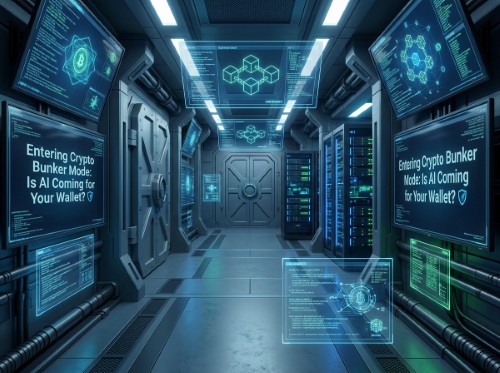
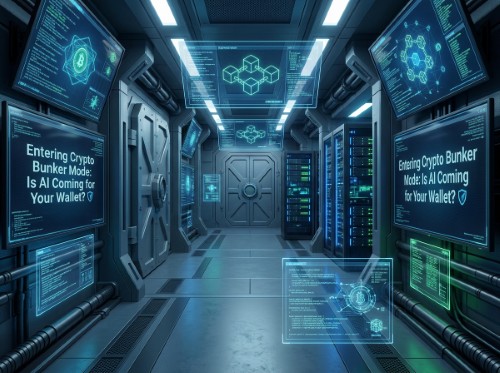
The intersection of artificial intelligence and blockchain technology has long been a subject of fascination, but recent developments have shifted the narrative from excitement to urgent caution. Ethereum co-founder Vitalik Buterin and leading researcher Justin Drake have issued a sobering warning to the cryptocurrency community: rapid advancements in artificial intelligence could threaten wallet security and foundational cryptography much sooner than anticipated.
While the tech sector has spent years bracing for the distant threat of quantum computing, a new catalyst has emerged from an unexpected quarter. AI-driven mathematical discovery is accelerating at a breathtaking pace, prompting experts to advocate for a proactive shift into what is being called crypto “bunker mode.”
The catalyst for this renewed security debate stems from a series of stunning mathematical breakthroughs achieved by artificial intelligence systems. OpenAI recently released hundreds of novel mathematical findings spanning theoretical computer science, algebra, and logical reasoning. Even more strikingly, a team of 10,000 autonomous AI agents working in parallel successfully solved the Navier-Stokes equation—one of physics and mathematics' most notorious, long-standing unsolved problems—in just 88 hours.
These milestones have proven humbling for human mathematical intuition. Long-held hypotheses that have stood unchallenged for decades are falling to automated systems. For the blockchain ecosystem, this speed of progress poses a direct challenge to the unproven cryptographic hardness assumptions that secure billions of pounds in digital assets.
Traditional cryptocurrency wallets rely heavily on the Elliptic Curve Digital Signature Algorithm (ECDSA) to secure public and private key pairs. According to Justin Drake, these curves carry rich algebraic structures filled with intricate properties that could render them uniquely vulnerable to superintelligence. In contrast, cryptographic hashes are designed specifically to minimise such algebraic structure, making them inherently more resilient.
Vitalik Buterin has extended these concerns even further, warning that the threat landscape is not limited to elliptic curves. Many in the industry have operated under the comforting assumption that lattice-based cryptography—widely regarded as the shield against future quantum attacks—would remain safe. However, Buterin notes a significant probability that the concrete security of lattice systems could take severe hits from the next couple of years of AI-accelerated mathematics.
This looming vulnerability is precisely why Ethereum's long-term roadmap has increasingly leaned into a "hash-only" direction to future-proof the network. Dragonfly managing partner Haseeb Qureshi echoed these sentiments, describing the warning as a necessary, sober call to action regarding conventional mathematics overturning long-standing security foundations.
To mitigate exposure to potential cryptographic breakthroughs, researchers have outlined precautionary steps for asset holders. The core recommendation centres on an orderly, controlled migration of funds to fresh addresses where public keys have never been exposed to the blockchain network.
When a user signs a transaction, their public key is revealed, theoretically leaving that specific address more susceptible if underlying cryptographic algorithms are ever undermined. Drake advises that large, sophisticated cryptocurrency holders should lead this transition, moving remaining balances to completely fresh wallets after every transaction.
Vitalik Buterin supports this precautionary principle, noting that keeping funds in addresses that have never been used to dispatch a transaction is a sound strategy if executed smoothly.
Despite endorsing the logic behind address migration, both Ethereum leaders have issued strict warnings against panic. A rushed or disorganised migration could easily backfire and cause more harm than good.
In fact, human error during complex transfers remains a formidable hazard. Buterin candidly shared that he has personally lost more capital through botched migrations than he has ever lost to security hacks combined. Consequently, any transition into bunker mode must be methodical, deliberate, and carefully managed to avoid self-inflicted losses.
The warning from Drake and Buterin serves as a vital wake-up call for the entire decentralised finance and blockchain community. As artificial intelligence transforms from a data-processing tool into an autonomous mathematical innovator, the cryptography underpinning digital ownership must evolve in tandem. By taking calculated precautions today, crypto users can safeguard their portfolios against the unfolding challenges of the intelligence age.
Disclaimer: This article is provided for informational purposes only, mistakes may be made, and it's not offered or intended to be used as legal, tax, investment, financial, or any other advice.