x




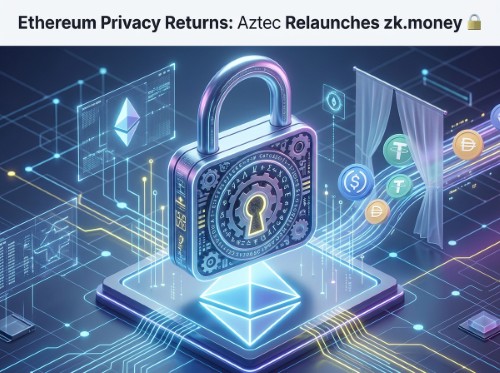
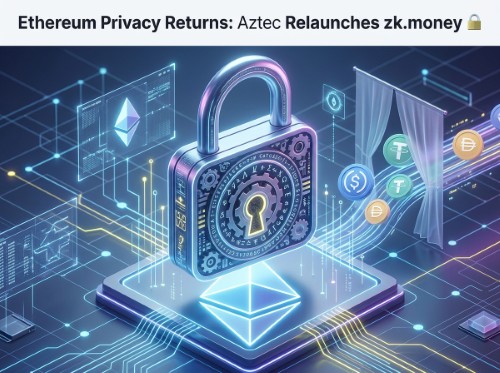
Public blockchains have long faced a fundamental paradox: while open ledgers offer transparency and auditability, they force users to broadcast their entire net worth and spending habits to the world. Aztec Labs is tackling this head-on with the relaunch of zk.money, its flagship self-custodial privacy wallet operating on the privacy-focused Aztec Network.
Originally mothballed three years ago so the team could focus on building a dedicated privacy-first Layer-2 execution layer, zk.money brings confidential stablecoin transactions back to Ethereum. By combining human-readable addresses with client-side zero-knowledge proofs, the wallet offers a glimpse into how everyday digital payments can remain private without sacrificing decentralised security.
In conventional crypto payment flows, sending funds to a recipient requires sharing a public key or wallet address. Anyone inspecting the blockchain can immediately view your account balance, transaction frequency, and historic counterparties. As Aztec Labs Chief Executive Joe Andrews noted, conducting peer-to-peer payments on-chain shouldn't necessitate publishing your complete financial ledger to the public domain.
The relaunched zk.money app solves this by enabling user-friendly identity tags—such as bob.zk.money—resolving through the Ethereum Name Service (ENS) directly to underlying deposit addresses. Once assets are inside the application environment, transactions between participants remain hidden from external view.
How Client-Side Zero-Knowledge Works
The core mechanism behind zk.money rests on local cryptographic execution:
To ensure safety and manage risk during the initial deployment phase, Aztec Labs has introduced conservative guardrails across the platform.
Deposit versus Internal Privacy
It is essential to understand the boundaries of the current privacy model:
Rate Limits and Self-Custodial Architecture
During the initial rollout, individual transfers are capped at $2,500 per transaction, alongside a global daily deposit ceiling of $50,000. These caps allow the team to monitor system stability under real-world conditions.
Crucially, zk.money remains strictly self-custodial. Because the software operates without privileged administrator access, Aztec Labs cannot spend, freeze, or censor user assets, ensuring users retain full ownership of their capital at all times.
The return of zk.money marks the revival of one of Ethereum’s earliest zero-knowledge payment applications. When the original product launched in 2021, it rapidly gained traction, attracting over 75,000 unique wallets and facilitating more than $100 million in transaction volume. Following a $17 million Series A funding round led by Paradigm, Aztec expanded the product suite with Aztec Connect, allowing users to interact with decentralized finance (DeFi) protocols privately.
However, the team ultimately decided to sunset the original iteration to engineer a dedicated Layer-2 network capable of supporting general-purpose private smart contracts. The newly revived zk.money represents the first major consumer-facing application deployed on this upgraded architecture.
The relaunch comes at a pivotal moment for the broader Ethereum ecosystem, where transactional privacy has evolved from a niche feature into a core strategic priority.
Ethereum co-founder Vitalik Buterin recently outlined his vision for a "cryptographic world computer," highlighting how recursive STARKs and zero-knowledge proofs can deliver robust privacy guarantees for specialised applications. Simultaneously, developers evaluating proposals for the upcoming Hegotá network upgrade are exploring mechanisms to allow privacy pools to settle transaction fees autonomously without relying on third-party intermediaries.
As Web3 transitions toward mainstream adoption, solutions like zk.money demonstrate that financial confidentiality and regulatory compliance can coexist through well-engineered cryptographic primitives. By allowing individuals to send stablecoins effortlessly without broadcasting their entire balance sheet, Aztec Labs is bringing Ethereum one step closer to fulfilling its promise as a usable, private global settlement layer.
Disclaimer: This article is provided for informational purposes only, mistakes may be made, and it's not offered or intended to be used as legal, tax, investment, financial, or any other advice.