x




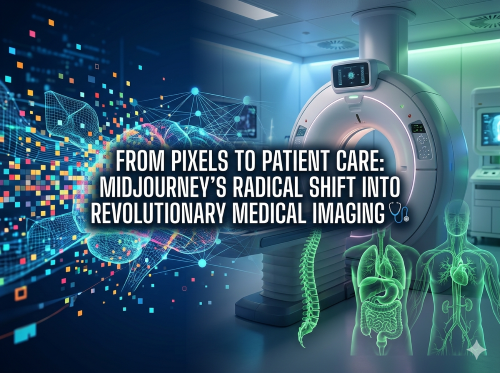
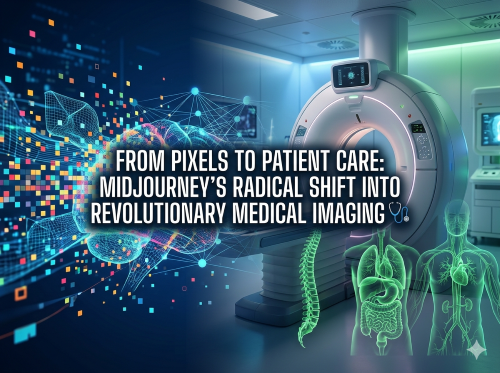
Midjourney, the artificial intelligence powerhouse renowned for transforming simple text prompts into breathtaking digital art, has announced a spectacular and unexpected pivot. The generative AI giant is officially stepping out of the digital canvas and entering the healthcare sector. With the launch of its brand-new division, Midjourney Medical, the organisation is swapping whimsical fantasy landscapes for high-tech anatomical exploration.
This ambitious venture aims to revolutionise the way we look inside the human body by building an AI-powered alternative to the traditional MRI scanner.
At the heart of Midjourney Medical's mission is a proprietary technology termed "Ultrasonic CT". Instead of relying on the intense magnetic fields of a standard MRI machine or the radiation associated with traditional CT scans, Midjourney’s proposed hardware combines state-of-the-art ultrasound sensors with advanced AI image reconstruction.
The scanning process sounds like something straight out of a science fiction novel. Patients will enter a specialised, water-filled chamber where they are gently lowered through a ring equipped with roughly 500,000 ultrasonic transmitters and receivers. As the individual descends into the water, hundreds of thousands of tiny components fire soundwaves into the body and listen simultaneously.
The colossal stream of raw acoustic data is then instantly beamed to a massive, distributed computing cluster. Thousands of computers work in tandem to process the data, utilising Midjourney’s advanced AI algorithms to stitch together highly detailed, three-dimensional internal scans of the body in just about 60 seconds.
For anyone who has ever undergone a traditional full-body MRI, the experience can be daunting. It typically requires lying perfectly still inside a loud, claustrophobic tube for 30 minutes or longer. Midjourney promises to bypass these limitations completely. By replacing heavy radiation and magnetic fields with soundwaves, water, and artificial intelligence, the Ultrasonic CT promises a safer, faster, and vastly more comfortable experience.
Intriguingly, Midjourney is not planning to roll this technology out via cold, clinical hospital basements. Instead, the company is merging healthcare with hospitality.
The initial launch of the scanner will take place at the premier "Midjourney Spa," a wellness facility scheduled to open its doors in San Francisco in late 2027. This innovative wellness centre will blend cutting-edge medical diagnostics with premium relaxation services, featuring hot tubs, saunas, cold plunges, and dedicated scanning rooms. Following the flagship launch, a broader global expansion is anticipated for 2028.
Midjourney’s long-term objectives are staggering in scale. The company aims to deploy approximately 50,000 of these futuristic scanners worldwide over the next six years. With this massive fleet of hardware sensors, Midjourney Medical intends to facilitate an incredible one billion full-body scans every single month.
The philosophy driving this massive scale is rooted in preventative medicine and early detection. The company believes that giving people frictionless, affordable, and frequent access to high-fidelity imaging could fundamentally alter human longevity. According to Midjourney, with widespread early imaging adopted in the future, society could potentially prevent 30% of all deaths and eliminate 50% of all global healthcare costs.
While the system will initially focus on providing comprehensive body composition maps, Midjourney plans to spend the coming year conducting rigorous research trials, refining its custom hardware, and updating its algorithms. The ultimate goal is to achieve full regulatory approval for diagnostic applications, officially turning the scanner into a validated medical device.
While other major AI heavyweights are aggressively integrating themselves into the medical landscape, Midjourney's approach is distinctly unique.
Tech titans like OpenAI and Anthropic have focused heavily on the software side of medicine. OpenAI has introduced initiatives like ChatGPT Health to connect personal medical records with natural language processing, while Anthropic has deployed Claude to assist with clinical research data and administrative hospital workflows. Even Elon Musk’s Grok has been positioned as a digital tool for medical enquiries.
Midjourney, however, is taking a massive gamble on physical infrastructure. Rather than simply analysing existing data, they are designing the physical hardware and sensor tech from scratch. They are betting that the fusion of advanced physical sensors with raw computing power can redefine the foundational building blocks of the human experience.
Ultimately, Midjourney's pivot signals a new chapter for artificial intelligence, proving that generative models are capable of much more than just digital entertainment. By turning their expertise toward the intricacies of human biology, they may well succeed in building a healthier, longer-living world.
For more details on this groundbreaking announcement, you can read the full report at Decrypt:
👉 Midjourney Pivots From AI Images to Medical Imaging, Aiming to Build a Better MRI Alternative
Disclaimer: This article is provided for informational purposes only, mistakes may be made, and it's not offered or intended to be used as legal, tax, investment, financial, or any other advice.