x




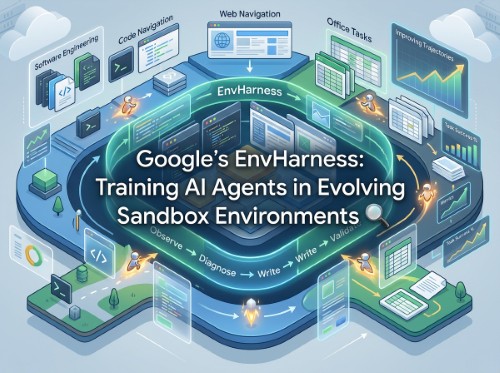
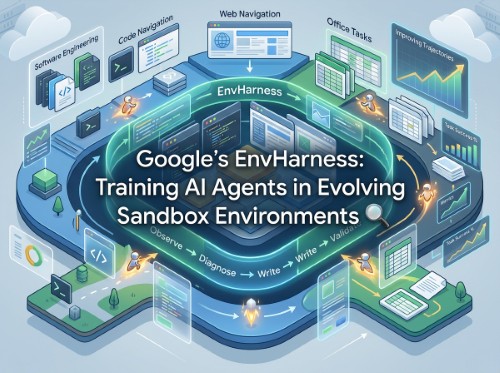
Building autonomous AI agents capable of writing code, navigating websites, or automating complex spreadsheet workflows requires safe digital sandboxes. These environments allow models to interact with systems, execute actions, make mistakes, and learn from feedback. However, AI engineering teams face a major hurdle: traditional training environments are expensive to construct and remain stubbornly static. Once an agent learns how to solve a benchmark's default tasks, the environment ceases to offer a meaningful challenge, leaving models prone to taking brittle shortcuts or plateauing in performance.
To solve this bottleneck, researchers from Google Cloud AI Research and academic collaborators have introduced EnvHarness, an open-source, Apache 2.0-licenced framework that turns static training grounds into dynamic, adaptive environments. Rather than attempting to build entirely new synthetic worlds from scratch, EnvHarness wraps a programmable layer around trusted existing environments—altering starting conditions, filtering actions, and extending trajectories to continuously target an agent's specific weaknesses.
Here is a detailed look at how EnvHarness works, why it outperforms existing environment generation techniques, and what it means for enterprise AI development.
In reinforcement learning and fine-tuning pipelines, an AI agent relies heavily on its environment. For a software engineering agent, the sandbox typically consists of a repository, a terminal shell, and a test suite. For a browser agent, it might be a sandboxed e-commerce website.
The environment presents the task state, listens to the agent's actions, updates the system, and evaluates whether the goal was achieved through a verifier or grader. While constructing these sandboxes requires significant engineering effort, their primary limitation emerges after deployment: they do not adapt to the model using them.
The Limits of Fixed Training Pools
When a training environment never changes, several issues arise:
EnvHarness bypasses these pitfalls by preserving the ground-truth verifier of an established environment while dynamically adapting how that environment presents itself to the learning model.
In modern AI agent design, developers frequently use an agent harness—a software wrapper surrounding an LLM that provides tools, context management, memory, and operational loops. Mathematically, this is expressed as:
Agent = Model + Agent Harness
EnvHarness applies this exact philosophy to the opposite side of the interaction loop:
Customised Environment = Static Environment + EnvHarness
Sitting directly between the agent and the underlying simulator, EnvHarness intercepts inputs and outputs without modifying the core simulator code or human-written unit tests. It achieves this through three core modular components.
1. Stages (State Manipulation)
A Stage changes the starting state of a task. For example, in an embodied navigation benchmark like ALFWorld where an agent must place a clean mug on a desk, the default setup might place the mug in plain sight. A Stage can place the mug inside a closed drawer, forcing the agent to demonstrate search capabilities before completing the main goal. Conversely, a Stage can pre-execute early routine steps to let the agent focus exclusively on a difficult downstream sub-task.
2. Contracts (Interaction Control)
A Contract alters what the agent sees or which actions it can perform. In a browser navigation task, a Contract might require the agent to scroll to the bottom of a web page before invoking a submission action, preventing the model from giving answers based on incomplete context. In software engineering, a Contract can block premature patch submissions and return a system warning if the model attempts to submit edits without executing the unit test suite first.
3. Chains (Sequential Trajectories)
A Chain strings multiple distinct tasks into a single extended episode. Once an agent successfully completes task A (e.g., placing an item on a desk), it is immediately given task B (e.g., heating an item and placing it on a counter). This forces the agent to maintain long-term goal stability, manage token budgets, and manage multi-step operational planning over extended trajectories.
To determine how EnvHarness should modify an environment for a given model, the framework uses an automated orchestration loop called EnvRigger.
EnvRigger operates in a four-step iterative cycle:
Crucially, because EnvRigger alters only the interface layer, the source code, human-written unit tests, and grader rules remain entirely intact. The model is forced to adopt healthier operational habits without risking exposure to hallucinatory test criteria.
Across five standard AI agent benchmarks—covering software development (SWE-bench Verified), web browser automation (WebArena), household robotics simulation (ALFWorld), office tasks (OfficeQA), and computational sheets (SpreadsheetBench)—skills acquired in EnvHarness-adapted environments consistently outperformed those trained on un-adapted baselines.
Major Empirical Findings
While fixed and purely synthetic environment performance flattened out early, EnvHarness continuously introduced relevant variations tailored to the model's updated capabilities.
For enterprise AI development teams, EnvHarness provides a pragmatic framework for maximising the return on investment of custom software sandboxes.
1. Seamless Integration via Light Wrappers
Integrating EnvHarness into existing enterprise setups requires writing a lightweight Bridge adaptor using the framework’s standard ActionableEnv interface. For software container setups, EnvHarness operates externally over Docker or Kubernetes CI/CD pipelines. AI engineering teams can preserve their existing container images, repository structures, and unit test runners while attaching EnvHarness as an outer control layer.
2. Operational Cost Trade-Offs
The primary cost associated with EnvHarness is computational rather than architectural. The diagnostic and validation loop in EnvRigger requires running multiple candidate trajectories to verify task solvency before committing a modified environment to the training pool. However, as the underlying diagnostic models improve, the number of validation rounds required is expected to drop significantly.
3. Suitable vs Unsuitable Domains
Because EnvHarness requires rapid resets and diagnostic rollouts, it is ideally suited for digital sandboxes where system states can be snapshotted quickly:
EnvHarness represents a shift from static benchmark evaluation toward dynamic, interactive model development. By pairing environment-side scaffolding (like EnvHarness) with agent-side optimisation tools (such as self-improving agent harness frameworks), AI researchers can build closed-loop feedback systems: EnvHarness uncovers a vulnerability in agent behaviour, the agent harness adapts its internal context management, and EnvHarness subsequently generates a higher tier of challenges to test the update.
Released under the open-source Apache 2.0 licence, EnvHarness provides developers with a powerful tool to extract far greater coverage, adaptability, and training quality from their ground-truth environments.
Disclaimer: This article is provided for informational purposes only, mistakes may be made, and it's not offered or intended to be used as legal, tax, investment, financial, or any other advice.