x




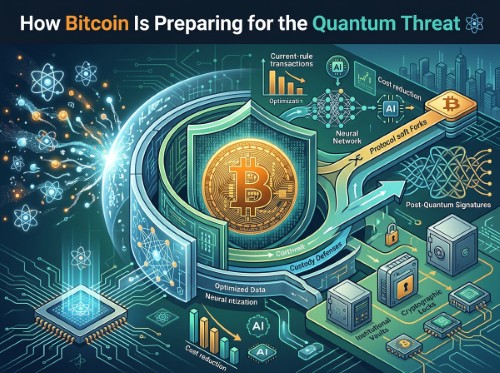
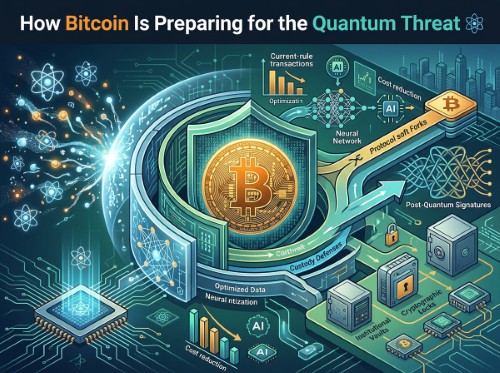
Every few months, alarming headlines warn that the rise of quantum computing could bring about the end of cryptocurrency. The scenario often revolves around "Q-Day"—the hypothetical point in time when a quantum computer becomes sufficiently powerful to crack modern cryptographic standards, derive private keys from exposed public keys, and drain Bitcoin wallets instantly.
While a quantum computer capable of breaking Bitcoin does not exist today, the timeline estimates are rapidly compressing. In response, cryptographers, protocol developers, and institutional custodians are accelerating their efforts. Recent breakthroughs demonstrate a pivotal shift in the industry: research is moving away from theoretical panic and towards practical logistics, engineering efficiency, and cost reduction.
Researchers and developers are currently pursuing three primary avenues to safeguard the world’s largest cryptocurrency against the impending quantum threat.
To appreciate the solutions, it is crucial to understand where Bitcoin's vulnerability lies. Bitcoin secures user funds using elliptic-curve cryptography—specifically the secp256k1 curve. This mathematical framework creates the digital signatures that link a secret private key to a public-facing key.
Under traditional computing constraints, calculating a private key from a public key would take billions of years. However, a sufficiently powerful quantum computer running Shor’s algorithm could theoretically reverse this math. If a Bitcoin wallet's public key is exposed on the blockchain—which happens whenever a transaction is sent from an address—a quantum adversary could intercept or derive the private key and transfer the funds away.
To counter this, researchers are tackling the challenge across three distinct layers.
The first approach focusses on creating quantum-resistant transactions within Bitcoin’s existing consensus rules, avoiding the need for immediate protocol changes.
Earlier this year, developers successfully mined the first quantum-safe transaction on the Bitcoin mainnet. However, the initial computation costs were prohibitively high. In a breakthrough development, collaboration between developers, researchers, and artificial intelligence models resulted in an optimisation process that dramatically reduced these overheads.
By refining the underlying code, the estimated compute cost to construct a quantum-safe transaction dropped nearly 80 per cent in a single week—falling from roughly $320 down to approximately $67 in graphics processing unit (GPU) compute.
The Limitations of Workarounds
While this cost reduction is a major milestone, developers openly acknowledge that current-rule transactions are an interim workaround rather than a permanent cure:
Consequently, while current-rule techniques buy critical time, long-term security requires more fundamental changes to the network.
The most durable and comprehensive fix for Bitcoin’s quantum problem lies at the protocol level. This involves executing a soft fork to introduce post-quantum digital signature schemes directly into the core consensus rules.
By integrating post-quantum cryptography—such as lattice-based cryptography or hash-based signatures—Bitcoin could protect all wallets natively, regardless of whether their public keys have been exposed.
The Governance Challenge
Upgrading Bitcoin at the protocol level is fundamentally a human and organisational challenge rather than just a mathematical one. Bitcoin’s decentralised governance prioritises security, backward compatibility, and immutability over speed.
The community has only recently begun engaging with post-quantum soft fork proposals in earnest. Because consensus takes time to build, starting these engineering discussions years before Q-Day arrives is vital.
While protocol upgrades remain in development, institutional custodians safeguarding hundreds of billions of pounds in assets are taking matters into their own hands.
Major exchanges and institutional custodians are actively engineering post-quantum custody architectures designed to adapt seamlessly to whichever cryptographic standard the Bitcoin network eventually adopts.
These custody playbooks include:
By securing assets at the custody level, institutional players ensure that large pools of capital remain protected even during transition periods on the main chain.
An interesting parallel development is the overlap between post-quantum cryptography and blockchain privacy. The advanced cryptographic primitives used to shield transactions against quantum attack often share underlying mathematics with zero-knowledge technology.
Researchers have recently published designs for shielded, Zcash-style transfers on Bitcoin that leverage post-quantum signature schemes. This dual-purpose research shows that the push for quantum resistance could simultaneously solve one of Bitcoin’s other long-standing challenges: user privacy on a public ledger.
Q-Day remains a moving target, but the crypto industry is no longer standing still. The focus has decisively shifted from abstract theoretical warnings to concrete engineering logistics—driving down transaction costs, preparing institutional custody infrastructure, and laying the groundwork for consensus-level protocol upgrades.
The safety of Bitcoin will ultimately depend on the gap between two velocities: how fast quantum hardware advances, and how swiftly the decentralised Bitcoin ecosystem can deploy robust post-quantum defences. With multi-layered solutions actively taking shape, the network is proving its capacity to evolve ahead of the threat.
Disclaimer: This article is provided for informational purposes only, mistakes may be made, and it's not offered or intended to be used as legal, tax, investment, financial, or any other advice.