x




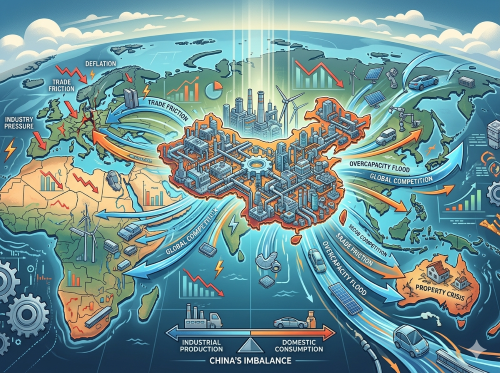
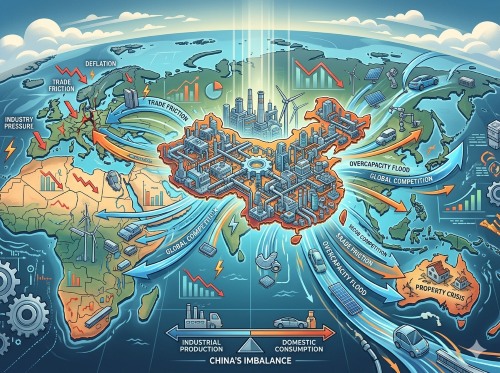
For decades, the global economic narrative surrounding China pointed in a single, upward direction. The world watched as the nation transformed, assuming it would naturally transition from a low-cost manufacturing hub into the world’s ultimate consumer market. Global brands, automotive manufacturers, and tech giants all positioned themselves to sell to an emerging, affluent middle class.
However, that transition has stalled. While China successfully built an expansive urban middle class, the structural shift from an investment-led economy to a consumption-driven society never fully materialised. Instead, the nation has constructed the most formidable industrial production system in history. Ironically, the global economy now faces a severe threat, not because Chinese factories are weak, but because they have become victims of their own immense success.
At the core of the current global economic tension is a profound internal imbalance within the Chinese economy. Every major economic think tank has warned of weak domestic demand and mounting deflationary pressures inside the country. The Chinese government itself frequently acknowledges this issue, routinely promising to implement policies that lift household consumption.
Yet, when faced with economic friction, Beijing consistently chooses to funnel support back into producers, local governments, and strategic industrial sectors. This preference stems from the political control and export leverage that a dominant manufacturing base provides.
Ordinary citizens are not reaping the rewards of this industrial boom. The domestic property market is in a deep crisis, job security is declining, and small businesses face intense local pressure. Historically, real estate served as the primary vehicle for household savings and retirement planning for the Chinese public. Following strict debt regulations introduced in 2020 and subsequent high-profile defaults of property giants like Evergrande and Country Garden, housing investment fell by 17 per cent in 2025. This real estate contraction has severely dented consumer confidence, dragging down spending on related goods such as furniture, appliances, and building materials.
Compounding this cautious consumer behaviour is a limited social safety net. Without robust state protections for healthcare and unemployment, citizens naturally save a higher proportion of their income. The youth employment market has been hit especially hard, with the youth jobless rate surpassing 21 per cent before official data publication methods were altered in 2023. Facing a weak job market and diminished housing wealth, Chinese households are saving rather than spending, plunging the domestic economy into deflation.
Faced with stagnant domestic demand, the political choice has been to keep the industrial machinery moving. Manufacturing represents far more than gross domestic product (GDP) for Beijing; it represents technological independence and geopolitical bargaining power.
To maintain this edge, the state has doubled down on a strategy heavily focused on what it calls "new quality productive forces". This approach prioritises advanced sectors such as:
This industrial push is sustained by substantial state subsidies. Analysis by the Organisation for Economic Co-operation and Development (OECD) indicates that industrial subsidies explain approximately 60 per cent of the global market share gains achieved by Chinese firms since 2005. Between 2005 and 2024, Chinese companies received between three to eight times more government support via grants, cheap loans, tax breaks, and equity injections than firms operating within OECD nations.
Furthermore, local government officials actively resist letting failing factories close. Factories provide essential local employment and tax revenue, meaning unviable firms are frequently kept afloat, which further worsens industrial overcapacity.
Because the domestic market cannot absorb this immense volume of manufactured goods, the excess supply must find buyers abroad. This phenomenon has triggered what economists are calling the "second China shock".
The first wave of Chinese trade integration in the early 2000s primarily affected low-cost consumer goods like textiles and toys. This second wave lands squarely on high-value manufacturing, automotive engineering, chemicals, and green technologies. In 2025, China's merchandise trade surplus reached a record $1.22 trillion, driven by aggressive export drives.
Impact on Europe and Germany
The European Union has declared the current trade dynamic unsustainable. Germany, the economic engine of Europe, is uniquely exposed because its own economic model relies on exporting premium industrial machinery and automotive products to global markets, including China. Now, German firms find themselves competing directly against heavily subsidised Chinese rivals in core sectors like automotive engineering and capital goods. By 2026, European authorities were warning of highly disruptive import surges across timber, chemicals, metals, and transport equipment.
Consequences for Developing Economies
The pressure is felt acutely across Southeast Asia and the Global South. Chinese exports redirected away from US tariffs have flooded into nations belonging to the Association of Southeast Asian Nations (ASEAN). While cheap components can benefit certain consumers, local manufacturing sectors in these developing countries are being heavily pressured, leading to factory closures and job losses. Large developing economies like India have also seen surges in finished steel imports, which arrive at prices well below local market rates despite pre-existing tariffs.
The sheer scale of Chinese production capability has led to self-defeating competition, often referred to within China as "involution", where intense price wars crush profit margins across entire industries.
In the automotive sector, assembly lines were capable of producing an astronomical 54 million vehicles per year by 2025, nearly doubling production capacity from the previous year. To survive, manufacturers are expanding overseas aggressively. Major brands like BYD continue their international expansion despite recording domestic profit declines caused by relentless local price cutting.
A similar pattern defines the clean energy sector. By late 2025, global solar panel production capacity was large enough to satisfy total worldwide demand roughly twice over. While this oversupply makes green energy components inexpensive, it has forced leading solar manufacturers to report consistent financial losses, sparking severe international trade friction.
In response to this influx, Western governments are turning to defensive industrial policies. The European Union raised tariffs on Chinese-built electric vehicles to as high as 45 per cent in 2026 following detailed anti-subsidy investigations. The United States has taken an even stricter stance, implementing 100 per cent tariffs on Chinese electric vehicles alongside steep duties on semiconductors, steel, and critical battery components.
In response, Beijing has leveraged its dominance over critical raw materials and supply chain choke points. The state has implemented strict export restrictions on rare earth elements and strategic metals like tungsten—crucial for aerospace and defence applications—citing national security concerns. Additionally, state regulations introduced in June 2026 expanded government oversight regarding how overseas investments, technology, and corporate data are handled, making it significantly harder to move strategic assets outside of China's regulatory reach.
This leaves the global community facing three highly challenging options:
Ultimately, the grand expectation that China would become the world's premier consumer engine has shifted. The nation has instead solidified its role as an unmatched global producer, leaving foreign industries to absorb the structural shock while international governments navigate the complex economic fallout.
Coin Bureau - China Will COLLAPSE The Global Economy
"China’s nonstop manufacturing is triggering new economic problems worldwide. As Chinese exports keep surging and domestic demand lags, the world faces job losses, falling profits, and rising trade tensions.
See how China’s epic property crash, shrinking consumer power, and aggressive factory subsidies are feeding the next big economic shock, one that risks spreading recession far beyond China’s borders."
~ TIMESTAMPS ~
0:00 — China’s Success Is Breaking The Global Economy
2:00 — The Hidden Reason China Keeps Winning Trade Wars
4:07 — China's Property Crisis Is Destroying Household Wealth
6:06 — Why Chinese Consumers Stopped Spending
8:09 — Beijing’s Trillion-Dollar Plan To Dominate Future Industries
10:22 — The EV & Solar Bubble Nobody Is Talking About
12:10 — Europe Faces A New "China Shock"
14:16 — How Chinese Imports Are Crushing Global Manufacturing
16:15 — The Rare Earths Weapon In The US-China Economic War
18:17 — The World's Three Bad Options For Dealing With China
Source: 👉 https://www.youtube.com/watch?v=nqIESCmMc-c
Disclaimer: This article is provided for informational purposes only, mistakes may be made, and it's not offered or intended to be used as legal, tax, investment, financial, or any other advice.