x




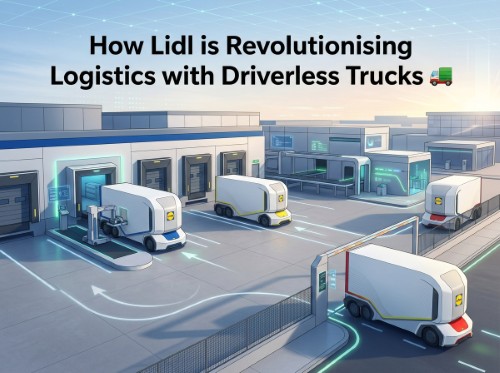
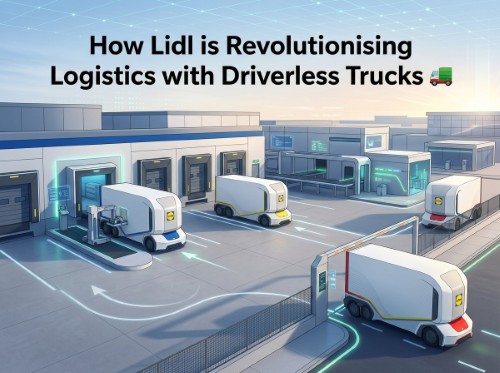
The supermarket aisle is changing, but the real revolution is happening on the roads leading to it. In a landmark move for retail logistics, discount supermarket giant Lidl has deployed a fully autonomous, cab-less electric truck for regular store replenishment routes in Germany. Operating without a driver or on-board safety operator, the vehicle represents a major milestone in turning driverless technology from experimental trial into daily operational reality.
Partnering with Swedish freight technology specialist Einride, Lidl is using the vehicle to transport dry goods between its distribution centre in Edermünde and a nearby retail store. This initiative marks a significant step forward in automated freight, providing a glimpse into the future of resilient, low-emission retail supply chains across Europe.
The autonomous electric vehicle operates under a permit issued by Germany’s Federal Motor Transport Authority (KBA). It is certified for SAE Level 4 driving automation, meaning the vehicle can perform all driving tasks within a defined operating area without requiring a human driver to take the wheel. Notably, Lidl and Einride have confirmed that this is the first permit of its kind in Germany for a completely cab-less Level 4 truck integrated into everyday retail supply lines.
The operational stats behind the pilot demonstrate its practical focus:
Rather than running hypothetical tests on closed tracks, Lidl is putting automated transport through its paces under real-world conditions to evaluate how autonomous solutions seamlessly blend into existing distribution workflows.
While technological innovation is a major motivator, the driverless push is also driven by acute commercial necessity. Heavy Goods Vehicle (HGV) driver shortages are placing immense pressure on European logistics, threatening supply chain continuity and pushing delivery costs higher.
Data from the International Road Transport Union (IRU) highlights the scale of the challenge:
By automating routine, short-haul freight paths—such as shuttle routes between regional distribution centres and local stores—retailers like Lidl can free up human drivers for complex long-haul routes, ensuring goods continue to flow smoothly despite severe workforce constraints.
Germany has positioned itself as a pioneer in autonomous vehicle regulation. The country’s Autonomous Driving Act, which came into effect in July 2021, created a clear legal pathway for Level 4 vehicles to operate on public roads beyond restricted test tracks.
Under German law, approval requires a dual-tier framework:
Safety and Remote Technical Oversight
Crucially, German regulations maintain human oversight through a technical supervisor. While no operator sits inside the vehicle, a remote supervisor can monitor operations, approve specific manoeuvres, or deactivate the vehicle if unexpected conditions arise on the road.
If the autonomous system encounters an insurmountable obstruction or reaches its operational limit, it is programmed to execute a minimal-risk state. This protocol safely guides the vehicle to a halt in the safest available spot and activates hazard warning lights, preventing traffic disruptions and ensuring public safety.
Einride’s autonomous platform relies on a sophisticated "stack" combining machine-learning navigation algorithms with an independent, deterministic safety checker.
To safely navigate unpredictable road conditions, the truck utilises a redundant hardware sensor suite including:
Before hitting public roads, the technology underwent rigorous testing, including vehicle-in-the-loop simulations, proving-ground trials, and independent functional reviews by Sweden’s RISE research institute and Germany's TÜV SÜD.
The current Edermünde deployment connects one distribution centre directly to a single retail store. However, Lidl’s vision extends beyond single point-to-point shuttle runs.
Following successful validation of the current pilot, Lidl plans to expand the concept into a multi-stop "milkrun" model at another location. In supply chain management, a milkrun route combines multiple collection or delivery locations into a single scheduled circuit. Moving to multi-stop autonomous routes will test the system's ability to navigate complex urban traffic, manage varied delivery windows, and handle multiple unloading docks.
With Lidl operating more than 3,250 stores and 39 distribution centres across Germany alone, successful scaling could significantly alter how goods are moved across the retail supply network. Conversations regarding further deployments across other Schwarz Group subsidiaries are already underway.
Lidl’s trial builds upon Einride’s previous work in the United States, where the technology company transitioned an autonomous public-road pilot into daily recurring operations for GE Appliances in Tennessee.
In that project, autonomous trucks shuttled finished products between factories and warehouses up to seven times daily. By linking autonomous road vehicles with AI-enabled dock cameras and automated mobile loading equipment, GE Appliances reduced loading times by 80%. Lidl’s German operation takes this concept a step further by leveraging Germany’s progressive legal framework to run fully driverless vehicles on public roads within a busy retail grid.
Lidl’s deployment of cab-less electric trucks marks a crucial turning point for European freight. By proving that driverless vehicles can safely and reliably handle daily store replenishment, Lidl and Einride are paving the way for cleaner, quieter, and far more resilient logistics networks.
As regulatory frameworks mature and battery-electric autonomous platforms continue to improve, driverless shuttle routes could quickly become the standard baseline for modern supermarket logistics.
Disclaimer: This article is provided for informational purposes only, mistakes may be made, and it's not offered or intended to be used as legal, tax, investment, financial, or any other advice.