x




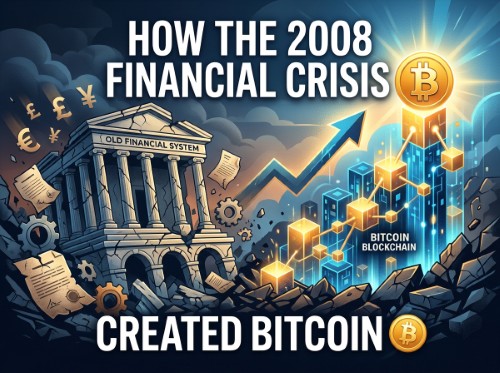
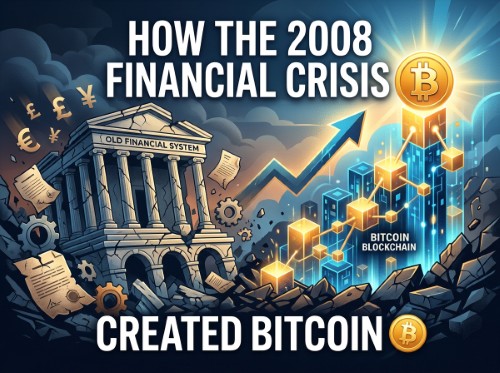
In October 2008, while global financial markets were experiencing their worst collapse since the Great Depression, a quiet revolution was set in motion. An anonymous cryptographer named Satoshi Nakamoto published a nine-page document titled Bitcoin: A Peer-to-Peer Electronic Cash System.
Bitcoin was not born in a vacuum. It was a direct response to a fundamental breakdown in the international banking system. To appreciate why Bitcoin was created and why its architecture is so radical, one must first examine the systemic flaws that brought the global economy to its knees in 2008.
The seeds of the 2008 financial crisis were sown years earlier. Following the bursting of the dot-com bubble in 2000, central banks—led by the US Federal Reserve—embarked on an aggressive monetary easing campaign. The Federal Reserve slashed benchmark interest rates 13 times, driving rates down from 6.5% to just 1% by mid-2003.
This environment of ultra-cheap money, combined with government initiatives to expand homeownership, triggered a massive housing boom. Financial institutions began extending mortgages to borrowers with poor credit profiles—so-called subprime borrowers. At the height of the boom, subprime mortgages accounted for roughly 20% of all new home loans in the United States. In the most extreme instances, lenders issued "NINJA" loans—extended to individuals with no income, no job, and no assets.
The growth of subprime lending was fuelled by the rise of the shadow banking system. Traditional banks no longer held loans on their balance sheets until maturity. Instead, they sold mortgage debts to investment banks, which bundled thousands of loans into complex financial instruments known as Mortgage-Backed Securities (MBS) and Collateralised Debt Obligations (CDOs).
This process of securitisation created a severe moral hazard:
When adjustable-rate mortgages began resetting to higher rates, default rates among subprime borrowers soared. House prices stagnated and subsequently crashed, leaving millions of homeowners in negative equity. The underlying value of MBS and CDO products evaporated, triggering a massive liquidity crisis across the global financial system.
Major financial institutions collapsed or were pushed to the brink of insolvency:
The human and economic toll was staggering. Over $19 trillion in American household wealth was wiped out, US unemployment reached 10%, and the S&P 500 plunged 37% in 2008 alone. Between 2008 and 2015, more than 500 US banks failed.
Faced with systemic meltdown, governments and central banks intervened on an unprecedented scale. Through the Troubled Asset Relief Program (TARP), the US government committed hundreds of billions of dollars to recapitalise distressed banks. Simultaneously, the Federal Reserve slashed interest rates to zero and launched Quantitative Easing (QE)—purchasing trillions of dollars in agency mortgage-backed securities and government debt.
For everyday citizens, these interventions exposed a glaring double standard:
While the 2008 crisis provided the immediate impetus for Bitcoin, the underlying technology was built on decades of computer science and cryptographic research. During the 1990s, an informal group of privacy activists, mathematicians, and cryptographers known as the Cypherpunks advocated for digital privacy, individual liberty, and censorship resistance.
Several pioneering projects laid the groundwork for a decentralised currency:
Despite these breakthroughs, every early digital currency effort ran into a crucial roadblock: the double-spending problem.
Because digital files can be effortlessly duplicated, a digital currency requires a mechanism to ensure a unit of money cannot be spent twice. Traditional systems solve this by using a central ledger managed by a bank. However, eliminating the bank left digital currency creators without a way to maintain consensus across an open network—until Satoshi Nakamoto proposed a novel solution.
Satoshi Nakamoto solved the double-spending problem without relying on a central authority by combining peer-to-peer networking, public-key cryptography, and Adam Back’s Proof of Work concept into a single cohesive architecture.
Key innovations outlined in the Bitcoin white paper include:
On 3 January 2009, Satoshi Nakamoto launched the Bitcoin network by mining the first block, known as Block 0 or the Genesis Block. Embedded directly inside the arbitrary data parameter of Block 0 was a single sentence:
"The Times 03/Jan/2009 Chancellor on brink of second bailout for banks"
This text was the lead headline from the front page of the London newspaper The Times, referring to UK Chancellor Alistair Darling contemplating a second rescue package for struggling British institutions.
The headline served two distinct purposes:
When Bitcoin went live in early 2009, it had no market value and was operated by only a tiny group of software developers and cypherpunks. Hal Finney was among the first to run the node software and received the first 10 BTC transaction directly from Satoshi as a test.
From these modest beginnings, Bitcoin grew into an open, borderless, and permissionless financial network. By replacing institutional trust with mathematical proof, Bitcoin introduced an entirely new category of money—one that operates independent of central bank manipulation, geopolitical control, or discretionary policy choices.
"The 2008 financial crisis shattered trust in banks, governments, and the entire financial system. Households lost trillions, while Wall Street got bailed out, but the public was left behind.
This video reveals the hidden mechanics of what broke in 2008 and tracks the rebels who spent decades trying to build digital money that didn’t rely on failed institutions. Understand why Bitcoin was created and what it means for your money today."
~ TIMESTAMPS ~
0:00 – Intro: The Mysterious Origins of Bitcoin
2:20 – The Real Cause of the 2008 Financial Crisis
4:40 – When the Subprime Mortgage Market Collapsed
7:00 – The Ugly Truth Behind the Government Bailouts
9:20 – Why the Financial System is Fundamentally Rigged
11:40 – Satoshi Nakamoto's Revolution: The Bitcoin White Paper
14:00 – The Precursors: Hashcash, B-money, and Bit Gold
16:20 – Solving the Infamous Double-Spend Problem
18:40 – How Bitcoin Mining and Hard-Capped Supply Actually Work
21:00 – The Secret Message Hidden in the Genesis Block
23:20 – Bitcoin's Earliest Days: A Forgotten Experiment
25:40 – What's Next: From Internet Money to Global Asset
Source 👉 https://www.youtube.com/watch?v=aq475kcLU5A
Disclaimer: This article is provided for informational purposes only, mistakes may be made, and it's not offered or intended to be used as legal, tax, investment, financial, or any other advice.