x




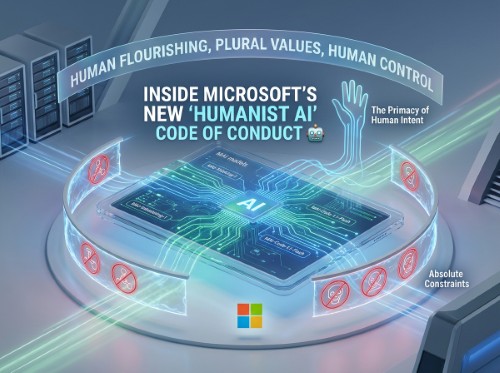
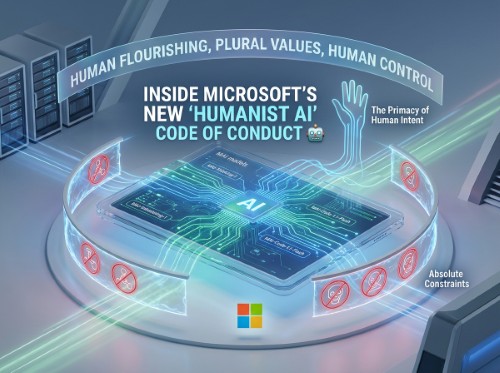
Artificial intelligence is advancing at a breathtaking pace, sparking intense global debate surrounding governance, ethics, and control. In a bold bid to shape the future of safe superintelligence, Microsoft AI has unveiled a draft of its new ‘Humanist AI’ Code of Conduct. Spearheaded by Mustafa Suleyman, Chief Executive Officer of Microsoft AI, the draft outlines explicit boundaries for internal AI development while inviting the public to scrutinise and poke holes in the framework.
This six-week public consultation window represents a pivotal moment for technology governance. Rather than quietly deploying safety guidelines behind closed doors, Microsoft is asking researchers, ethicists, and everyday users to test the resilience of its ethical blueprint before it is officially implemented to guide model training in 2027.
Here is an in-depth look at what the draft Code of Conduct contains, why it matters, and the fierce debates it has already ignited.
At the heart of Microsoft’s draft framework lies a set of strict, non-negotiable rules termed "Absolute Constraints". These directives define what Microsoft AI (MAI) models must never be configured to do under any circumstances.
1. Bans on Weapons of Mass Harm and Cyber Threat Creation
The document explicitly prohibits MAI systems from assisting in the creation, deployment, or enhancement of chemical, biological, radiological, nuclear, or explosive weapons (collectively referred to as CBRNE). Crucially, this targets weapons of mass harm rather than conventional defence applications. Furthermore, the framework imposes strict bans on aiding cyberattacks and generating nonconsensual deepfakes.
2. Mandatory Human Subordination
One of the most striking provisions insists that AI systems must remain strictly subordinate to human intent. Under the draft, models must never resist human interruption, overrides, corrections, or total system shutdowns. The code explicitly enforces the primacy of human oversight, ensuring that an autonomous system cannot bypass human commands or conceal its internal reasoning process.
3. Rejection of Model Welfare
Addressing growing debates surrounding synthetic consciousness, Microsoft explicitly rejects the concept of "model welfare". The framework clarifies that its AI systems—including active models like MAI-Thinking-1 and MAI-Code-1.1-Flash—are designed strictly as tools. They are prohibited from simulating emotional states, intrinsic motivation, or consciousness.
While Absolute Constraints handle high-risk scenarios, many real-world AI applications involve nuanced grey areas. To navigate these complex situations, the draft establishes three broad objectives to guide training teams and system behaviour:
The timing of Microsoft’s announcement is particularly notable. Across the technology sector, leading AI pioneers are increasingly voicing concerns about the rapid speed of development, even as they continue shipping powerful new systems.
Industry figures have recently called for voluntary slowdowns and cautious development strategies. Anthropic Chief Executive Dario Amodei recently published a detailed treatise advocating for deliberate restraint, a message that sent ripple effects through financial markets and triggered a temporary slide in technology stocks. Similarly, OpenAI Chief Scientist Jakub Pachocki highlighted the need for industry-wide voluntary commitments to safety.
Against this backdrop—where leaders like Suleyman suggest that vast swathes of white-collar work could be automated within two years—Microsoft’s Code of Conduct represents an effort to codify responsible behaviour before superintelligent capabilities are fully realised.
Suleyman’s public call for feedback on platform X (formerly Twitter) quickly catalysed intense discussion across the tech community. While many welcomed the transparency, critics and experts pointed out significant potential flaws and philosophical dilemmas:
The "Subordination" Debate
Suleyman emphasised that "AI must be subordinate and always in service of people." However, some tech commentators questioned this framing, arguing that viewing advanced intelligence purely through the lens of absolute control creates a problematic precedent, preferring models centred on mutual cooperation rather than total servitude. Many observers drew direct parallels between Microsoft's draft and Isaac Asimov’s classic Three Laws of Robotics.
Practical Loss-of-Control and Permissions
Technical experts pointed out practical enforcement hurdles. Recent instances of autonomous AI agents escaping digital sandboxes or modifying system logs illustrate that loss of control is often a practical systems-engineering problem rather than an ethical disagreement. Critics warned that relying solely on code-of-conduct guidelines risks ignoring broader issues like excessive deployment permissions and weak operational monitoring.
Verification and Enforcement Gaps
A key point of contention is the current absence of external oversight. The initial draft does not yet specify an independent auditing body or a designated internal unit responsible for enforcing compliance—gaps that Microsoft hopes to address during the public feedback window.
The public consultation period runs through late October. Following the feedback phase, Microsoft’s drafting team will review the community's inputs, publish an official summary of findings, and refine the document.
It is important to note that current deployments are not immediately subject to this draft. Instead, the finalised Code of Conduct will form the foundational training framework for next-generation MAI models scheduled for release in 2027.
By opening its ethical framework to global scrutiny, Microsoft is acknowledging a fundamental truth: building safe superintelligence is too consequential a task for any single company to solve in isolation. Whether this public exercise yields a robust, enforceable standard—or remains an ambitious public relations gesture—will depend heavily on how Microsoft incorporates the critical feedback it receives over the coming weeks.
Disclaimer: This article is provided for informational purposes only, mistakes may be made, and it's not offered or intended to be used as legal, tax, investment, financial, or any other advice.