x




Artificial intelligence agents are rapidly becoming the primary authors of enterprise software. At leading AI organisations, autonomous models already generate the vast majority of production code shipped. While this shift has unlocked unprecedented development velocity, it has simultaneously spawned a formidable governance challenge: how do enterprises ensure dozens of AI agents working in parallel do not write conflicting code, violate security policies, or overwhelm human overseers with unreviewable pull requests?
Enter G5 Labs. Founded by MIT computer science professor Tim Kraska alongside former Google and Amazon executive David Chang, the startup has emerged from stealth with $14 million in seed funding. Their flagship platform, G5, introduces a radical paradigm shift: making structured natural language the foundational source code of enterprise software, with traditional programming languages like Python, C#, or Rust acting merely as downstream compilations.
The fundamental problem with the current generation of AI coding assistants is not their ability to write syntax, but their inability to manage context and architectural intent across an entire organisation. When an individual engineer or autonomous agent submits a pull request containing hundreds of thousands of lines of machine-generated code, traditional line-by-line code reviews become impossible.
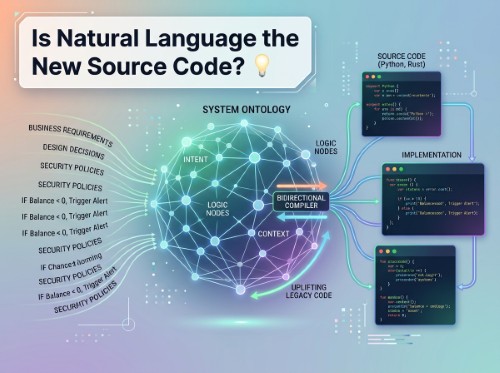
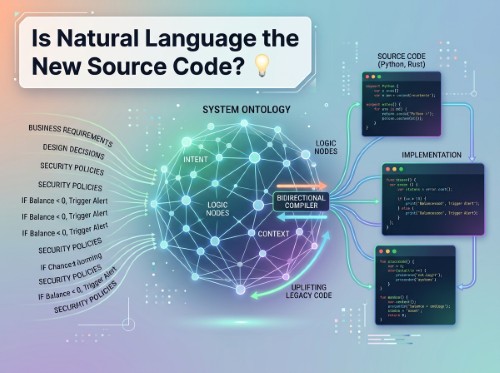
G5 Labs addresses this bottleneck by creating what it calls a system ontology—a structured semantic graph that maps business requirements, architectural constraints, regulatory compliance (such as GDPR rules), and operational workflows into a central model.
Rather than treating natural language as a disposable prompt used to generate a snippet of code, G5 elevates human intent into a permanent, compilable, and version-controlled abstraction layer. The semantic representation remains continuously synchronised with the underlying implementation. If business requirements change within the ontology, the corresponding code rewrites itself. Conversely, if developers adjust the underlying codebase, the ontology absorbs those updates to maintain operational alignment.
At the core of the G5 platform is a bidirectional compiler designed to bridge the gap between human language and execution code. The software operates through three distinct mechanisms:
This architecture positioning allows G5 to sit above coding frameworks like Claude Code or Codex. As a model-agnostic control plane, it coordinates multiple AI agents simultaneously, routing simpler tasks to cost-effective models while reserving expensive frontier models for complex architectural execution.
G5 Labs is initially targeting two main enterprise pain points, particularly within heavily regulated industries such as financial services.
1. Intelligible Legacy Modernisation
Traditional AI modernisation tools typically translate legacy code directly into modern languages, inadvertently preserving decades of technical debt, obsolete workarounds, and outdated assumptions. By first uplifting legacy software into a semantic ontology, enterprise teams can audit original business assumptions, prune unnecessary historical decisions, and generate a clean modern implementation reflective of current operational needs.
2. Replacing Blanket SaaS Subscriptions
As the cost of AI implementation drops, the economics of off-the-shelf Software-as-a-Service (SaaS) platforms face increasing scrutiny. Rather than paying recurring licencing fees for generalised software that requires complex workarounds, enterprises can use intent-driven platforms to build, own, and maintain custom applications tailored precisely to their internal workflows.
The concept of driving software from higher-level abstractions is not entirely new. Model-Driven Architecture (MDA) attempted a similar approach decades ago, and modern developer tools are actively evolving toward specification-driven workflows.
For instance, Amazon's Kiro platform utilises structured spec files to govern implementation steps and enforce architecture standards. Similarly, open-source frameworks like GitHub Spec Kit employ living specification files alongside convergence routines to detect drift between written plans and actual code. Legacy analysis platforms like AveriSource focus heavily on extracting business rules from mainframes to fuel forward engineering.
G5 Labs differentiates itself from these tools by maintaining a persistent, application-wide semantic graph rather than static Markdown files. While conventional spec-driven harnesses treat specifications as inputs to a generation process, G5 aims to establish an interactive, bidirectional system of record where intent and implementation remain permanently tied across multi-agent workflows.
For technology leaders assessing whether to transition toward natural-language-centric architectures, several operational considerations remain crucial:
As software engineering shifts from writing syntax to managing virtual agent fleets, success will increasingly depend on an organisation's ability to express, govern, and audit human intent at scale. Systems that successfully unify semantic clarity with automated code generation may well define the next fundamental abstraction layer in enterprise computing.
Disclaimer: This article is provided for informational purposes only, mistakes may be made, and it's not offered or intended to be used as legal, tax, investment, financial, or any other advice.