x




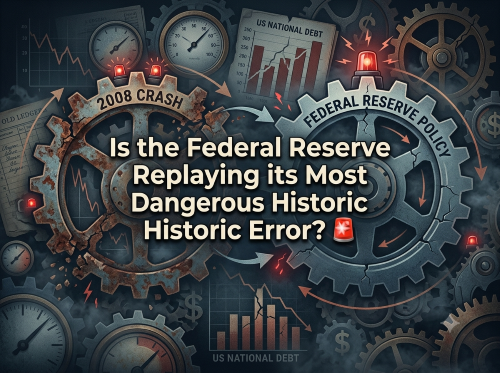
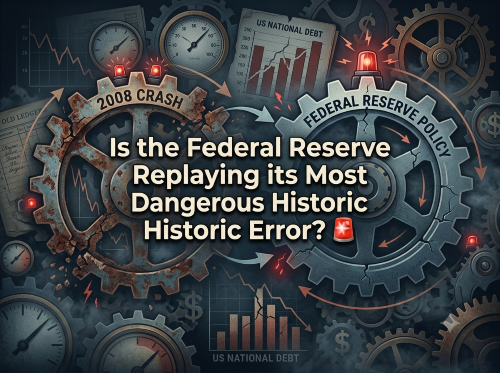
The global financial system is walking a tightrope, and the person holding the safety net may be relying on an outdated map. In monetary policy, timing is everything. Tightening interest rates too late can cause inflation to spiral out of control, while tightening too early can fracture an economic system that is far more fragile than it appears on the surface. As we look at the macroeconomic landscape, a familiar pattern is emerging at the Federal Reserve, raising an uncomfortable question: is the central bank preparing to repeat the exact policy misstep that worsened the 2008 financial crisis?
To understand the stakes, one must look closely at the ideological shifts happening inside the Fed. The institution is currently guided by an instinct that prioritises fighting inflation above all else, even when structural fragility is flashing red. This hawkish philosophy is not new, but when applied to the modern economic ecosystem, the potential consequences for everyday savers, portfolios, and pensions are unprecedented.
The roots of the current monetary strategy trace back to the chaotic months leading up to the 2008 collapse. In the summer of 2008, the global financial architecture was already fractured. Bear Stearns had vanished into JP Morgan, credit markets were seizing up, and deep leverage anxieties were rippling through Wall Street. Yet, during critical Federal Reserve meetings just months before Lehman Brothers collapsed, internal debates revealed a striking fixation.
While the banking system was hours from total collapse, key voices within the Fed argued that the real enemy was inflation, driven at the time by soaring oil prices near 140 dollars a barrel. The prevailing instinct among certain governors was that prevailing interest rates were too stimulative, leaning heavily toward policy tightening. They looked at an overleveraged, crumbling financial system and diagnosed it strictly as an inflation problem.
This instinct did not dissipate after the crash. When the Fed launched its second round of quantitative easing (QE2) to pull the economy out of a deep slump, hawkish dissenters publicly attacked the policy as "financial repression." They warned of an imminent surge in lending and rampant inflation that simply never arrived. Instead, unemployment remained stubbornly high whilst core inflation slumped to near zero. The policy instinct was clear: view economic fragility as mere froth and treat inflation as the only permanent danger.
Fast forward to the present day, and that exact ideological framework is back at the helm of the world's most powerful central bank. However, the patient is far sicker today than it was nearly two decades ago. Draining liquidity from a financial system depends entirely on how dependent that system has become on cheap money. Today, the global economy is hooked on a completely different scale.
Consider the stark structural differences between then and now:
This structural shift matters immensely. Passive and algorithmic frameworks do not provide stability during market downturns. Instead, they sell mechanically and indiscriminately, amplifying downward swings rather than cushioning them. Analysts frequently describe the modern market as a giant short-gamma ecosystem, where even minor funding shocks can trigger outsized, cascading price drops.
Layered on top of this systemic fragility is immense leverage. The Treasury basis trade accounts for an estimated 1 trillion dollars in exposure, leaving it highly vulnerable to sudden spikes in funding stress. Furthermore, the massive equity rally has been heavily concentrated in a handful of technology and artificial intelligence valuations. Private credit funds tied to these sectors carry opaque valuations and highly restricted liquidity, meaning any forced selling could spread across the broader economy with alarming speed.
Into this hyper-leveraged environment, the Fed is enacting a dramatic regime change. Recent policy statements have been aggressively gutted, stripping out the clear forward guidance that global markets have leaned on for more than a decade. By removing these communicative guardrails, the central bank is forcing the market to operate without a safety net.
Simultaneously, a dedicated task force has been launched to aggressively shrink the central bank's balance sheet, aiming to push massive amounts of government debt back out to private markets. Draining this liquidity is an inherently perilous gamble when the state itself faces severe fiscal dominance. The Treasury needs to borrow hundreds of billions of dollars every single quarter just to fund its existing obligations. The central bank is choosing to withdraw liquidity at the precise moment that the government is flooding the market with new debt.
This creates a brutal economic trilemma: a central bank cannot maintain sound money, aggressively shrink its balance sheet, and preserve abundant cheap capital all at the same time. Something has to give.
There is a optimistic scenario where this aggressive tightening works. If rapid advancements in artificial intelligence unlock massive, deflationary productivity booms, the Fed may find the economic cushion it needs to reduce its balance sheet without breaking the system.
However, if that specific gamble fails, the asymmetry of the fallout will mirror the worst parts of history. The affluent, the institutional bondholders, and those with deep pockets can easily hedge their bets, rotate capital, and capture higher yields.
The true burden will be carried by everyday people. The ordinary household carrying variable debt will bear the immediate brunt of higher interest rates. The younger generation, operating with the thinnest savings buffers, will face the headwinds of an artificial economic downturn. Most crucially, anyone holding a standard workplace pension or a default stock market index fund is directly exposed to the most concentrated, liquidity-dependent market in modern history. If the liquidity tide goes out, these everyday vehicles will absorb the structural unwind.
The guardrails are officially gone, and the central bank is humming a very familiar tune. Time will tell if the institution can successfully drain the system, or if it is poised to misread systemic fragility once again—only this time, on a far larger and more dangerous stage.
Finance Bureau - The Fed is Making The 2008 Mistake Again.
"In 2008, the Fed's Kevin Warsh argued inflation was the real threat, right up to the moment the financial system nearly collapsed. Now, as Fed Chair in 2026, he’s ramping up the same policy instincts, draining liquidity and risking a major repeat.
This breakdown shows why Warsh’s tightening could be more dangerous today: the U.S. is far deeper in debt, markets rely on endless cheap money, and passive strategies could magnify any shock. Your savings, stocks, and pension are all on the line if this gamble goes wrong."
~ TIMESTAMPS ~
0:00 – The 2008 Mistake
2:08 – Prioritising Inflation Over Stability
4:18 – The Great Resignation
6:27 – The Hawkish Reversal
8:36 – A System Addicted to Debt
10:45 – The "Fiscal Dominance" Trap
12:56 – Removing the Guard Rails
15:01 – The Final Verdict
Source 👉 https://www.youtube.com/watch?v=Vi-0hs1nwIU
Disclaimer: This article is provided for informational purposes only, mistakes may be made, and it's not offered or intended to be used as legal, tax, investment, financial, or any other advice.