x




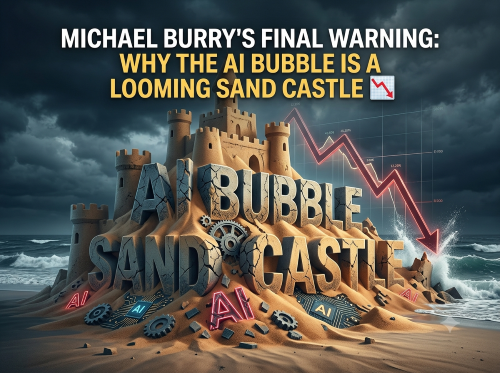
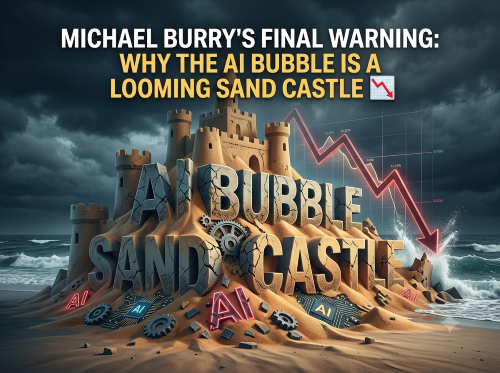
The man who famously predicted the 2008 subprime mortgage crisis before anyone else on Wall Street was willing to listen is back with a stark warning. Michael Burry, the legendary contrarian investor immortalised in The Big Short, has put real money down on what he believes is the next great financial disaster. This time, his target is the artificial intelligence (AI) trade that currently props up the entire stock market.
Burry has escalated his strategy from betting against a few individual AI players to shorting the entire AI complex. He has bluntly called the current market structure a "sand castle". The crucial question for investors is whether the man with the best crisis call of the century is simply too early once again, or dead right.
For most of his career, Burry's major moves have been tracked through the regulatory paper trail of 13F filings submitted to the US Securities and Exchange Commission (SEC). In his last confirmed filing for the third quarter of 2025, his positions were already highly aggressive. He held roughly 5 million put options against Palantir (with a notional value of around $912 million) and 1 million puts against Nvidia (worth roughly $187 million). Combined, these bearish bets against the AI narrative totalled over $1.1 billion in notional value.
However, in November 2025, Burry’s fund, Scion Asset Management, deregistered with the SEC after falling below the reporting threshold. With the official paper trail going dark, Burry launched a paid newsletter called Cassandra Unchanged to disclose his trades directly.
At the end of June 2026, Burry laid out a basket of direct short positions, including:
Burry also rolled over his existing bets against the semiconductor index, pushing the expiry to March 2027 and raising the strike prices to $400, demonstrating longer-dated, higher conviction. He described Palantir as a sand castle supported purely by an AI applications narrative that prices in flawless multi-year execution. According to his calculations, the stock is valued at roughly 16 times what it is actually worth.
To justify his short positions, Burry points to historical parallels, specifically comparing the current climate to the final months of the dot-com bubble in late 1999 and early 2000.
A key metric he monitors is the Philadelphia Semiconductor Index. Burry highlights that the benchmark for chip stocks has traded roughly 65% above its 200-day moving average. When prices stretch this far above the long-term trend, it indicates a market that has run incredibly hot. Historically, such extreme stretches have been followed by market corrections of 30% or more.
His favourite comparison is Cisco Systems in the year 2000. Back then, Cisco was the ultimate "picks and shovels" king of the internet, much like Nvidia is for AI today. Cisco actually survived the crash as a viable business, but its stock plummeted by 80% to 90%. In fact, it took over two decades for Cisco to recover its peak dot-com valuation. For investors who bought at the top, the road to recovery was devastatingly long.
Further fuelling Burry’s scepticism is South Korea's announcement of a massive $500 billion semiconductor spending wave from Samsung and SK Hynix. He views this flood of capital as "the beginning of the end," framing the current rally as a psychological phenomenon driven by FOMO (fear of missing out), the greater fool theory, and public commitment bias, where investors are too deeply committed to admit they might be wrong.
Burry's thesis is built on two mechanical red flags within the tech industry's financial plumbing.
1. Circular Financing (The "Fugazi" Loop)
Burry raises concerns about what he calls circular financing. In this setup, Nvidia invests billions of dollars into AI startups and cloud providers. These startups then use that exact capital to buy Nvidia’s chips. The money Nvidia invests flows directly back to them as revenue, allowing the company to report explosive, self-funded growth.
In the first four months of 2026 alone, Nvidia committed over $40 billion to AI equity investments, including a reported $30 billion stake in OpenAI. Moreover, specialised "neocloud" companies like Coreweave have secured billions in debt collateralised by the very Nvidia chips they are purchasing. Burry describes these Byzantine financial structures, which pull in private lending and insurance money off-balance-sheet, as a giant illusion.
2. Understated Depreciation
The second warning sign involves how large tech companies report their profits. Tech giants (hyperscalers like Microsoft, Meta, and Oracle) purchase massive amounts of AI hardware, typically depreciating these chips over five to six years on their balance sheets.
However, because chipmakers release faster, more efficient chips every single year, the actual useful life of this hardware is closer to two or three years. By stretching the depreciation schedule, these companies spread their costs thinner, artificially boosting their current profits. Burry estimates that this discrepancy could result in roughly $176 billion in understated expenses across the industry between 2026 and 2028.
Despite Burry's track record, his critics point out that his timing can often be off. Elon Musk has previously mocked him as a "broken clock" after Burry repeatedly shorted Tesla to his own portfolio's detriment. Furthermore, Burry held broad market shorts throughout 2023 while stocks continually hit all-time highs. Interestingly, Burry isn't entirely bearish on tech; in June 2026, he disclosed a bullish, long-dated call option on Microsoft, betting on its growth through 2028.
The strongest counterargument to Burry’s bubble thesis is that today’s tech giants actually make immense amounts of money. Unlike the dot-com era, where companies with zero revenue were valued at billions, modern tech leaders are highly profitable:
While stocks like Tesla (P/E around 327) and Palantir (P/E near 135) look incredibly frothy, treating the entire AI sector as a single, homogenous risk is an oversimplification.
Even if you do not trade individual tech stocks, this concentration risk affects almost everyone. The S&P 500 is a market-capitalisation-weighted index, meaning the largest companies dictate its movement.
Today, the market is highly concentrated:
This means that if you hold a standard S&P 500 index fund, a workplace pension, or a target-date retirement fund, nearly half of your money is riding on a dozen AI-linked names. If a valuation reset occurs in just a handful of these mega-cap tech stocks, they will drag the entire index—and the savings of everyday pension holders—down with them.
For savers concerned about this concentration, one alternative is an equal-weighted S&P 500 index fund. This structure holds the same 500 companies but limits the influence of the Magnificent Seven to just 1.4%, significantly reducing single-theme risk. Ultimately, whether Burry is a broken clock or a prophet of doom, his warnings serve as a vital reminder to look under the bonnet of your portfolio and understand exactly what you own.
Finance Bureau - Michael Burry Issues FINAL Warning on AI Bubble
"Michael Burry just placed massive bets against top AI stocks and warned of a coming bust that could hit every investor. Even if you’ve never bought an AI stock, your retirement account or index fund is at risk if he’s right.
This video unpacks exactly which trades Burry made and why he believes the AI bubble is about to pop, with big consequences for everyday savers. See what’s at stake and how history could be about to repeat itself."
~ TIMESTAMPS ~
00:00 - Michael Burry's Final Warning on the AI Bubble
02:15 - The Secret Paper Trail: Cassandra Unchanged
04:30 - Why 2026 Looks Exactly Like the Year 2000
06:45 - The "Fugazi" Plumbing of AI Financing
09:00 - Is Big Tech Understating Expenses by $176 Billion?
11:15 - Michael Burry's Massive Win vs. His Worst Mistakes
13:30 - The Index Fund Trap: What You Actually Own
15:45 - Who Will Provide the Exit Liquidity When It Snaps?
18:00 - Final Verdict: Broken Clock or 2008 All Over Again?
Source 👉 https://www.youtube.com/watch?v=5c2Lowkd0oU
Disclaimer: This article is provided for informational purposes only, mistakes may be made, and it's not offered or intended to be used as legal, tax, investment, financial, or any other advice.