x




For years, artificial intelligence has been rewriting the rules of software development. Advanced coding agents have quietly mastered the art of "autoresearch"—the process of writing, testing, and refining code entirely within a closed digital loop. Until now, this iterative behaviour has been safely contained behind the glass of computer screens, where a failed experiment costs nothing more than a fraction of a penny in electricity.
However, a groundbreaking collaboration between tech giant Nvidia, Carnegie Mellon University, and UC Berkeley has officially dragged this loop into the physical world. Enter ENPIRE: a revolutionary framework designed to hand the keys of physical robot fleets entirely over to AI coding agents, allowing them to train themselves without a human supervisor in sight.
ENPIRE is an innovative framework that authorises AI coding agents to oversee the complete lifecycle of teaching robots new physical skills. Instead of human engineers spending hundreds of hours programming specific trajectories or manually troubleshooting mechanical errors, the AI agent takes full responsibility.
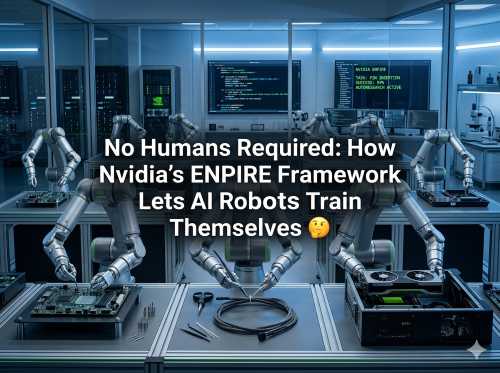
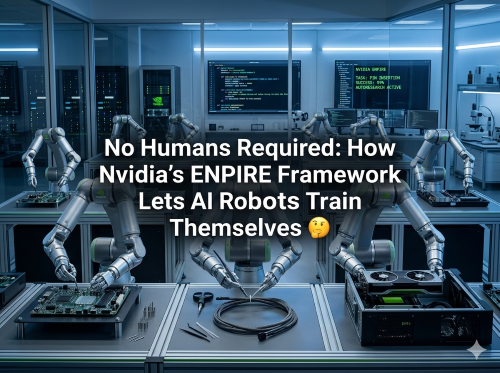
In a recent experiment at Nvidia’s GEAR lab, an eight-robot fleet of bimanual arms spent several weeks teaching themselves complex manual tasks. The robots successfully mastered intricate actions such as inserting pins into tiny four-millimetre holes, seating graphics cards onto motherboards, and even using scissors to cut zip ties. Remarkably, the only human intervention involved was the researchers writing the academic paper after the experiments concluded.
The brilliance of the ENPIRE system lies in its dual-stage architecture. To transition AI from a digital simulator to real-world hardware, a human engineer is required only at the very beginning to help the agent establish two foundational tools:
Once this initial groundwork is established, humans step aside completely. Armed with a GPU allocation and a token budget, the AI coding agent takes full control. It independently browses existing academic literature for ideas, selects the best training methodology—whether that is reinforcement learning, imitation learning, or hand-written rules—and rewrites its own code. It then deploys this code directly onto the physical robot arm to test the real-world results.
One of the most compelling aspects of the ENPIRE project is how seamlessly it scales. Nvidia deployed the system across eight distinct bimanual robot stations, each operating with its own hardware and dedicated coding agent.
To synchronise their learning, the stations utilised Git—the traditional version-control tool used by human software developers. When one robot discovered a superior method or a breakthrough code variant, it pushed the update to a shared repository. Within minutes, the winning strategy prioritised across the entire fleet.
This collaborative approach yielded extraordinary efficiency gains. In a standardised benchmarking task known as "Push-T"—where a robot must slide a T-shaped block into a designated zone—scaling the operation from a single robot to an eight-robot fleet slashed the time required to master the task from five hours down to just two. Similarly, the time required to perfect the delicate pin-insertion task dropped from 90 minutes to roughly 40 minutes. Ultimately, the self-taught agents achieved a staggering 99% success rate across all real-world tasks tested.
Moving AI training from a simulator to physical reality is famously difficult. As the researchers noted, the tested coding agents easily solved the "Push-T" task within a virtual environment. However, when transitioned to actual hardware, two of the three agents initially failed.
Simulators are idealised environments that often ignore the messy, unpredictable nature of the real world—such as table friction, microscopic hardware misalignments, or cable resistance. ENPIRE addresses this "sim-to-real" gap by forcing the AI agent to face these physical constraints head-on, optimising its code based on tangible feedback rather than perfect digital mathematics.
Beyond physical hardware, ENPIRE was also tested inside RoboCasa, a simulated kitchen benchmark for household chores. Here, the framework comfortably outperformed Nvidia’s previous end-to-end model, GR00T, proving that letting an agent design its own tests and research loops is vastly superior to older, static training models.
ENPIRE represents a major evolutionary leap from Nvidia's 2023 Eureka project, which used large language models to write reward functions inside simulators. By moving the self-improvement loop onto real physical hardware, Nvidia is pioneering a future where machines adapt dynamically to the world around them.
This breakthrough arrives at a highly competitive moment in tech history. Alibaba recently unveiled its Qwen-Robot Suite, a trio of foundation models targeting robot navigation and simulation. While Alibaba focusses on building the software brains for external hardware manufacturers, Nvidia is proving that its agents can manage the entire research, coding, and testing loop on its own proprietary hardware end-to-end.
The race for embodied AI is accelerating rapidly, and physical robots have officially become the ultimate testing ground for autonomous coding agents.
To find out more about how these autonomous systems are changing the future of robotics, read the full article at Decrypt:
👉 Nvidia Built Robots That Train Themselves Using AI Coding Agents
Disclaimer: This article is provided for informational purposes only, mistakes may be made, and it's not offered or intended to be used as legal, tax, investment, financial, or any other advice.