x




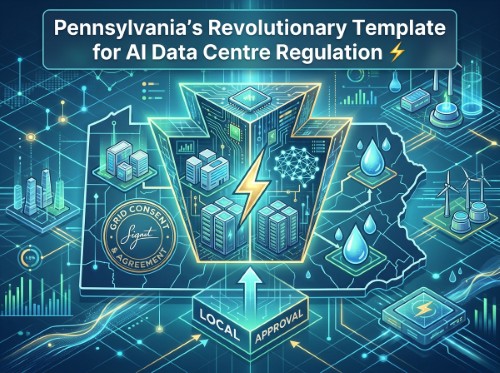
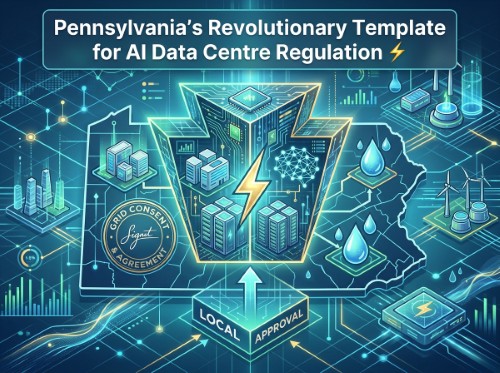
The exponential growth of artificial intelligence has sparked a frantic global race to build massive data centres. However, this infrastructure boom comes with immense challenges: staggering electrical power demands, heavy water consumption, and rising energy bills for local residents. While governments around the world struggle to draft new legislation to govern these facilities, the US state of Pennsylvania has unveiled a fast, potent alternative.
By issuing Executive Order 2026-05, Governor Josh Shapiro introduced a groundbreaking regulatory blueprint that requires no new laws. Instead, the state is leveraging its existing environmental permitting powers to reshape how AI infrastructure developers operate.
Here is a detailed breakdown of how Pennsylvania’s new framework works, why it turns traditional development on its head, and why regulators worldwide are paying close attention.
Traditionally, technology firms and data centre developers secure state environmental permits first before negotiating with local municipalities. Pennsylvania has completely inverted this sequence through its newly established Governor’s Responsible Infrastructure Development (GRID) requirements.
Under the new directive:
By turning voluntary guidelines into pre-requisites for basic administrative processing, Pennsylvania has created a powerful regulatory gate without waiting for legislative battles.
Perhaps the most radical element of Executive Order 2026-05 is its ban on Non-Disclosure Agreements (NDAs).
For years, NDAs have been standard practice across the tech industry. They frequently prevent local residents and city councils from knowing which tech giant is building in their back garden, how much electricity the site will pull, or how many millions of gallons of water it will consume.
Pennsylvania has declared that this culture of secrecy is fundamentally incompatible with public interest. Under the new rules:
A central criticism of hyperscale data centre expansion is that local households end up subsidising the massive grid upgrades needed to power AI facilities. Pennsylvania’s framework enforces the core principle that growth must pay for growth.
1. Developer-Funded Infrastructure
Developers governed by the GRID agreement must pay the full financial cost for electricity generation, transmission, and distribution upgrades required by their projects, ensuring these expenses are not passed onto local families or small businesses.
2. Prioritising Households During Power Shortages
In addition to financial protections, the order addresses grid stability. During peak demand periods or extreme grid stress, data centres will face mandatory curtailment—meaning data centres will lose power before residential homes do. This turns uptime from a pure engineering calculation into a legal and regulatory constraint.
Across the United States and Europe, governments have attempted to manage data centre expansion through heavy-handed legislative overhauls, energy taxes, or outright moratoriums. For instance, New Jersey introduced strict cost-sharing statutes, while Virginia enacted specific energy consumption taxes to manage the load.
Pennsylvania’s strategy is distinct because it required no legislative debates or tax overhauls. By using existing executive authority, the state has established that the primary variable in AI infrastructure planning is no longer just access to land, cheap power, or grid queues.
The essential currency for AI expansion is now community consent and public transparency.
Disclaimer: This article is provided for informational purposes only, mistakes may be made, and it's not offered or intended to be used as legal, tax, investment, financial, or any other advice.