x




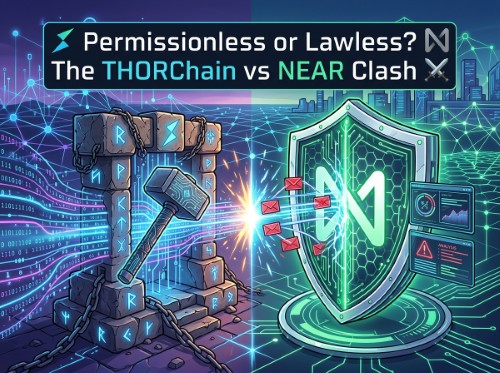
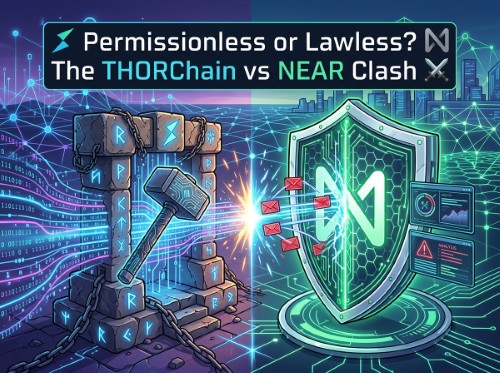
The standard narrative of Web3 promises an open, permissionless financial world governed strictly by code. Yet, when real-world crises collide with decentralized architecture, that ideal faces an existential test.
A major flashpoint emerged following the massive $387.7 million breach of exchange Bitget on 24 September 2026. As hundreds of millions of dollars in illicitly obtained capital rushed across various blockchain bridges, a fierce ideological debate erupted across the decentralized finance (DeFi) ecosystem. At the heart of this confrontation stand two dominant cross-chain contenders—THORChain and NEAR Intents—representing fundamentally opposing philosophies on what it truly means to be "permissionless".
When Bitget CEO Gracy Chen publicly urged protocols to block attacker-linked wallet addresses, the industry's response split down ideological lines.
THORChain, a premier cross-chain liquidity network known for its core cypherpunk principles, refused to step in. Having previously processed over $1.2 billion in funnelled assets from earlier high-profile exploits, THORChain’s stance remained firm: code is neutral, and a protocol cannot select who is worthy of transacting.
Protocol contributor Boone Wheeler captured this uncompromising view, explaining that a genuinely permissionless protocol must remain blind to where funds originated. From THORChain's perspective, if a network possesses the technical ability to black-list specific addresses or halt targeted transactions, it forfeits its status as a permissionless system altogether.
Conversely, NEAR Intents took a diametrically opposed approach. By deploying its automated security layer, known as SHIELD, NEAR intercepted incoming illicit transfers linked to the Bitget incident. SHIELD flagged over $50 million in suspicious transaction attempts, successfully preventing $503,000 from executing while waiving its share of Bitget's recovery bounty.
THORChain's unwavering neutrality has drawn sharp criticism from industry observers, who point to past interventions as proof that network controls do exist.
When a vault vulnerability led to a $10 million exploit on THORChain in May, validator node operators voted to halt network activity to protect protocol solvency. Critics contend that if node operators can freeze network operations to protect themselves, refusing to intervene during massive external exploits represents a deliberate choice rather than a technical impossibility.
However, THORChain advocates draw a clear line between protocol-level emergencies and user-level censorship. Emergency halts are triggered automatically or through node consensus only when the network's internal math or solvency is threatened. Wheeler noted that firm consensus exists among node operators that halts are restricted strictly to active protocol failures, emphasising that the protocol was intentionally designed without address-screening functionality.
NEAR Protocol’s approach presents an alternative blueprint for cross-chain architecture—one that attempts to balance open access with financial integrity.
Alex Shevchenko, General Manager at NEAR, outlined the nuanced philosophy behind NEAR Intents. While anyone remains free to build, transact, or validate on NEAR Protocol without prior approval, individual applications operating within the ecosystem are not required to execute every incoming request uncensored.
The SHIELD system operates as an automated, AI-driven defence mechanism. By evaluating real-time on-chain telemetry against anti-money laundering (AML) intelligence, SHIELD applies targeted execution blocks to illicit flows automatically. In addition to flagging Bitget-related transfers, the system successfully halted a separate $3.8 million exploit targeting an Omni deposit-and-withdrawal interaction.
From a legal and operational standpoint, this automated design offers a distinct advantage. Crypto legal expert Yuriy Brisov highlighted that because SHIELD functions programmatically rather than via a manual human compliance committee, it retains the protections and autonomy inherent to smart contract systems while mitigating ecosystem risk.
The decision by NEAR Intents to intervene has ignited broader fears among decentralisation purists. Critics argue that once a network demonstrates the capacity to stop specific transactions, it creates a dangerous precedent that invites regulatory pressure and censorship.
Joël Valenzuela, head of business development at Dash and a prominent cypherpunk advocate, warned that drawing lines around stolen funds ultimately converts a permissionless network into a permissioned one. While acknowledging how painful it is to watch bad actors transfer stolen wealth across public networks, Valenzuela argued that granting protocols intervention powers opens a "Pandora's box" that could eventually justify censoring innocent users under different jurisdictions.
Bitwise Europe senior research associate Max Shannon echoed this tension, noting that "credible neutrality at all costs" remains an ideal championed by a dedicated subset of Web3 builders. However, Shannon questioned whether absolute neutrality remains viable when it effectively drives illicit money-laundering volume toward protocols that refuse to filter transactions.
The clash between THORChain and NEAR Intents reveals a fundamental rift in how the crypto industry views its responsibilities:
Bitget’s Gracy Chen emphasised that identifying illicit flows does not necessarily destroy decentralised foundations. As the cross-chain landscape matures, the industry faces an unavoidable question: Can protocols maintain true credible neutrality while building effective automated defences, or will Web3 ultimately be forced to choose between absolute permissionlessness and practical survival?
Disclaimer: This article is provided for informational purposes only, mistakes may be made, and it's not offered or intended to be used as legal, tax, investment, financial, or any other advice.