x




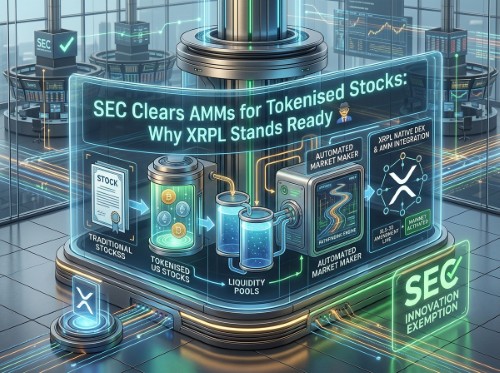
The intersection of traditional finance and blockchain technology has reached a major milestone. A landmark decision by the US Securities and Exchange Commission (SEC) has opened a regulatory pathway for tokenised US stocks to be traded through Automated Market Makers (AMMs).
While the ruling does not explicitly name any single cryptocurrency or network, it creates a crucial framework for Tokenised Securities Venues. For observers of the crypto space, one network immediately stands out in this new regulatory landscape: the XRP Ledger (XRPL).
Having launched its own native AMM architecture in early 2024, the XRP Ledger possesses built-in liquidity capabilities that align remarkably well with what regulators are beginning to envision for the future of capital markets.
The SEC’s temporary exemption establishes a conditional five-year relief window for eligible trading venues. This framework allows platforms to operate permissioned AMM liquidity pools to match buyers and sellers of tokenised National Market System (NMS) stocks.
Historically, automated market makers—which rely on liquidity pools and mathematical formulas rather than traditional order books—have operated primarily in the permissionless, unregulated world of decentralised finance (DeFi). The SEC’s decision acknowledges that AMM mechanics can play a legitimate role in regulated equities markets, provided strict safeguards are in place.
Key Regulatory Conditions
To participate under this relief framework, venues and liquidity providers must satisfy several stringent requirements:
By establishing a five-year window, regulators aim to observe how onchain liquidity pools perform under real-world market conditions without compromising investor protection.
While many smart-contract platforms require complex third-party protocol layers to run automated market makers, the XRP Ledger takes a fundamentally different structural approach.
Native Layer-1 Integration
In March 2024, the XRPL community activated the XLS-30 amendment, introducing a native AMM directly into the ledger’s protocol layer. Because the AMM is built straight into the core code rather than running via external smart contracts, it benefits from the underlying security, predictable cost structure, and high throughput of the XRP Ledger itself.
The Hybrid Liquidity Advantage
One of the most compelling features of XRPL’s trading infrastructure is its auto-bridging and pathfinding engine. The ledger seamlessly connects its long-standing central limit order book (CLOB) with its newer AMM liquidity pools.
When a trade is executed onchain, the network automatically routes the transaction through whichever combination of order book liquidity and AMM pools delivers the optimal exchange rate. For institutional venues seeking efficient price execution across tokenised assets, this hybrid engine provides a pre-built solution to liquidity fragmentation.
The SEC’s regulatory shift signals a broader trend: real-world asset (RWA) tokenisation is moving from experimental pilots to regulated market infrastructure. Financial institutions are actively seeking blockchains capable of handling high-volume asset issuance, settlement, and trading with minimal latency and negligible transaction costs.
XRPL was designed from its inception for enterprise settlement and cross-border asset movement. Its operational characteristics—settlement in 3 to 5 seconds, sub-penny transaction fees, and a proven decade-long operational record without major downtime—make it a natural candidate for institutions evaluating tokenised equity venues.
Furthermore, recent developments on XRPL, including expanding support for permissioned sidechains and compliance-focused features, give institutional actors the tools to satisfy the SEC's requirement for gated, permissioned liquidity environments.
It is vital to distinguish between regulatory alignment and official endorsement. The SEC's innovation exemption is entirely technology-neutral; it does not constitute an approval or endorsement of Ripple, XRP, or the XRP Ledger specifically.
The regulatory framework dictates how tokenised stock venues must operate, not where they must be hosted. The responsibility now lies with financial institutions, fintech issuers, and trading venues to choose which blockchain networks best serve their operational and regulatory needs.
For XRP holders and network advocates, the significance of the SEC's announcement is structural rather than immediate. It validates the technical roadmap that the XRPL development community has pursued over recent years. As regulatory barriers dissolve and traditional equities move onchain, networks with ready-made, battle-tested AMM infrastructure will be well-positioned to capture institutional interest.
The decision by US regulators to accommodate AMM liquidity pools for tokenised stocks marks a pivotal moment in the convergence of Wall Street and Web3. While challenges remain regarding compliance, issuer consent, and institutional onboarding, the direction of travel is clear.
The XRP Ledger already possesses the core technical building blocks—a native AMM, an integrated decentralised exchange, and high-performance settlement capabilities. As financial institutions explore the possibilities opened up by the SEC's five-year framework, XRPL stands ready as one of the few public ledgers with the native architecture required to power the next generation of digital asset markets.
Disclaimer: This article is provided for informational purposes only, mistakes may be made, and it's not offered or intended to be used as legal, tax, investment, financial, or any other advice.