x




We have all experienced that distinct frustration of searching for a file, a photo, or a specific message that you know exists, only for your device to return a blank screen. At Apple’s Worldwide Developers Conference (WWDC) 2026, Stacey Ford, Vice President of OS Program Management, used that exact scenario to describe improvements to Spotlight. Yet, she could just as easily have been describing Apple’s broader artificial intelligence ambitions over the last few years.
For a long time, the revolutionary AI assistant we were all waiting for simply would not show up.
That changed at Apple Park, where the tech giant finally unveiled Siri AI. Rebuilt entirely from scratch after years of under-delivering, this new iteration of Siri feels like the assistant Apple always promised. It can maintain genuine, multi-turn conversations, understand the context of what is on your screen, cross-reference data across your mail, messages, and photo library, and execute complex tasks across multiple applications. It even has its own dedicated app, with real-time processing elegantly tracked within the iPhone’s Dynamic Island.
It was a masterclass in classic Apple integration. However, the real story of WWDC 2026 was not what happened in the slickly produced on-stage demos. It was hidden in the footnotes. When you look closely at who is actually powering Siri AI, and who is legally allowed to use it, a much more complicated reality emerges.
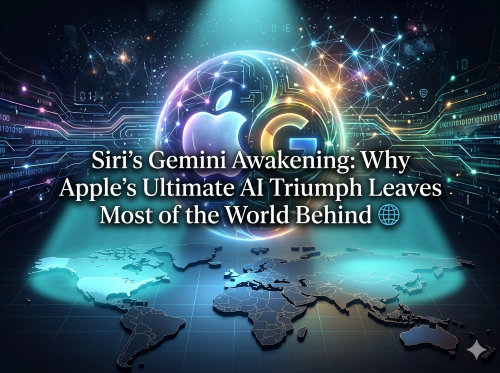
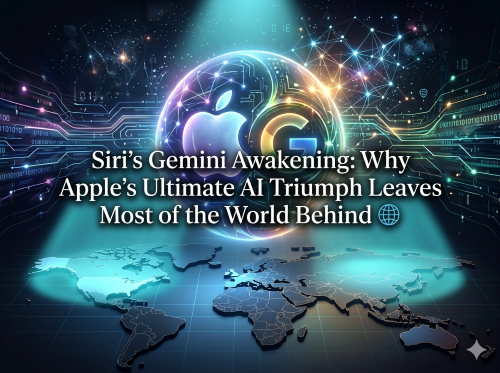
The most monumental disclosure of the event was also one of the quietest. Apple revealed that it collaborated directly with Google, utilising the Gemini family of models to develop the next generation of Apple Foundation Models. This architecture is the foundational bedrock upon which Siri AI and the broader Apple Intelligence ecosystem run.
For the past two years, Silicon Valley insiders assumed Apple was quietly building its own proprietary frontier models to close the gap with its rivals. This announcement answered the burning question of how Apple caught up so quickly: it didn't do it alone.
Apple executives went to great lengths to address the immediate privacy concerns this partnership raises. Craig Federighi, Senior Vice President of Software Engineering, emphasised that privacy in AI is entirely non-negotiable, reassuring users that data is strictly used to execute requests and that independent, outside experts can verify this architecture at any time.
While Apple’s privacy framework may well be airtight, the strategic compromise is impossible to ignore. Apple, a company that prides itself on total vertical integration, now relies heavily on its chief search and mobile rival for the intelligence layer of its ecosystem. Meanwhile, Google continues to ship Gemini natively across Android, Google Workspace, and its own Pixel hardware.
This arrangement carries massive implications that extend far beyond Cupertino. If the world’s most valuable hardware company—with its unparalleled custom silicon advantage and a virtually bottomless cash reserve—chose to license a model rather than build one from scratch, it serves as a reality check for the rest of the world. Sovereign nations and rival tech firms currently drafting grand plans to "build their own frontier models" may need a much more honest assessment of what competing in the AI race truly costs.
The second major revelation is the remarkably restrictive rollout map for Siri AI. The initial beta, scheduled for release later this year, will exclusively support English. Furthermore, regulatory hurdles have kept China off the map entirely, and users in the European Union will not see the new assistant on the iPhone or iPad at launch. Instead, the EU availability is temporarily restricted to macOS 27 and visionOS 27.
When viewed from a global perspective, these geographical omissions are staggering. China represents one of Apple's most fiercely contested and lucrative markets, yet iPhone users there are entirely excluded while domestic Chinese smartphone vendors continue to ship advanced AI assistants without restriction.
An English-only launch also means that hundreds of millions of iPhone users across the world's fastest-growing smartphone markets—including speakers of Mandarin, Japanese, Korean, Bahasa, and Hindi—are stuck using the legacy version of Siri for the foreseeable future. Apple has notably declined to provide a concrete timeline for when additional languages will be supported.
For a company that built its global empire on the principle of shipping the exact same premium experience to everyone, everywhere, on the same day, this is a massive departure from tradition. Apple's most critical software update in a decade is launching to English speakers only, completely bypassing China and heavily restricting the EU.
The very structure of the WWDC keynote gave away Apple's cautious positioning. Rather than framing Siri AI as the singular, revolutionary headline act, the company chose to repair what was broken first, treating the upgraded assistant as just one impressive entry on a very long list of system updates.
This keynote also marked a profound moment of corporate transition. This was Tim Cook’s final WWDC as CEO before handing the reins over to John Ternus, Apple’s Senior Vice President of Hardware Engineering, on September 1st, 2026. While Cook closed the event with his characteristic optimism, stating that the best is still ahead for the company, his successor inherits a fascinating paradox.
John Ternus takes over an Apple ecosystem where the flagship AI assistant thinks using Google's brains, and a global launch strategy that asks a massive portion of the planet to sit tight and wait. Siri AI is finally a reality, and Apple's brilliant knack for user interface design remains completely intact—but the race to truly catch up has only just begun.
To find out more about the original reporting on this rollout and the global implications of Apple's AI strategy, you can read the full article on Artificial Intelligence News:
👉 Siri AI arrives with Google inside, and much of the world is locked out
Disclaimer: This article is provided for informational purposes only, mistakes may be made, and it's not offered or intended to be used as legal, tax, investment, financial, or any other advice.