x




For years, the generative artificial intelligence boom in software engineering has been a solitary affair. A developer sits alone in front of a terminal or integrated development environment (IDE), exchanging prompts with tools like Claude Code, GitHub Copilot, or OpenAI in complete isolation. While this has undoubtedly boosted individual output, it has created a blind spot for the wider enterprise: the work remains invisible to teammates until a pull request suddenly appears.
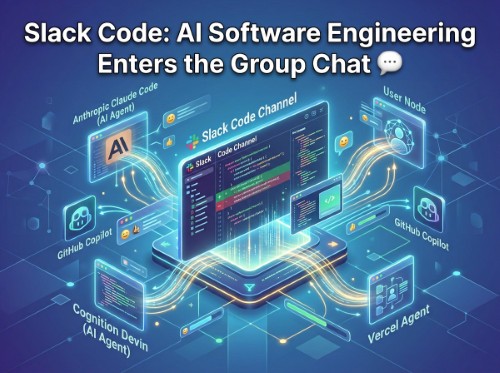
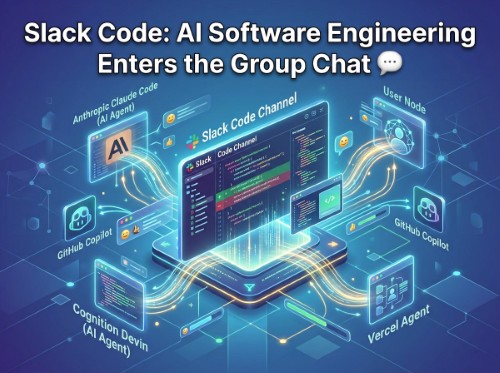
Slack is attempting to rewrite that script. With the launch of Slack Code, the Salesforce-owned collaboration platform is pulling AI coding agents out of private terminal sessions and placing them directly into public team conversations. By embedding autonomous agents—including Cognition’s Devin, Anthropic’s Claude Code, Vercel’s agent, and GitHub Copilot—into shared channels, Slack is making software development a multiplayer experience.
This shift marks a fundamental redesign of enterprise workflows, raising intriguing questions about how software will be built, reviewed, and governed in the age of autonomous AI.
The core philosophy behind Slack Code is simple: shift AI coding from a secretive "single-player" activity to a transparent "multiplayer" team sport.
In the standard workflow, when a user mentions a supported coding agent within a conversation, Slack Code spins up a dedicated, project-specific channel. Inside this temporary workspace, the AI agent performs its tasks out in the open. Teammates can watch the agent work in real time, inspect code diffs, review live previews, and monitor an interactive plan in dedicated tabs. Once the work is complete and validated, the channel is automatically archived, leaving a fully searchable audit trail for future reference.
According to Rob Seaman, interim CEO of Slack, this transition shifts the focus of software creation away from the mechanical act of typing syntax. The true bottleneck in modern software development is no longer the speed at which code is written, but human judgment, creative direction, and taste. By moving code generation into shared communication spaces, non-engineering stakeholders—such as product managers, UI/UX designers, and quality assurance leads—can contribute directly to the creative process.
To understand how this operates in a real-world enterprise setting, consider a standard bug-fix workflow demonstrated by Slack and its partner Cognition.
When an employee reports a broken UI element in an engineering channel:
Because these cloud-based agents operate within central infrastructure rather than on an individual developer’s local machine, creating auditable records and verifying output becomes far more straightforward for enterprise teams.
A major concern regarding the democratisation of code generation is quality control. If anyone across an organisation can summon an AI agent to generate software, does the business run the risk of being flooded with low-quality, poorly architecture code—often referred to as "AI slop"?
Slack’s leadership argues that public visibility serves as the ultimate filter against poor output. In a private terminal, an inexperienced user might accept flawed code without oversight. In a shared channel, every prompt, iteration, and diff is visible to the entire team.
When team members can see an agent’s intent in real time, experienced engineers can intervene, offer technical guidance, or refine the prompt before any code hits production repositories. Public transparency encourages immediate peer review, ensuring that AI-generated artifacts undergo strict human curation.
This concept aligns with policies adopted by forward-thinking tech companies. For instance, Shopify has previously encouraged agentic coding to take place within public channels to disseminate knowledge instantly across the organisation and prevent duplicated effort.
For IT leaders and Chief Information Security Officers (CISOs), introducing autonomous agents into daily workflows introduces obvious security risks. A primary concern is whether an agent could inadvertently expose sensitive source code across departmental boundaries.
Slack Code addresses this through a strict permission model designed around existing user identity:
By positioning agents as digital extensions of existing users rather than unmonitored service accounts, enterprise IT departments avoid the administrative nightmare of managing complex, custom permission structures.
The launch of Slack Code comes at a pivotal time for its parent company, Salesforce. As enterprise software buyers evaluate the long-term ROI of artificial intelligence, platform providers are under pressure to demonstrate tangible value rather than novel conversational interfaces.
Research from analyst firms highlights this tension. Gartner has projected that over 40 percent of agentic AI projects could be cancelled by late 2027 due to escalating infrastructure costs and unclear business impact. Furthermore, studies by McKinsey suggest that while many organisations experiment with AI agents, only a fraction have successfully scaled them to achieve measurable bottom-line improvements.
To bridge this gap, Slack is positioning itself as the open, central orchestrator for enterprise AI work. Rather than walling off its data ecosystem, Slack is embracing an open platform strategy, allowing third-party framework providers—such as LangChain, n8n, Lovable, and OpenAI—to integrate seamlessly.
By making Slack the neutral operational arena where human teams and diverse AI agents collaborate, Salesforce aims to ensure the platform remains an essential layer of the modern workplace stack.
Does the arrival of multiplayer AI channels spell the end of command-line terminals and traditional IDEs? Highly unlikely.
The future of software engineering will almost certainly rely on a hybrid model:
As teams build trust in agentic systems, the reliance on manual code reviews for minor tasks may gradually decrease. However, the fundamental unit of AI adoption is shifting from the isolated individual to the collective team. By dragging AI coding out of the dark and into the light of the group chat, Slack is making a bold bet that the future of software development belongs to those who build together.
Disclaimer: This article is provided for informational purposes only, mistakes may be made, and it's not offered or intended to be used as legal, tax, investment, financial, or any other advice.