x




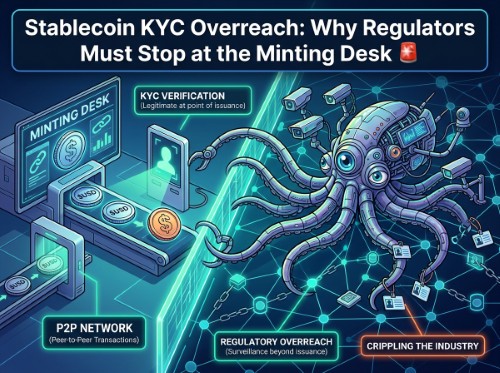
As the global financial system increasingly converges with blockchain technology, payment stablecoins have emerged as the bedrock of digital asset adoption. However, a major legal battle is brewing in the regulatory corridors over who should be required to show their identity when transferring dollar-backed digital tokens.
The Blockchain Association, a prominent crypto trade group led by former CFTC commissioner Summer K. Mersinger, has issued a stark warning to top US financial watchdogs: extending strict identity verification requirements to everyday peer-to-peer (P2P) wallet transactions could effectively cripple the digital asset industry.
At the heart of the dispute is the implementation of the landmark Guiding and Establishing National Innovation for U.S. Stablecoins (GENIUS) Act. While the law was passed to establish a legal framework for dollar-pegged cryptocurrencies, its execution by regulatory agencies threatens to drag ordinary, un-intermediated wallet transfers into an unworkable compliance regime.
The GENIUS Act established a long-sought regulatory framework for payment stablecoins, providing legitimate issuers with a legal pathway to operate within the mainstream financial sector. However, the legislation must now be translated into actionable rules by five key regulators:
In response to proposed Customer Identification Program (CIP) requirements issued by these agencies, the Blockchain Association submitted a formal comment letter advocating for clear, sensible boundaries on financial surveillance.
The core message from the trade group is straightforward: identity checks—commonly known as Know Your Customer (KYC) rules—must remain confined to the primary market where stablecoin issuers hold direct relationships with their immediate clients.
To understand the controversy, one must distinguish between primary issuance and secondary peer-to-peer usage:
1. The Primary Market (Direct Relationships)
When an institutional client, market maker, or registered user deposits fiat currency directly with an issuer like Circle or Tether to mint or redeem stablecoins, a direct commercial relationship exists. The Blockchain Association fully supports requiring Customer Identification Programs at this interface, aligning with traditional Bank Secrecy Act principles.
2. The Secondary Market (Peer-to-Peer Transfers)
Once stablecoins are minted and circulating on open public blockchains, they pass between self-custody wallets, decentralised protocols, and secondary market users. These downstream transfers occur without the issuer's active facilitation, approval, or intervention.
Attempting to force issuers to collect identity data for these downstream, wallet-to-wallet transactions presents insurmountable technological and operational barriers. An issuer cannot practically know, let alone verify, the real-world identity of every individual sending a digital token across a public network.
Forcing stablecoin issuers to monitor and verify every secondary transaction would fundamentally distort how public blockchains operate.
If issuers were mandated to enforce KYC on un-intermediated transfers, they would be forced to implement centralized freeze mechanisms, maintain permissioned white-lists for every wallet on Earth, or halt open issuance entirely. This approach would strip stablecoins of their defining advantages: speed, borderless availability, low fees, and permissionless utility.
Furthermore, subjecting technology providers, software developers, or unrelated corporate entities to CIP obligations would create an unbearable regulatory burden, driving open-source development away from regulated jurisdictions.
Rather than imposing outdated 20th-century surveillance models onto decentralized infrastructure, the Blockchain Association urges regulators to accommodate modern, tech-forward verification tools.
Privacy-enhancing cryptographic mechanisms—most notably zero-knowledge proofs (ZKPs)—allow users to prove specific attributes (such as age, citizenship, or non-sanctioned status) without exposing their sensitive personal data or full identity history to every counterparty.
By endorsing digital identity tools and interoperable compliance protocols, regulators could achieve their anti-money laundering objectives while safeguarding individual financial privacy and fostering technological innovation.
In addition to defining the boundaries of KYC requirements, the trade group highlighted two operational concerns:
Third-Party Reliance Protections
Stablecoin issuers frequently rely on regulated financial intermediaries (such as partner banks or broker-dealers) to conduct identity verification. The industry is advocating for clear safe-harbour protections: if an issuer reasonably relies on a partner bank's regulated Customer Identification Program, the issuer should not face automatic legal liability if that third party makes an administrative error.
Streamlined Regulatory Deadlines
Currently, multiple regulatory bodies—including FinCEN and the Office of Foreign Assets Control (OFAC)—are rolling out updated anti-money laundering and sanctions rules on staggered timelines. Without cross-agency coordination, crypto companies face a chaotic environment where they must continuously overhaul their compliance architecture every few months to satisfy overlapping requirements.
The GENIUS Act represents a monumental step toward integrating digital dollars into the global economy. However, as five separate federal agencies work to finalise its rules, the balance between curbing illicit finance and preserving open-source software remains delicate.
By restricting Customer Identification Programs strictly to primary issuance and redemption, embracing zero-knowledge privacy tools, and coordinating compliance deadlines across departments, regulators can build a resilient system that deters financial crime without stifling the digital economy.
Disclaimer: This article is provided for informational purposes only, mistakes may be made, and it's not offered or intended to be used as legal, tax, investment, financial, or any other advice.