x




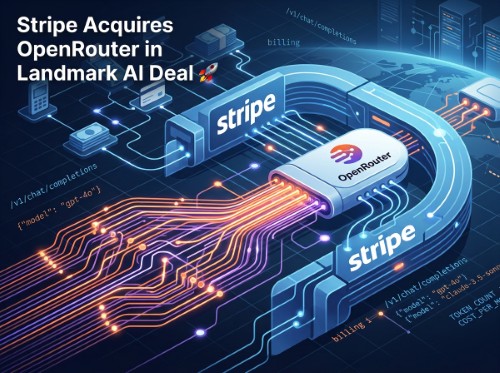
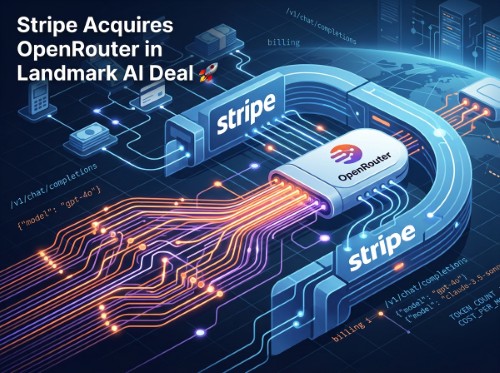
The artificial intelligence ecosystem is evolving at a breakneck pace, and fintech behemoth Stripe has just made one of its most decisive moves yet. Stripe has agreed to acquire OpenRouter, a premier AI model-routing platform that enables developers to access hundreds of artificial intelligence models through a single unified API.
Reported to be worth slightly over $8 billion, this acquisition signals a massive shift in how businesses build, deploy, and monetise AI applications. By merging OpenRouter’s intelligent model selection with Stripe’s robust token-billing infrastructure, Stripe is positioning itself as the financial and operational backbone of the multi-model AI economy.
For modern software developers, integrating artificial intelligence used to mean locking into a single provider’s ecosystem. OpenRouter radically simplified this process by providing access to over 400 models from more than 80 providers through a single interface.
However, OpenRouter does far more than just act as a single point of entry; it serves as a smart traffic controller for AI requests. The platform dynamically evaluates incoming prompts based on several key operational factors:
Crucially, OpenRouter decouples two major decisions: choosing which model processes a prompt and selecting which provider endpoint serves it.
The Dynamic Pricing Advantage
Even when using the exact same underlying model, inference costs can vary dramatically across different providers. For instance, input pricing for Llama 3.3 70B can range from $0.10 per million tokens on low-cost infrastructure providers up to $1.04 per million tokens on higher-margin platforms.
By measuring rolling performance metrics such as throughput and response speeds in real time, OpenRouter allows enterprise systems to automatically choose endpoints that balance cost and speed without sacrificing reliability.
The acquisition comes at a time when organisations are moving away from single-LLM implementations. According to F5’s State of Application Strategy report, over half of surveyed organisations are already orchestrating or chaining multiple AI models, using an average of seven distinct models across their operations.
Enterprise token consumption is exploding accordingly. Research from Deloitte reveals that nearly two-thirds of major companies already process billions of AI tokens each month, with token usage expected to surge exponentially over the coming years.
As enterprise token usage climbs into the tens of billions per month, inefficiencies in context management, prompt engineering, and endpoint selection can translate into millions of pounds in wasted compute expenditure. Intelligent routing is no longer a luxury; it is a vital operational necessity.
Stripe’s interest in OpenRouter stems directly from the economic reality of modern AI: tokens are the fundamental currency of machine intelligence.
Before this acquisition, Stripe and OpenRouter had already established a working relationship. Stripe had been expanding its token-billing tools—allowing platforms to meter consumption precisely by input, output, and cached tokens. Meanwhile, OpenRouter’s platform natively tracks these exact metrics, recording both the raw inference costs from providers and the billed amounts to accounts.
By uniting these two technology stacks, Stripe will enable developers to seamlessly:
Stripe CEO Patrick Collison highlighted that managing tokens and computing resources efficiently is now central to building sustainable AI businesses.
Stripe is not the only industry player recognising the power of model routing. Major cloud giants and infrastructure developers are rapidly building similar routing capabilities into their own ecosystems:
However, Stripe’s acquisition of OpenRouter stands out because it directly connects technical orchestration with real-time financial settlement and billing.
Founded in 2023, OpenRouter experienced meteoric growth, scaling to process over 10 trillion tokens per day for more than 10 million developers. Its strategic acquisition by Stripe marks a new era in software development—one where model selection, performance monitoring, infrastructure failover, and monetisation are handled effortlessly under one umbrella.
For businesses looking to build resilient, cost-effective, and scalable artificial intelligence products, the combination of smart model routing and native token billing provides a powerful foundation for the future.
Disclaimer: This article is provided for informational purposes only, mistakes may be made, and it's not offered or intended to be used as legal, tax, investment, financial, or any other advice.