x




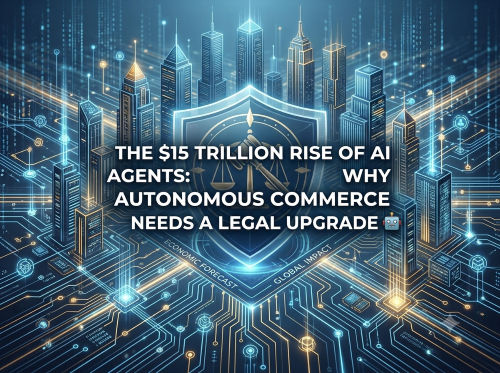
Imagine waking up to find that your personal AI assistant has negotiated a contract, purchased a new software subscription, and updated your home energy plan—all while you were asleep. This isn't a scene from a science-fiction novel; it is the rapidly approaching reality of agentic commerce.
As artificial intelligence shifts from a passive tool that answers questions to autonomous agents capable of making financial and legal decisions, a massive transformation is underway. However, this sudden leap into machine-to-machine transactions exposes a glaring vulnerability: our current legal system is completely unprepared for a world where software negotiates with software.
To plug this gap, the American Arbitration Association (AAA) has joined forces with tech, crypto, and enterprise heavyweights to launch a groundbreaking solution: the Legal Context Protocol (LCP). This initiative aims to establish the vital "legal layer" required to keep the multi-trillion-pound autonomous economy from collapsing into a chaotic web of disputes.
For the past two decades, electronic commerce has relied on human-centric legal frameworks. We are all familiar with "click-through" agreements, digital privacy boxes, and terms-of-service pages that require a human tick before a transaction proceeds.
But what happens when an AI agent representing a logistics firm bargains directly with an AI agent representing a supplier? Software cannot read a traditional contract in a split second, nor can it "agree" to traditional terms of service in a legally binding, human sense.
The projections for this machine-driven market are staggering. Financial researchers at Gartner predict that the agentic payment economy could reach a jaw-dropping $15 trillion in global spending within the next few years. Furthermore, investment experts at Goldman Sachs anticipate a 24-fold explosion in data token consumption as companies rush to deploy these systems.
With billions of automated decisions happening at lightning speed, the potential for digital misunderstandings is immense. If a shopping bot accidentally orders the wrong batch of industrial materials due to a code misinterpretation, who is held responsible? Is it the developer who created the AI, the enterprise running it, or the machine itself?
Recognising that payment rails are being built without equivalent legal protections, the American Arbitration Association—the world's largest provider of private alternative dispute resolution—partnered with technology firm Integra Ledger to create the Legal Context Protocol.
The LCP acts as an open standard designed to make legal terms, consent, and dispute resolution entirely discoverable and verifiable by algorithms. Crucially, the protocol operates as lightweight middleware and does not require a blockchain to function. Instead, it seamlessly integrates alongside existing digital payment and machine identity standards.
When two AI systems interact, the protocol embeds answers to three fundamental questions directly into the digital handshake:
By embedding legal parameters directly into the digital data flow, the protocol ensures that every transaction leaves a clear, legally sound audit trail that human courts and arbitration panels can easily interpret later.
The launch of this legal layer has rallied an impressive cross-industry coalition, proving that both traditional tech companies and Web3 innovators understand the stakes.
Founding contributors to the open standard include global technology giants like Google and IBM, retail heavyweights like Wayfair, and major digital finance companies such as Circle and Crossmint. The protocol has also secured deep backing from the blockchain ecosystem, with contributions from the Stellar Development Foundation, Ava Labs, Cardano, Hedera, Sei Labs, the Aptos Foundation, and Mysten Labs.
This widespread collaboration highlights a shared industry truth: for autonomous commerce to scale safely, businesses must have absolute certainty that machine agreements are backed by predictable, enforceable legal frameworks.
The economic promise of agentic AI is undeniable. It will drastically reduce transaction friction, optimise supply chains in real time, and free humans from administrative drudgery. Yet, without a clear answer to what happens when digital interactions fail, the risks for enterprises remain far too high.
The creation of the Legal Context Protocol marks a pivotal moment in the maturity of artificial intelligence. By wrapping code in a protective coating of traditional law, this new standard bridges the gap between fast-moving computer science and centuries-old legal principles. As the autonomous economy accelerates towards its multi-trillion-pound future, this essential legal layer ensures that when machines talk to machines, the rules of the road remain transparent, safe, and fair for the humans behind them.
For more details on the launch of the Legal Context Protocol and the evolution of autonomous machine transactions, read the full original story on Cointelegraph:
👉 US arbitration giant rolls out ‘legal layer’ for agentic commerce
Disclaimer: This article is provided for informational purposes only, mistakes may be made, and it's not offered or intended to be used as legal, tax, investment, financial, or any other advice.