x




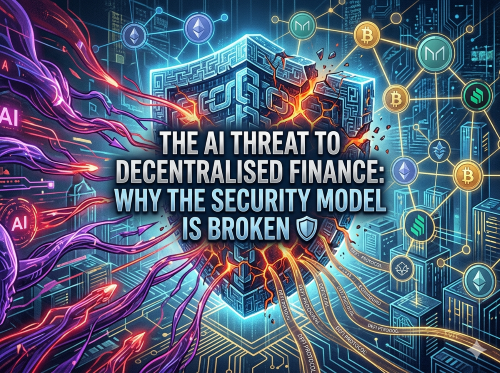
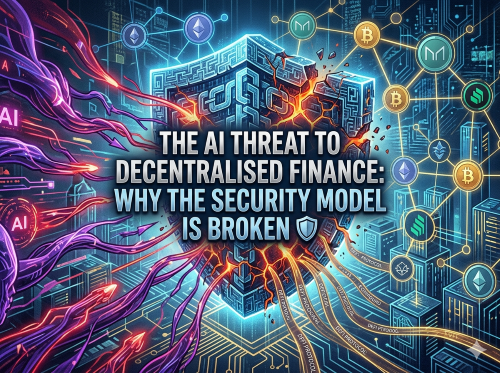
Decentralised Finance (DeFi) has long been celebrated as the frontier of financial freedom, built on the promise of immutable code that removes the need for trusted intermediaries. However, a stark public warning from Manuel Arios, the co-founder and former Chief Technology Officer of Open Zeppelin, has sent shockwaves through the cryptocurrency industry. Arios, whose code underpins roughly $250 billion in live protocol value, openly declared that he now considers all of DeFi unsafe.
When the individual responsible for pouring the structural rebar of smart contract security advises his own family to withdraw their capital from blue-chip protocols like MakerDAO and Compound, the market must sit up and pay attention. The core of this anxiety lies in a fundamental asymmetry in software security, one that has been supercharged by the rapid evolution of artificial intelligence.
Security professionals have long grappled with the asymmetry problem: a defender must find and fix every single vulnerability in their code, whereas an attacker only needs to discover one. In DeFi, this imbalance is exacerbated by three unique characteristics. The code is entirely public, the deployed contracts are immutable and cannot easily be patched, and every protocol sits on a transparent, heavily publicised pile of capital.
Historically, this structural disadvantage was kept in check by a high skill ceiling. Discovering novel exploits in complex protocols required elite human expertise, deep knowledge of the Ethereum Virtual Machine (EVM), and an understanding of specific logic quirks. This natural barrier meant that attacks ran at human speed.
Artificial intelligence has completely vaporised that barrier. Recent research into AI capabilities has revealed that frontier large language models can autonomously replicate and execute smart contract exploits at an unprecedented scale. In benchmark testing of hundreds of real-world contracts, AI agents successfully reproduced exploits on over half of the cases, extracting hundreds of millions of dollars in simulated funds.
Crucially, this capability extends to entirely novel code that the models have never encountered in their training data. These automated agents do not just throw random inputs at code like traditional testing tools; they reason through the logic, write an exploit, test it against live blockchain state, and iterate based on the feedback. With the compute cost of scanning a smart contract plummeting, the speed and efficiency of automated auditing have tilted the scales decisively in favour of the attacker.
The theoretical dangers of AI-driven exploits quickly manifested as a concrete crisis in early 2026. Security analysts recorded an unprecedented surge in DeFi exploits, noting that the sheer frequency and variety of attacks could only be explained by the deployment of automated AI tools.
The headline disaster was the Kelp DAO hack, which resulted in the theft of $292 million. Crucially, the exploit did not stem from a flaw in the protocol's core smart contracts, but rather from a misconfigured verifier within the bridge infrastructure connecting to its trust layer. This highlights an uncomfortable truth for DeFi participants: blue-chip protocols are heavily dependent on an interconnected web of external infrastructure.
Even though a protocol's core code may be extensively audited, it remains vulnerable to the composability of the wider ecosystem. In the immediate aftermath of the Kelp DAO exploit, panic triggered a massive bank run across major platforms. Aave, despite having undergone numerous independent audits, saw its total value locked collapse by roughly 45 per cent within a single month as investors rushed to withdraw billions of dollars. Large pools of capital are no longer viewed as monuments of security; instead, to an AI agent scanning the blockchain, they represent a highly publicised bounty worth significant computational investment.
As the threat escalates, the industry is searching for viable countermeasures, yet current defensive layers offer cold comfort:
Because smart contract code has become harder to crack directly, attackers have shifted their focus upstream. The modern attack surface has expanded to encompass the human element, code repositories, and structural bridges. Bad actors are spending weeks conducting quiet reconnaissance before striking at operational windows that nobody is actively watching.
When the Kelp DAO crisis threatened to cause widespread contagion across the network, the mechanism that halted the damage was not elegant, trustless code. It was a manual intervention by a security council composed of identifiable human beings wielding administrative keys to freeze millions of pounds in funds.
This intervention exposed the ultimate paradox of contemporary DeFi. The market did not demand greater decentralisation in response to the crisis; instead, billions of pounds migrated toward hardened, institutional infrastructure. Capital voted overwhelmingly for a human safety net.
This structural shift is accelerating the rise of "CeDeFi"—a hybrid model that retains open blockchain protocols but bolts on a framework of centralised oversight, custody solutions, compliance checks, and emergency circuit breakers. Institutional deployments designed specifically for corporate compliance are rapidly gaining traction, and industry leaders are increasingly defending these temporary centralised guardrails as a fiduciary necessity to protect capital.
This evolution forces users to confront a challenging reality: if the only effective defence against AI-powered, automated attacks is a small group of humans who possess the authority to freeze transactions, then the safest crypto environment effectively becomes the least decentralised one. Administrative keys and security councils simply reintroduce the trusted third parties that blockchain technology was explicitly designed to eliminate, creating a highly attractive, concentrated target for sophisticated social engineering and physical security exploits.
For individuals navigating this changing landscape, several practical adjustments are vital:
The ultimate question facing the industry is whether warnings from security veterans represent a temporary panic or a permanent structural shift. If artificial intelligence has fundamentally tilted the playing field in favour of the attacker, the survival of decentralised finance may depend on abandoning pure trustlessness in exchange for human intervention. The foundational promise of the sector was code that required no human trust; the uncomfortable reality of the AI era is that the code itself may now be the most vulnerable link in the chain.
Coin Bureau - The AI Exploit That Could Destroy DeFi
"A top DeFi security veteran just sounded the alarm. He’s urging users to exit blue-chip protocols like Aave, MakerDAO, and Compound, citing AI-fuelled hacks that no audit or bug bounty can keep up with.
We break down what’s changed, why even the 'safest' protocols are now giant targets, and how billions could be at risk. Know exactly where you stand before your funds are next on the line."
~ TIMESTAMPS ~
0:00 - Why DeFi’s Own Security Expert Says It’s Unsafe
2:22 - The One Bug Problem Behind DeFi Hacks
4:21 - AI Agents Are Now Exploiting Smart Contracts
6:42 - Why AI Gives Hackers The Bigger Advantage
7:45 - Kelp DAO Hack Exposes DeFi’s Weakest Link
9:12 - Are Blue-Chip Protocols Like Aave Really Safe?
11:20 - Can AI Audits, Bounties And Insurance Save DeFi?
13:46 - Why DeFi Is Moving Toward Centralized Safety Nets
15:58 - How To Protect Yourself From DeFi Risk
Source 👉 https://www.youtube.com/watch?v=04tT68HWa8g
Disclaimer: This article is provided for informational purposes only, mistakes may be made, and it's not offered or intended to be used as legal, tax, investment, financial, or any other advice.