x




The landscape of AI-assisted software development is evolving at a breakneck pace. What started as simple code completion tools has rapidly transformed into what developers fondly call "vibe coding" — prompting AI agents in plain English to build entire applications, patch bugs, and deploy features.
However, anyone who has used AI coding agents for large-scale, continuous software engineering knows the ultimate bottleneck: session drift. Opening a new terminal session often meant re-explaining architecture, re-uploading context files, or relying on heavily compacted conversation summaries.
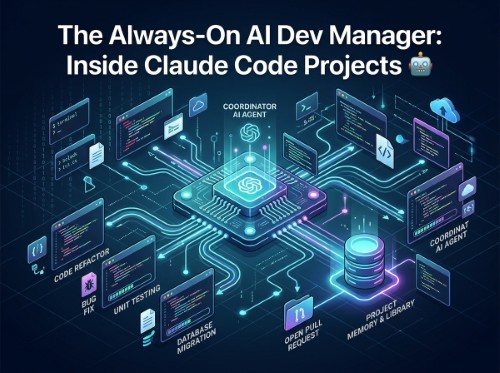
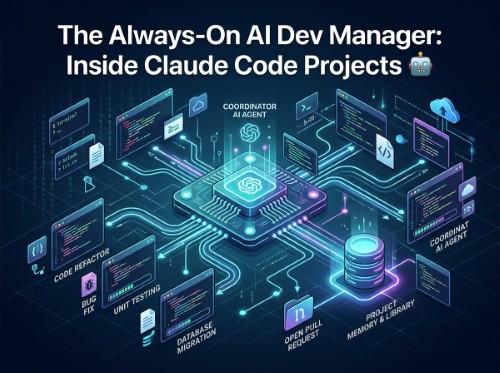
Anthropic aims to eliminate this friction entirely with Claude Code Projects. Designed as an always-on conversational coordinator, this new system acts as an orchestrator that remembers your project's trajectory, sub-divides complex tasks into parallel worker threads, and coordinates execution over long-running development jobs.
In traditional software engineering, digital products like web applications, enterprise platforms, or content management systems rarely have a fixed endpoint. They are continually patched, refactored, and updated over years.
When managing these ongoing workflows with AI agents, developers previously had to act as human task schedulers. You would break down a massive objective — such as migrating a database or reducing API response times — into small, bite-sized tasks, feed them into separate AI sessions, manually handle merge conflicts, and keep track of context yourself.
Claude Code Projects shifts the primary unit of interaction from a single prompt to a persistent, long-running body of work. Instead of treating each coding task as an isolated interaction, Anthropic introduces a hierarchy:
In practice, working with a Claude Code Project feels like briefing a technical chief of staff. You can delegate multiple, interconnected objectives at once. The coordinator decides whether each task belongs in an existing thread or requires spawning a new one, keeping the entire effort synchronised.
While running AI agents in parallel is no longer unique, the real breakthrough of Claude Code Projects lies in its persistent operational memory.
Every worker thread contributes to and draws from a unified Project memory. If a release date changes, a feature scope gets trimmed, or a specific refactoring rule is established in one branch, that context is immediately carried forward to all other threads.
Additionally, each project includes a centralised library that aggregates user-supplied files, documentation, and agent-generated artifacts. You can configure individual environments, custom plugins, model temperature settings, and system instructions at the project level, giving every sub-agent a shared foundation.
Because Anthropic introduced a web feature named Claude Projects in mid-2024, the naming convention has caused some initial confusion. It is vital to distinguish between the two:
In short: Claude Projects helps the AI remember static context you provided, while Claude Code Projects helps the AI remember and coordinate dynamic work it is actively performing.
Anthropic is far from alone in attempting to solve the AI orchestration challenge. Key industry rivals are tackling parallel developer workflows from different angles:
OpenAI
OpenAI’s Codex application provides a multi-agent workspace where developers can execute multiple coding agents concurrently in isolated environments. Like Claude Code Projects, it normalises parallel execution. However, Anthropic places greater emphasis on a single conversational coordinator that acts as the steering wheel for all parallel streams.
GitHub
GitHub leverages its position as the primary repository control plane. Its agent tools tie deeply into pull requests, GitHub Issues, branch structures, and continuous integration pipelines. Anthropic, by contrast, positions its coordinator above individual repositories, allowing a single project to span API, mobile, and web codebases seamlessly.
Google
Google’s Jules focusses on asynchronous repository-level tasks and accumulating repository knowledge over time. Anthropic expands this concept into initiative-level persistence, uniting multiple worker threads under a shared operational memory.
At launch, Claude Code Project worker threads execute entirely in the cloud. This offers a significant benefit: your agents can continue profiling code, testing optimisations, and opening pull requests even after you close your laptop. An Overview panel allows developers to monitor progress and steer threads directly from a mobile device.
However, cloud execution currently means these threads cannot access local host files, private internal tools, or restricted corporate networks. Anthropic has confirmed that local execution support is coming soon, which will unlock full functionality behind enterprise firewalls.
In terms of pricing, Claude Code Projects does not require a separate subscription, instead drawing from existing usage limits on Claude Pro and Max plans. Because running several worker threads simultaneously consumes usage faster, users can adjust model selection, effort levels, and check-in frequencies for individual threads.
The AI coding landscape has officially moved past the question of whether an agent can write syntactically correct code. Today's challenge is delegation, orchestration, and continuity.
By introducing an always-on coordinator backed by shared operational memory, Claude Code Projects offers a glimpse into the future of software engineering — one where developers step away from micro-managing individual prompts and step into the role of high-level architects guiding a coordinated team of AI agents.
Disclaimer: This article is provided for informational purposes only, mistakes may be made, and it's not offered or intended to be used as legal, tax, investment, financial, or any other advice.