x




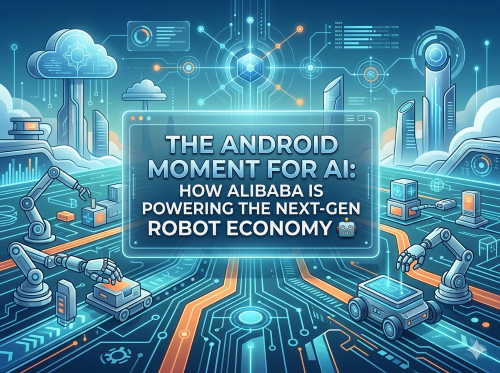
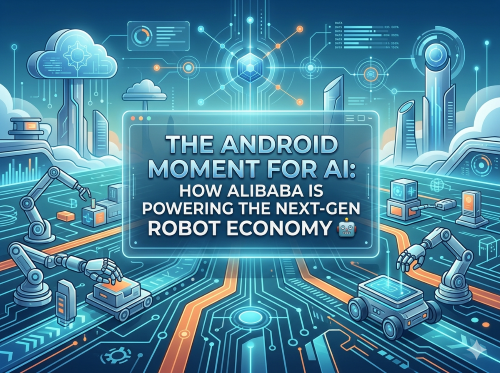
The race for artificial intelligence has officially moved out of the digital cloud and into the physical world. While the West has been heavily focused on text-based chatbots and image generators, a quieter, arguably more profound revolution is taking place in the field of "embodied AI"—the term scientists use for AI that possesses a physical body. At the absolute forefront of this movement is the Chinese tech giant Alibaba, which has just unveiled a groundbreaking software suite that could very well become the "Android operating system" for the global robotics industry.
By launching the Qwen-Robot Suite, Alibaba is not building hardware, gears, or metal limbs. Instead, they are building the brain. It is a highly sophisticated, unified software stack designed to give diverse robots the ability to navigate, manipulate objects, and understand the laws of physics.
Here is a detailed look into how Alibaba is shaping the future of the robot economy and why this represents a massive leap forward for embodied intelligence.
Rather than creating a single, bloated AI model, Alibaba’s Qwen team has engineered a trio of specialised foundation models. Each model can operate independently, but when combined, they form a complete stack for physical AI.
1. Qwen-RobotNav: Redefining Digital Navigation
Most traditional robots are hardcoded to navigate in specific ways, struggling to adapt if the environment changes. Qwen-RobotNav shatters this limitation by unifying five distinct navigation tasks into a single interface: tracking targets, searching for objects, following natural instructions, goal-directed navigation, and autonomous driving.
Trained on a staggering 15.6 million samples, this model allows a planner to reconfigure visual strategies mid-route, adjusting variables like camera weights and memory retention on the fly. In rigorous testing, it achieved an impressive 76.5% success rate on real-world vision-and-language navigation benchmarks and a 90% accuracy rate in consistently tracking moving targets.
2. Qwen-RobotManip: Bridging Different Robot Bodies
One of the biggest hurdles in modern robotics is that different machines "think" about movement differently. A standard Franka robotic arm calculates movements based on joint angles. A low-cost research robot platform, like ALOHA, relies on the exact position and orientation of its grippers. Humanoid robots complicate things further by requiring full-body coordination.
Qwen-RobotManip acts as a universal translator for robotic movement. To bridge these incompatible action spaces, Alibaba synthesized roughly 38,100 hours of training data from open-source robot datasets and human videos. The result is a model that outperforms previous approaches by 20% on major manipulation benchmarks, allowing different robot shapes and sizes to learn from the same core intelligence.
3. Qwen-RobotWorld: A Simulator Bound by Physics
Perhaps the most ambitious piece of the puzzle is Qwen-RobotWorld. This is a video world model that treats natural human language as a universal command. If you tell the system to "pick up the red cup and pour water on the flower," the model understands the intent whether the machine executing it is a mechanical gripper, a self-driving vehicle, or a mobile drone.
Fed on a corpus of 8.6 million video-text pairs—amounting to 200 million individual frames—this world model scores perfectly on physics adherence. It deeply understands Newton's laws, fluid dynamics, gravity, and the conservation of mass, allowing it to predict the real-world consequences of physical actions with startling accuracy.
It is easy to mischaracterise this suite as a simple extension of standard large language models (LLMs). However, a traditional AI chatbot merely predicts the next word in a sentence; it knows text, not reality. A language model can easily type out the sentence, "If you drop a glass, it will break."
Alibaba's Qwen models go infinitely deeper. Qwen-RobotWorld can accurately predict how that glass will shatter—calculating the fracture patterns, the fluid dynamics of the spilling liquid, and the secondary collisions of the shards. Meanwhile, Qwen-RobotManip works out the precise grip required to prevent the drop from happening in the first place. These models do not just process prompts; they process the physical universe.
Western tech titans like Google DeepMind, Nvidia, Figure, and Physical Intelligence are all fiercely pursuing physical AI. However, many of these laboratories focus heavily on isolated tasks, such as perfecting navigation or mastering grip mechanics.
Alibaba’s distinct advantage lies in its massive, vertically integrated ecosystem. The company spans across microchips, cloud computing infrastructure, AI models, serving platforms, and consumer applications. They control the full stack from top to bottom. Furthermore, by training their models on open-source data rather than keeping their findings entirely proprietary, Alibaba is positioning itself as the foundational infrastructure provider for a multitude of third-party hardware manufacturers, including AgileX, Franka, Universal Robots, and Unitree.
Despite these breathtaking technical milestones, we are still a long way from having autonomous robotic housemaids or fully automated factories handling complex, unpredictable tasks.
There is an enormous, humbling chasm between a controlled laboratory demonstration—where a robot successfully places a piece of fruit into a basket—and the chaotic reality of a human home or a bustling street. Real-world deployment introduces random sensor noise, mechanical wear, actuator drift, and a virtually infinite number of unpredictable edge cases.
Alibaba freely acknowledges this reality. The current benchmarks are largely simulated, and the company has chosen to remain quiet regarding timelines, commercial pricing, or wider customer access outside of specialised pilot programs.
Nevertheless, the architecture Alibaba has built is undeniably real. By solving crucial bottlenecks in cross-robot training and physical world simulation, they have laid down the digital tracks for the upcoming robot economy. The software brain is officially ready; now, the physical world just needs to catch up.
For more details and in-depth reporting on this development, read the full original story on Decrypt:
👉 Alibaba Is Building Qwen-Robot: The Operating System for the Robot Economy
Disclaimer: This article is provided for informational purposes only, mistakes may be made, and it's not offered or intended to be used as legal, tax, investment, financial, or any other advice.