x



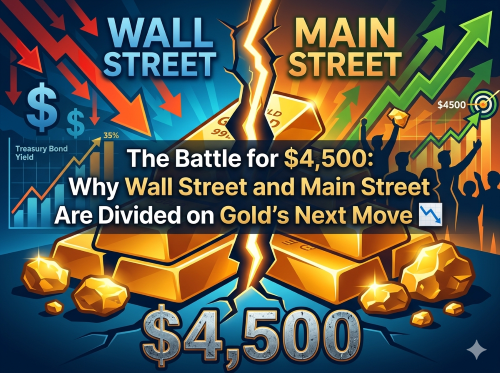
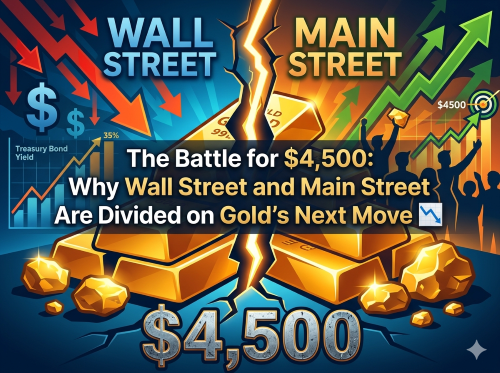
The global precious metals market is witnessing a fascinating tug-of-war. For months, gold has been the undisputed king of safe-haven assets, scaling historic heights and rewarding bullish investors. However, a sudden shift in macroeconomic fundamentals has triggered a dramatic weekly selloff, forcing Wall Street institutional analysts to throw in the towel on short-term gains. Meanwhile, retail investors on Main Street are refusing to back down, holding onto their bullish biases as a critical psychological support level is tested.
If you are tracking the markets, navigating this sudden volatility requires a deep look into the economic forces at play. Let’s break down exactly what dragged gold prices down, why the $4,500 level is the ultimate line in the sand, and what the experts predict for the weeks ahead.
The trading week started with immense promise. Spot gold kicked off trading at $4,687.50 per ounce, and amid persistent geopolitical anxieties, buyers initially stepped up. By Monday evening, a strong push during the North American session drove the yellow metal to its weekly high of $4,768 per ounce.
Unfortunately for the bulls, that optimism evaporated as a barrage of hot U.S. economic data shifted the market’s focus from safe-haven demand to sticky inflation and restrictive monetary policy.
To understand why gold broke down so violently, one must look at the global bond and currency markets. Gold is traditionally a non-yielding asset. When government bond yields rise, the opportunity cost of holding physical gold increases, prompting institutional capital to migrate toward fixed income.
Concurrently, the U.S. dollar staged a powerful four-day advance. Because gold is priced globally in greenbacks, an appreciating dollar automatically makes the metal more expensive for international buyers, suppressing physical and speculative demand.
Interestingly, this selloff occurred despite oil prices holding above $100 a barrel and ongoing geopolitical tensions in the Middle East due to the Iran conflict. Usually, war and surging energy costs act as catalysts for gold. However, investors are currently hyper-focused on the inflationary impact of these energy costs. Higher oil means the Fed’s job is far from over, opening the door for further rate hikes rather than cuts—an absolute kryptonite scenario for precious metals.
The stark contrast between institutional "smart money" and retail investors was perfectly captured in the latest Kitco News Weekly Gold Survey.
Wall Street Swings Bearish
Out of 13 analysts who participated in the Wall Street survey, an overwhelming 77% predicted lower prices for the upcoming week. Only 15% remained bullish, while 8% expected a sideways consolidation. Analysts note that gold’s inability to defend multiple key support levels, paired with a falling 50-day moving average near $4,700, proves the bears are firmly in control of short-term price discovery.
Main Street Stays Stubbornly Bullish
In stark contrast, retail investors participating in online polls held onto their optimistic outlook. 59% of retail traders expect gold to rise, 14% look for further losses, and 28% predict a sideways trend. Many retail investors view the steep drop as a classic "buy the dip" opportunity, banking on long-term central bank purchasing power and structural global debt issues to reassert themselves.
With spot gold hovering just above $4,540, all eyes are locked onto the $4,500 handle. Market experts are split on whether this floor will hold or shatter.
The Bearish Case: A Drop to $4,350 or $3,800
Many analysts warn that the technical damage inflicted over the past week is severe. Marc Chandler, managing director at Bannockburn Global Forex, pointed out that gold has not traded below $4,500 since late March. He cautioned that a definitive break below this level could quickly trigger a cascading selloff toward $4,350.
Daniel Pavilonis, senior commodities broker at RJO Futures, shared an even starker warning, stating that if $4,500 fails to hold, the broader macro trend breaks to the downside, potentially exposing the high $3,800s. Furthermore, the disappointment surrounding the recent Trump-Xi summit—which yielded no major economic breakthroughs to calm global bond yields—leaves the market without a positive catalyst.
The Bullish Case: The 200-Day Moving Average to the Rescue
On the flip side, technical analysts like Alex Kuptsikevich from FxPro note that while the 50-day moving average is acting as heavy resistance overhead, a powerful rising 200-day moving average sits just below. This specific long-term moving average has successfully halted major selloffs for the last two and a half years.
Furthermore, analysts at CPM Group issued a tactical "Sell" recommendation with an initial target price of $4,400, but they emphasised that much of the liquidating pressure is purely speculative. Physical buyers, including central banks and long-term stackers, are hesitant to liquidate their physical holdings given systemic global uncertainties, and are eagerly waiting on the sidelines to accumulate more physical gold at discounted prices.
The upcoming economic calendar is packed with events that could trigger intense volatility across risk assets and precious metals alike:
Ultimately, the easy, uninterrupted upward trade that gold enjoyed earlier this year is over. As seasonal selling patterns collide with hawkish global central banks, gold traders must buckle up for a highly volatile, range-bound environment. Whether $4,500 holds as a fortress or crumbles as a trap will decide the trajectory of the precious metals market for the rest of the summer.
To deep dive into the original data, market surveys, and expanded analyst commentary, you can read the comprehensive report on Kitco News.
Disclaimer: This article is provided for informational purposes only, mistakes may be made, and it's not offered or intended to be used as legal, tax, investment, financial, or any other advice.