x




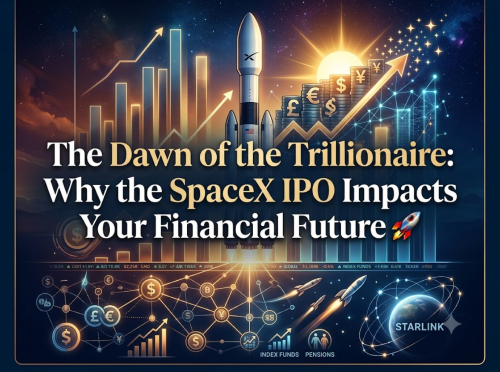
The global financial landscape changed forever on 12 June 2026. With the historic initial public offering (IPO) of SpaceX, the world witnessed the birth of its very first trillionaire: Elon Musk.
As the aerospace giant made its thunderous debut on the public markets, it didn't just smash records; it concentrated an unprecedented amount of capital into the hands of a single individual. Today, one man controls more wealth than the poorest 46% of the global population combined.
This staggering milestone has ignited a fierce global debate. Should anyone hold this much economic power? More importantly, how does the rise of the trillionaire class directly affect your own paycheck, your investments, and your hard-earned pension?
To understand how this astronomical wealth was created, one must look at the sheer scale of what SpaceX achieved. Founded in 2002, the company was initially viewed as an incredibly risky gamble. At the time of the IPO, Musk admitted he originally gave the venture less than a 10% chance of survival. Traditional institutions, governments, and mainstream investors refused to back the idea of fully reusable rockets. After the first three Falcon 1 launches failed, the company teetered on the brink of bankruptcy in 2008.
However, the fourth launch succeeded, changing the trajectory of space exploration forever. Reusability transformed the economic framework of aerospace. Before SpaceX, rockets were discarded as multi-million-pound pieces of junk after a single flight. Today, individual Falcon 9 boosters are capable of landing and flying as many as 35 times, slashing the cost of reaching orbit by more than 70%.
By 2025, SpaceX was responsible for roughly 83% of all US space launches, lifting over 80% of all mass placed into global orbit by weight. Yet, whilst the rockets grab the headlines, they are not the primary cash engine driving the company's multi-trillion-pound valuation. That crown belongs to Starlink.
Starlink, the satellite internet division of SpaceX, beams high-speed connectivity across the globe via an immense constellation. With over 10,000 satellites in orbit, SpaceX now controls roughly three-quarters of every active, manoeuvrable satellite circling the Earth.
In 2025 alone, Starlink generated £11.4 billion ($11.4 billion) in revenue, accounting for roughly 61% of SpaceX's total intake, whilst delivering an impressive £4.4 billion in operating profit. Financial analysts track Starlink eagerly because it boasts "software-like margins". This means that once the satellite infrastructure is deployed, the cost of adding each new subscriber is negligible, allowing subsequent revenue to flow almost entirely as pure profit.
When SpaceX finally went public, the market reacted with unbridled euphoria. Shares priced at $135 opened at $150 and closed the first day up over 19%. The offering raised $85.7 billion in fresh capital, nearly tripling the previous global record held by Saudi Aramco. To put the market capitalisation into perspective, the debut was the financial equivalent of listing 17 Facebooks simultaneously. Within just three days of trading, SpaceX briefly approached a total valuation of $3 trillion, momentarily eclipsing retail titan Amazon.
Because Musk retains an ownership stake estimated between 42% and 49%, this public market explosion propelled him comfortably past the trillion-dollar threshold. On paper, the IPO also minted over 4,000 new millionaires amongst SpaceX engineers and support staff who held company equity.
The sheer magnitude of a trillion-dollar fortune is almost impossible for the human brain to fully comprehend. To break it down conceptually, it helps to look at the dimension of time. A million seconds passes in about 12 days. A billion seconds takes roughly 32 years to tick away. A trillion seconds, however, spans approximately 31,700 years—a journey through time that takes us back to the peak of the last ice age, long before humans invented agriculture.
Alternatively, consider the wealth gap. The financial distance between an average citizen and centi-billionaires like Jeff Bezos is vast. Yet, the gap between Bezos and Musk sits at an even more staggering level. Statistically, the average citizen is closer in total net worth to Jeff Bezos than Bezos is to Elon Musk. On the day of the SpaceX IPO alone, Musk’s paper net worth increased by more than $100 billion—a single-day gain larger than the entire lifetime fortune of Bill Gates.
Despite these mind-boggling numbers, there is a fundamental catch to this massive fortune: Musk cannot easily spend it. Less than one-tenth of 1% of his total wealth is held in actual cash. The remaining 99.9% exists entirely as unrealised stock. Under the legal terms of the IPO, Musk is bound by a strict 366-day lock-up period, legally forbidding him from selling his shares until mid-June 2027.
Therefore, when headlines declare a net worth of one trillion dollars, it simply means the stock market is pricing his shares at that collective value on that specific day. Paper wealth of this scale is remarkably volatile.
The reality of this volatility was proven just ten days after the IPO. On 22 June, SpaceX issued $20 billion in bonds to refinance existing debt, causing the stock to tumble by roughly 16% in a single trading session. In the span of a few hours, between $150 billion and $350 billion of Musk's paper net worth completely evaporated. It was a paper loss larger than the entire net worth of Warren Buffett, disappearing before lunchtime without a single share being sold.
Furthermore, market experts question whether the multi-trillion-dollar valuation is fundamentally justified. At its IPO, SpaceX traded at roughly 94 times its annual revenue. For comparison, Meta trades at around 22 times revenue, and Amazon sits at 18. Historically, any valuation multiple above 40 carries a dismal long-term track record of corrections. Analysts at firms such as Morningstar and CFRA argue that the intrinsic value of SpaceX sits closer to $780 billion—less than half of its peak public market pricing. The current valuation relies heavily on a narrative of future triumphs: a belief that the massive Starship rocket will achieve an airline-like daily launch cadence, and that Musk's integrated artificial intelligence ventures will dominate the tech landscape.
The emergence of the trillionaire era has divided economists, politicians, and the public into two distinct camps.
Defenders of ultra-high net worth individuals argue that massive capital rewards are necessary to incentivise monumental risks. Developing fully reusable rockets, constructing a global satellite network, and transitioning the automotive industry toward electric vehicles are decades-long, capital-intensive endeavours that do not fit into standard corporate quarterly earnings cycles. Nobel laureate William Nordhaus previously calculated that technological innovators typically capture only about 2% of the total economic value created by their inventions, with the remaining 98% flowing back to society via superior products and reduced costs. Proponents argue that a trillion-dollar payoff is a small price to pay for unlocking the cosmos and advancing global communication infrastructure.
Conversely, critics raise serious concerns regarding the sheer mechanics of unchecked power. Even if a fortune exists primarily on paper, the real-world control it grants is absolute. One private individual now maintains an effective monopoly over two-thirds of all active satellites in orbit, commanding a vital chokehold over global communication and defence infrastructure without ever being elected by a democratic body.
There is also the burning issue of taxation. Because Musk's wealth accumulates via unrealised stock, he can fund his lifestyle by borrowing loans against his shares rather than drawing a traditional salary. This strategy allows ultra-wealthy individuals to pay a remarkably low rate of income tax relative to their economic growth. Consequently, a working-class citizen, such as a firefighter paying standard income tax on every single monthly paycheck, contributes a higher effective percentage of their growth to the public purse than the wealthiest individual in human history. This disparity has led politicians to renew intense demands for a global wealth tax, proposing annual levies on fortunes exceeding $100 million.
The most critical takeaway of the SpaceX milestone is that it is no longer just a story about an eccentric billionaire and his rocket ships. It directly involves the financial stability of ordinary savers.
SpaceX is currently being fast-tracked for inclusion into major global stock market indices. If you hold a passive index fund, a workplace pension, or an institutional retirement account, you are about to become an involuntary investor in SpaceX. Your retirement savings will be exposed to a business valued at over 90 times its revenue—an organisation built heavily on market sentiment rather than a traditional, conservative balance sheet.
If the grand narrative surrounding SpaceX ever falters, the resulting financial fallout will ripple far beyond Musk's personal balance sheet. It will directly impact the retirement funds of ordinary people who never actively chose to buy a single share. While the world's richest man possesses the deepest possible cushion of advisers, alternative options, and wealth to withstand a multi-billion-pound market swing, the everyday saver enjoys no such protection.
Ultimately, the dawn of the trillionaire class forces us to take a hard look at the global economic machine. We must decide if a system that mints individual fortunes larger than the economies of 160 independent nations is a triumphant feature of human innovation, or a fundamental flaw that leaves the public holding the financial risk if it all comes crashing down.
Finance Bureau - The Trillionaire Era Begins and It's NOT GOOD
"On June 12th, 2026, one man's fortune hit a trillion dollars, shaking up the entire system behind your paycheck, taxes, and retirement. What does it mean when so much wealth pools at the very top and is it even real?
We dig into the numbers behind the SpaceX IPO, what a trillion dollars looks like up close, and why the rise of the first trillionaire lands inside your wallet."
~ TIMESTAMPS ~
0:00 Elon Musk Becomes the World's First Trillionaire
1:06 How SpaceX Went From Near Bankruptcy to $2.5 Trillion
2:10 Why Starlink Is the Real Money Machine
4:37 How Big Is $1 Trillion? Putting It Into Perspective
7:07 Why Musk Can't Actually Spend His $1 Trillion
9:05 Is SpaceX Really Worth $2.5 Trillion?
10:36 Do We Need Trillionaires?
14:09 Why Your Pension Could Soon Be Exposed to SpaceX
Source 👉 https://www.youtube.com/watch?v=K6fPeZ2vzMA
Disclaimer: This article is provided for informational purposes only, mistakes may be made, and it's not offered or intended to be used as legal, tax, investment, financial, or any other advice.