x




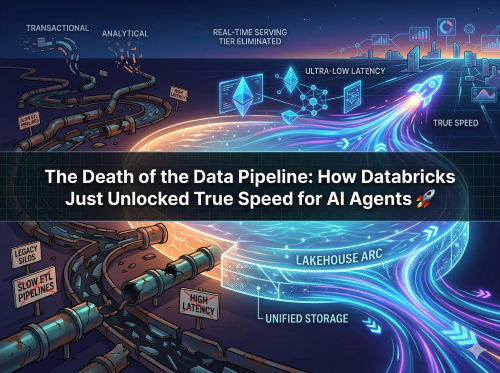
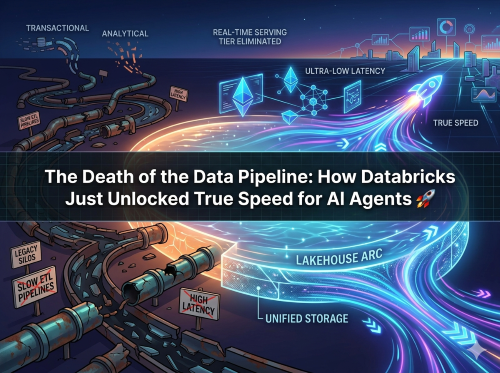
For decades, data engineers and IT professionals have wrestled with a fundamental architectural flaw in enterprise technology: the deep divide between transactional databases (the operational systems running live applications) and analytical databases (the data warehouses used for deep reporting and insights).
Bridging this gap has traditionally required complex, brittle, and expensive Extract, Transform, Load (ETL) data pipelines. While this delayed, siloed approach was manageable when data was only consumed by human analysts reviewing weekly reports, the rise of artificial intelligence has pushed this infrastructure to its absolute breaking point.
Enter the era of AI agents. An AI agent is a system designed to continuously reason, plan, and execute tasks based on live enterprise information. For these autonomous systems, a data pipeline that introduces hours—or even minutes—of latency is a structural failure. An agent cannot act effectively on the present if it is looking at a snapshot of the past.
At the recent Data + AI Summit, Databricks announced a massive architectural shift that aims to collapse this traditional infrastructure entirely, solving a decades-old bottleneck and offering what industry insiders call the "holy grail" for AI agent performance.
To understand why this is a massive milestone, we have to look at how data moves within an enterprise. Traditionally, when a customer buys a product or updates their profile, that data lands in a transactional database (like PostgreSQL). Later, a pipeline copies and converts that data into a columnar format so that an analytical platform (like a data lakehouse) can query it.
This introduces two massive problems for AI:
If an AI agent is tasked with processing a medical insurance claim or executing a real-time financial trade, it needs instant access to live operational data, historical context, and governance rules in a single workflow. Gaps between systems stop being a mere IT maintenance headache—they become an active operational risk.
The tech industry has tried to solve this before. Back in 2014, the analyst firm Gartner coined the term HTAP (Hybrid Transactional/Analytical Processing) to describe systems that tried to run both workloads in a single database engine. However, HTAP systems often forced compromises, failing to excel at either high-speed transactional writes or massive analytical queries.
Databricks is taking a completely different path with LTAP (Lake Transactional/Analytical Processing). Instead of trying to force a single query engine to do everything, LTAP unifies data at the storage layer using open formats like Delta Lake and Apache Iceberg.
Under this new architecture, Databricks uses its serverless cloud database service, Lakebase. Postgres remains the transactional engine handling live writes, while Spark and the Lakehouse handle the heavy analytics. Crucially, the transactional data lands directly in Delta or Iceberg format from the very point of write. Both engines read from the exact same single copy of data.
The primary engineering obstacle to this approach is that cloud object storage is inherently slow, with response times measured in seconds—far too sluggish for operational applications that require sub-millisecond speeds.
Databricks resolves this by embedding an intelligent caching layer between the Postgres compute instances and cloud object storage. When the transactional system is idle, spare CPU capacity within this caching layer converts data from row format to highly compressed column format before it ever hits the object store. This reduces data size by more than ten times, drastically lowering network costs and preserving real-time performance.
Alongside LTAP, Databricks introduced Lakehouse//RT (Real-Time), a product designed to completely replace the dedicated real-time serving tiers that enterprises have traditionally maintained to handle low-latency queries.
Powered by a brand-new, high-concurrency engine called Reyden, Lakehouse//RT queries Delta and Iceberg tables directly on the lake without moving data out of the system. The performance metrics are striking:
Because these queries happen directly within the lakehouse, they are fully governed by Databricks' Unity Catalog. There are no separate permissions to configure, no extra ingestion pipelines to monitor, and no duplicate data copies floating around the enterprise.
The broader market is already moving away from fragmented, specialised data layers. Industry data from early 2026 shows that enterprise intent to adopt hybrid data retrieval strategies has tripled, while the adoption of standalone, niche databases has begun to drop.
The strategy of choosing separate, "best-of-breed" tools for every individual data task is becoming increasingly difficult to defend. It creates an expensive burden of copying, syncing, and securing data across multiple environments.
By allowing transactional writes to land immediately in open data formats, and enabling real-time queries directly off the lake, this new approach provides an incredibly strong argument for retiring a whole generation of specialised databases and pipelines. For data engineers building the foundations for autonomous AI, the infrastructure is finally stepping out of the way, allowing agents to reason, learn, and act at true digital speed.
To read the full, original announcement and explore deeper technical insights, check out the detailed report on VentureBeat:
👉 Databricks says it solved the decades-old data pipeline problem that's been slowing AI agents
Disclaimer: This article is provided for informational purposes only, mistakes may be made, and it's not offered or intended to be used as legal, tax, investment, financial, or any other advice.