x




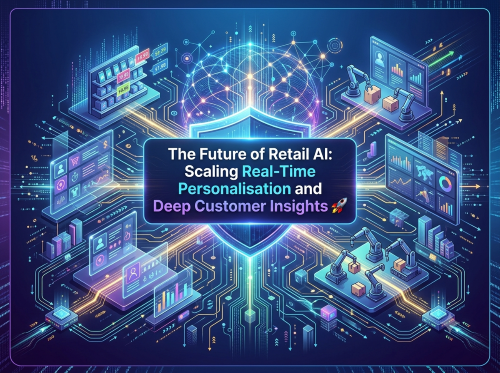
The landscape of modern retail is undergoing a monumental paradigm shift. The era of static store layouts, broad demographic segmentation, and slow human focus groups is rapidly drawing to a close. In its place, a new standard has emerged: a dynamic, hyper-personalised digital and physical environment powered by advanced retail Artificial Intelligence (AI) infrastructure.
For forward-thinking brands, deploying retail AI is no longer a futuristic luxury—it is an operational necessity. To successfully scale personalisation and extract real-time customer insights, leaders are overhauling legacy frameworks and building robust data pipelines capable of modifying the user environment during a live, active session.
Here is how cutting-edge retail AI infrastructure is reshaping the industry, from the digital storefront to the automated warehouse floor.
Traditional customer interaction patterns often rely on rigid, pre-defined rules. However, broad demographic categorisations generate insufficient engagement when compared to individualised, session-based interface modifications. Modern consumers do not want to be grouped into generic buckets; they expect a digital experience that adapts to their immediate needs.
In fact, research from McKinsey highlights that more than three-quarters (76%) of consumers grow frustrated when digital experiences fail to adapt to their requirements. Conversely, businesses that implement real-time tailored layouts clear a remarkably high revenue bar. These organisations see an impressive 35% lift in purchase frequency alongside a 21% increase in average order values (AOV).
To achieve this level of customisation, retailers are deploying Generative User Interfaces (Generative UIs). Instead of loading a static template, these systems employ predictive AI models to build unique layouts, native copy, and interactive components at the exact moment of page execution. By analysing active clickstreams, historical purchase records, and inferred intent parameters concurrently, the application environment constructs a one-of-a-kind visual environment tailored exclusively to that specific live session.
As digital media shifts heavily toward video and audio, legacy text-based ingestion pipelines are becoming obsolete for tracking consumer sentiment. Today, video content accounts for roughly 82% of total internet traffic, with the average consumer dedicating over 60% of their digital media consumption time to streaming formats. Marketing operations that rely solely on keyword monitoring face a substantial visibility gap.
To bridge this gap, enterprises are investing in multi-modal social listening platforms. These sophisticated engines ingest unstructured video streams, audio, and unlabelled imagery concurrently. They can automatically identify corporate iconography, product usage patterns, and spoken sentiment across unlinked distribution networks.
The analytical advantage is clear: 76% of media analysts report a verifiable return on investment (ROI) across visual platforms when using multi-modal systems, compared to under 60% for operations limited to text databases. By catching unbranded mentions and visual trends before they peak on standard search engines, retail supply chain teams gain the crucial lead time required to adjust regional inventory to match sudden spikes in online demand.
Traditionally, testing a new marketing campaign, localised pricing structure, or app layout meant spending weeks running expensive and slow human focus groups. Retail AI changes this entirely through the introduction of synthetic user simulations.
By building virtual personas on large language models (LLMs), technology teams can mirror real target consumer behaviour. These virtual agents integrate complex demographic, psychometric, and historical behavioural datasets to simulate group decision-making, content feedback, and application navigation patterns.
Engineers deploy these synthetic cohorts within virtual sandbox environments to execute thousands of automated interviews and content stress tests simultaneously. Depending on the complexity of the analytical task, developers employ distinct model execution frameworks—ranging from single-model setups to dynamic model-switching engines that choose the optimal base architecture on the fly.
To maintain strict accuracy and prevent the synthetic population from diverging from market realities, high-performance deployments continuously inject fresh interview data from real human control groups. This enables product managers to isolate structural workflow friction in application designs before deploying a single line of code to live production servers.
The impact of retail AI extends far beyond the screen. Computer vision models trained on physical interactions, spatial layout geometry, and environmental variables are allowing edge nodes to orchestrate real-world actions. McKinsey data indicates the market for these physical automation platforms will exceed $370 billion by 2040, driven by verified returns in logistical efficiency and retail labour optimisation.
In brick-and-mortar stores, physical installations target high-friction points, enabling registerless checkout, real-time shelf tracking, and intuitive layout navigation. Behind the scenes, warehouse supply chains rely on advanced robotic arms trained in software sandboxes. By running millions of trial runs in virtual models before handling actual physical goods, these machines learn to pick and pack oddly shaped items smoothly and safely.
Delivering this immediate physical response requires processing power situated right on the factory or store floor. Edge computing hardware processes incoming sensor feeds locally, which drastically cuts latency. Crucially, processing data at the edge also eliminates the corporate vulnerability of routing constant, raw video streams through centralised cloud servers, keeping sensitive data secure.
Transitioning to a truly autonomous enterprise requires seamless communication between AI models and legacy retail systems, such as product catalogues, databases, and Customer Relationship Management (CRM) platforms.
The implementation of the Model Context Protocol (MCP) establishes an open communication standard that acts as a universal connection layer. This open framework eliminates the need for software engineering teams to author custom integration code for every backend tool deployment.
Within this architecture, operational models deploy modular instruction packages known as "skills" to handle discrete workflows—such as checking warehouse stock levels or modifying a customer's loyalty tier. Rather than flooding the model's context window with every operational policy at session launch, the application discovers and loads specific folders only when the workflow demands them.
Governed by the Linux Foundation via the Agentic AI Foundation, and supported by major technology providers, this collaborative standard ensures long-term cross-platform compatibility. Ultimately, it lowers processing latency and minimises token consumption costs during long, multi-step customer interactions, making enterprise AI both scalable and cost-effective.
Want to explore the original discussion on scaling retail AI?
For more technical insights and detailed analysis, check out the original article published on Artificial Intelligence News:
👉 Deploying retail AI to scale personalisation and customer insight
Disclaimer: This article is provided for informational purposes only, mistakes may be made, and it's not offered or intended to be used as legal, tax, investment, financial, or any other advice.