x




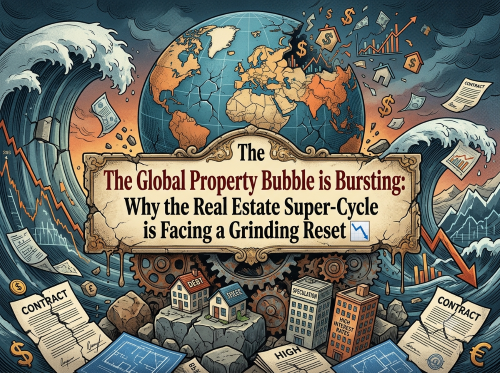
For over a decade, investing in the global housing market felt like an absolute certainty. It was the closest thing the modern financial system had to an infinite money glitch: buy a property, watch the value skyrocket, refinance on historically low interest rates, and repeat the process. However, underneath the surface of stubbornly high asking prices, the structural foundations of the global real estate market are fracturing.
From New York and London to Madrid and Auckland, the era of easy money is officially over. A combination of tapped-out buyers, defensive builders, hawkish central bank policies, and escalating geopolitical tensions has pushed the global property trade to its absolute limit. The market is not experiencing a temporary lull; it is entering a profound, long-term structural reset.
To the casual observer, the housing market might still look robust because nominal prices remain high in many major cities. However, this is a lagging indicator that masks a rapid loss of seller pricing power. Data reveals a stark shift in market psychology. For instance, in the United States, national median list prices have registered a 2.4% year-over-year decline—marking the steepest annual drop on record since 2017.
Sellers are no longer dictating terms. In a telling turn of events, over a third of American home sellers have been forced to slice their asking prices simply to attract interest. This trend has been running consecutively for over thirty weeks, with outright annual declines persisting for months. The heat is evaporating fastest in the markets that ran the hottest during the pandemic boom, such as Texas and Florida, where intense investor activity and surging inventory are forcing a rapid repricing.
The core issue is that the modern homebuyer is entirely tapped out. Roughly 65% of households can no longer afford a median-priced new home. This has created a massive wall of missing demand, entirely shifting the psychological dynamic of the real estate landscape.
To understand how the market became so distorted, one must look back to the easy-money era surrounding the pandemic. In early 2021, borrowing costs collapsed to historic lows, with 30-year fixed mortgages in the US bottoming out at an unprecedented 2.65%. This triggered a refinancing frenzy of epic proportions, with over fourteen million homeowners locking in historically low financing costs.
While this provided millions of households with immense financial breathing room, it simultaneously created a severe structural hazard known as the "lock-in effect." By the mid-2020s, more than half of all outstanding mortgage holders enjoyed rates well below 4%. For these individuals, moving house today means voluntarily relinquishing a once-in-a-lifetime financial deal and replacing it with a mortgage bill that could easily double their monthly commitment.
Consequently, the resale market has frozen. Existing homeowners are staying put, severely restricting the supply of established homes. However, while regular homeowners can afford to wait, commercial homebuilders cannot.
Unlike emotional homeowners who refuse to sell at a perceived loss, corporate homebuilders view property strictly through the lens of cash flow and inventory turnover. As demand has evaporated due to higher borrowing costs, builders have aggressively altered their tactics to undercut the traditional resale market.
Recent housing data highlights that nearly a third of homebuilders have slashed prices outright, while over 60% are leveraging heavy sales incentives—such as structural upgrades and mortgage rate buy-downs—to move inventory. The average builder price reduction has hovered around 6%, a discount that has sustained itself for over a year.
A traditional homeowner, who typically needs every pound or dollar of their sale price to fund their next purchase, simply cannot compete with a commercial developer offering to artificially lower a buyer's mortgage rate. As a result, the traditional resale market is stuck in a severe structural bind, and homebuilder confidence has plunged deep into negative territory.
For the past two years, the prevailing market narrative was that buyers just needed to hold on until central banks lowered interest rates. However, that optimistic scenario has been completely derailed. Central banks are not tasked with protecting real estate valuations; their mandate is price stability.
With the outbreak of major geopolitical conflicts, such as the Iran war, global energy pressures have resurfaced with a vengeance. Consumer price inflation has accelerated to over 4% year-over-year—the fastest pace in three years and double the target threshold. Central bank officials are deeply concerned that prolonged inflation will permanently alter wage and price-setting behaviour across the wider economy.
Consequently, the narrative has aggressively pivoted from rate cuts to the reality of higher-for-longer borrowing costs, with some central bank officials even forecasting further rate hikes. This is an incredibly hostile setup for real estate. With 30-year fixed mortgages stubbornly stuck around 6.5%, the strategy of buying a house today with the intention of refinancing it at a lower rate next year is completely dead. The anticipated affordability reset has evaporated.
This property crisis is uniquely global, behaving like a contagion across developed economies. In the United Kingdom, house prices have experienced consecutive month-on-month declines, with major lenders noting that elevated borrowing costs are placing a massive burden on transactions. While the average UK property price remains around £300,000, market friction is intense. The Royal Institution of Chartered Surveyors notes that buyer inquiries and overall sales volume are falling sharply, with transactions now taking an average of over 21 weeks to complete.
In mainland Europe, the crisis has manifested as a fierce political battle over rental affordability. In cities like Rome and Madrid, locals have been entirely priced out as landlords shifted long-term housing stock into highly lucrative short-term holiday rentals ahead of major tourist years. The strain has become so severe that the European Union is executing a massive crackdown on the Airbnb economy, handing out tens of millions in fines for unlicensed rentals. The affordability crisis on the continent has reached a point where startups are actively marketing individual bedrooms in shared flats as a form of homeownership. When developers are forced to pitch shared bedrooms to buyers, it is an undeniable sign that a market is completely exhausted and ready to roll over.
For the ultimate warning sign of how this ends, one must look to New Zealand. For a quarter of a century, New Zealand treated real estate as a foolproof national wealth strategy, pushing leverage to the absolute limit. After peaking in 2022, the market suffered a catastrophic reversal. Real house prices have plummeted by roughly 31% from their peak, completely erasing a decade of gains and dragging down the entire national economy. In Auckland, nearly a fifth of all home sellers—and a staggering 40% of apartment sellers—are registering outright financial losses upon sale.
The global real estate market is not facing a dramatic, abrupt collapse mirroring the subprime crisis of 2008 because there is far less predatory leverage embedded within the system today. Instead, the danger is a long, grinding economic erosion.
The social consequences are already severe. A massive generational divide has opened up, with roughly 60% of young adults expressing profound anxiety over housing affordability compared to a much smaller percentage of older generations who benefited directly from the historic asset boom.
Simultaneously, financial distress is beginning to surface in the wider consumer economy. Total household debt has climbed to historic highs, with mortgage balances making up the vast majority of that burden. Foreclosure filings are flashing warning signs, hitting a six-year high due to rising ownership costs.
Crucially, many property owners who felt insulated by locking in cheap fixed mortgage rates are discovering that debt is only half the battle. Non-mortgage housing bills are exploding. Rising property taxes and skyrocketing insurance premiums—particularly in climate and economic high-risk zones—are forcing monthly bills to unbearable levels regardless of the underlying interest rate.
The reality is that real estate takes far longer to adjust than the stock market. Sellers will resist lower valuations for as long as possible, freezing transactions and stalling economic growth. But eventually, gravity wins. The easy-money era that fuelled the great global property boom has drawn to a definitive close, proving that the infinite money glitch was never truly infinite.
Finance Bureau - The Housing Market is About to COLLAPSE
"The housing market's boom is cracking. Home prices are falling, buyers are maxed out, and rising rates have ended the easy profit game for both homeowners and investors.
We break down why affordability has collapsed, why seller power is fading, what the Fed’s latest moves mean for your mortgage, and how the crash is spreading globally. Find out what’s next before you make your next big move."
~ TIMESTAMPS ~
0:00 The Housing Market Is Crumbling
1:16 Home Prices Are Falling Across America
3:12 Why Texas and Florida Are Cutting Prices
4:22 How Cheap Money Created the Housing Boom
6:29 Builders Are Beating Regular Home Sellers
8:12 Why the Fed Won't Rescue Housing
10:31 The Mortgage Rate Relief Buyers Expected Is Gone
11:55 This Housing Slowdown Is Now Global
13:26 Europe Is Cracking Down on Airbnb
15:17 New Zealand's Housing Bubble Has Burst
17:56 Why Even Cheap Mortgages Aren't Enough Anymore
Source 👉 https://www.youtube.com/watch?v=kbstnLKe9QY
Disclaimer: This article is provided for informational purposes only, mistakes may be made, and it's not offered or intended to be used as legal, tax, investment, financial, or any other advice.