x




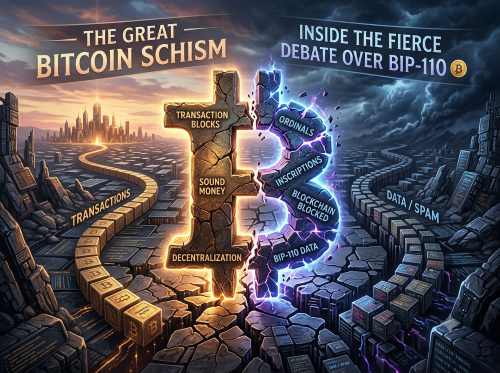
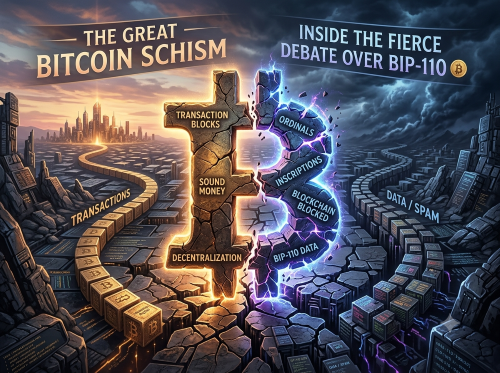
The Bitcoin network is currently locked in its most intense governance crisis in nearly a decade. Bitcoin Improvement Proposal 110, or BIP-110, has split the community of developers, miners, and industry heavyweights down the middle. What began as a technical debate over blockchain data has reopened deep ideological wounds, echoing the legendary "Blocksize Wars" of 2015–2017.
At its core, BIP-110 asks a fundamental question: Is Bitcoin purely a decentralised monetary network, or is it a neutral, permissionless ledger that can be used for whatever its users are willing to pay for?
Drafted by developer Dathon Ohm, BIP-110 is a proposed temporary soft fork. Its primary objective is to restrict the amount of arbitrary, non-financial data that can be embedded directly into the Bitcoin blockchain.
Historically, Bitcoin transactions were meant to transfer value from one party to another. However, updates like SegWit and Taproot inadvertently made it much easier and cheaper to store non-payment data on the network. This paved the way for "Ordinals" and "Inscriptions"—which act similarly to Non-Fungible Tokens (NFTs) by embedding images, text, and video directly onto the blockchain.
To kerb this trend, BIP-110 proposes several key technical restrictions on how data can be written to the ledger:
Importantly, the proposal is designed to be temporary, lasting for roughly one year once activated, to serve as a cooling-off period while the community searches for a permanent consensus.
Supporters of BIP-110, including prominent figures like developer Luke Dashjr, argue that embedding heavy media files onto the blockchain is an abuse of the network. In their view, block space is a precious, finite resource that must be preserved strictly for monetary transactions.
Proponents claim that storing large, non-financial data files causes "blockchain bloat". When the blockchain grows too quickly, it becomes increasingly expensive and technically demanding for ordinary users to run their own Bitcoin nodes. If only massive corporations can afford the hardware to run nodes, Bitcoin’s decentralised nature is compromised. By filtering out what they classify as "spam," supporters believe they are defending Bitcoin’s primary mission to be the world's premier sound money.
Despite the concerns over blockchain bloat, some of Bitcoin’s most influential leaders have strongly rejected BIP-110. Critics, such as MicroStrategy founder Michael Saylor and Blockstream CEO Adam Back, view the proposal as a dangerous threat to the network's foundational principles.
The main arguments against BIP-110 focus on three core issues:
1. The Threat to Censorship Resistance
As Jameson Lopp, Chief Security Officer at Casa, pointed out, Bitcoin’s main strength is its neutrality and predictability. If the rules can be changed to invalidate transactions simply because a group of developers dislikes the type of data being sent, Bitcoin ceases to be permissionless. Critics argue that establishing a precedent of subjective censorship is far more dangerous to Bitcoin’s credibility than any amount of on-chain "spam".
2. Invalidating Legitimate Transactions
BIP-110 could inadvertently block perfectly legitimate financial transactions. Opponents warn that altering consensus rules in this manner could invalidate complex smart contracts, multisig wallet configurations, or pre-signed transactions that happen to use script patterns targeted by the proposal.
3. The Risk of a Chain Split
The proposal uses a controversial activation method that resembles a User-Activated Soft Fork (UASF). If a minority of nodes attempt to enforce these new rules without broad consensus from miners, it could lead to a permanent split in the network, effectively creating two competing versions of Bitcoin.
For veteran Bitcoiners, this dispute feels incredibly familiar. The current standoff has reopened debates that haven't been seen since the Blocksize Wars of 2015–2017. That battle, which was fought over whether to increase the block size to accommodate more transactions, eventually resulted in a hard fork that created Bitcoin Cash.
However, Samson Mow, a prominent Bitcoin advocate, notes a key difference this time. During the Blocksize Wars, the community naturally rallied around a shared vision. Today, the heavy-handed nature of BIP-110's activation and the aggressive rhetoric surrounding OP_RETURN policies have fractured relationships, creating an "us versus them" mentality that threatens internal unity.
BIP-110 is approaching its critical activation deadline in August. For the rules to lock in smoothly via miner signalling, the proposal requires a 55% support threshold from the network’s hashrate. Currently, miner support is sitting at an incredibly low 1%.
Major mining pools have shown virtually no interest in signalling for the change, and key industry leaders remain highly sceptical. Unless there is a sudden, massive shift in sentiment, BIP-110 appears unlikely to gain the necessary consensus.
Nevertheless, the debate itself has served as a powerful reminder of how Bitcoin is governed. It has shown that the barrier to altering Bitcoin's core consensus rules remains extraordinarily high—and that any attempt to restrict the protocol's radical freedom will always face a wall of resistance.
For more details on this developing story and to read the original coverage, visit the article on Decrypt:
👉 What Is BIP-110 and Why Is It Dividing the Bitcoin Community?
Disclaimer: This article is provided for informational purposes only, mistakes may be made, and it's not offered or intended to be used as legal, tax, investment, financial, or any other advice.