x




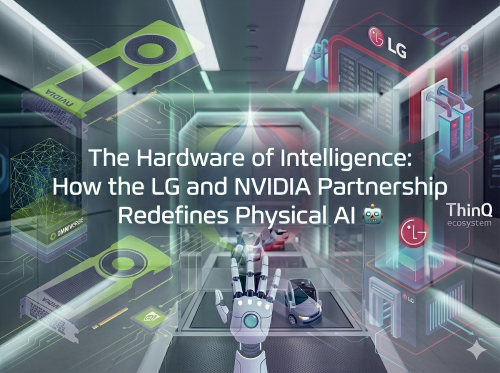
The boundary between the digital and physical worlds is blurring. While Large Language Models (LLMs) have mastered the art of conversation, the next frontier of innovation is Physical AI—the ability for machines to perceive, reason, and act in the messy, unpredictable real world.
Recent exploratory talks between LG and NVIDIA have signaled a massive shift in this landscape. By combining NVIDIA’s unrivaled computational power with LG’s massive manufacturing footprint and thermal expertise, the two giants are laying the groundwork for a future where autonomous systems aren't just confined to factories, but live in our homes and vehicles.
As AI models grow in complexity, the hardware required to train and run them is hitting a physical limit. NVIDIA’s high-density server racks generate immense heat. If this heat isn't managed, compute nodes throttle their performance, leading to massive financial losses for data center operators.
Traditional air cooling is no longer sufficient for the AI era. This is where LG enters the frame. By positioning itself as a provider of high-efficiency HVAC and advanced thermal management solutions, LG is solving a "physics problem" for the AI industry.
By integrating LG’s cooling hardware directly into infrastructure powered by NVIDIA, facility operators can pack more processing power into smaller spaces. For LG, this isn't just about selling air conditioners; it’s about becoming an essential infrastructure layer within the NVIDIA ecosystem.
One of the biggest hurdles in robotics is latency. When a robot tries to perform a task—like picking up a fragile glass—it must process visual data, identify the object, and calculate grip force in milliseconds. Even a slight delay in this "inference pipeline" can lead to shattered glass or safety hazards.
LG recently showcased CLOiD, a sophisticated home robot with seven degrees of freedom and five individually-actuated fingers. To make CLOiD truly "intelligent," it needs more than just good motors; it needs a digital brain capable of real-time spatial reasoning.
NVIDIA provides this brain through its Omniverse and Isaac robotics stacks. By leveraging NVIDIA’s edge-compute capabilities, LG can move the "thinking" process from the cloud directly to the robot. This reduces costs and ensures that the robot reacts to its environment with human-like speed and precision.
While NVIDIA has successfully tested its robotics stack in structured environments like Siemens factories, the average living room is far more chaotic. Toys on the floor, changing lighting, and moving pets create a level of variability that is difficult to simulate.
LG’s ThinQ ecosystem offers NVIDIA a golden ticket: access to mass-market domestic data. Training AI models on the messy reality of millions of homes allows for the creation of more robust, reliable physical AI. This synergy allows NVIDIA’s Omniverse to become the universal development platform for real-world autonomy, much like its GPUs became the standard for cloud computing.
The partnership also extends to the driveway. LG’s automotive components division—specializing in infotainment and in-cabin displays—complements NVIDIA’s DRIVE platform, which handles the actual autonomous driving logic.
Currently, car manufacturers struggle to bridge the gap between "entertainment" systems and "driving" systems. A collaboration between LG and NVIDIA would unify these layers. This means a more seamless experience for the driver and an easier way for manufacturers to push over-the-air (OTA) updates to improve the vehicle's intelligence over time.
The discussions between LG and NVIDIA represent more than just a business deal; they represent the convergence of hardware actuation and digital intelligence. By solving the problems of heat, latency, and environmental variability, these two companies are building the nervous system of the future.
As we move toward a world of "Affectionate Intelligence" and ubiquitous robotics, the collaboration between the masters of compute and the masters of infrastructure will be the catalyst that finally brings AI out of the screen and into our physical reality.
For more information, read this article on AINEWS:
👉 What LG and NVIDIA’s talks reveal about the future of physical AI
Disclaimer: This article is provided for informational purposes only, mistakes may be made, and it's not offered or intended to be used as legal, tax, investment, financial, or any other advice.