x




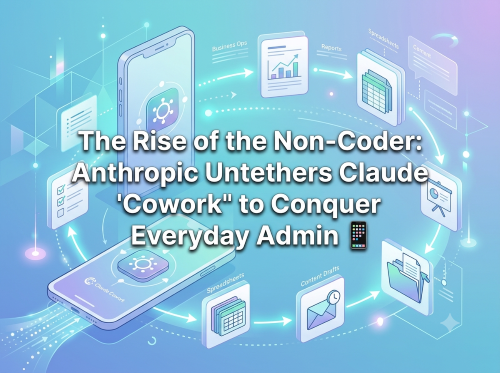
The dominant narrative surrounding enterprise artificial intelligence (AI) has long been obsessed with the software engineer. Since the dawn of large language models, the spotlight has firmly remained on coding assistants, automated debugging, and developer productivity. Yet, underneath the tech-heavy headlines, a quiet revolution has been brewing amongst a vastly larger cohort: the everyday knowledge worker.
Anthropic has officially acknowledged this shift by launching Claude Cowork across mobile and web platforms. Originally a desktop-only agent, this tool has become a crucial bridge between developer-centric terminal apps and the immense market of professionals who never touch a line of code. By making Cowork cross-device, Anthropic is pivoting towards an autonomous, background-operating platform designed to tackle the mundane tasks that bog down corporate life.
The timing of this mobile and web expansion is far from accidental. Alongside the rollout, Anthropic published anonymised usage data from 1.2 million Claude Cowork sessions sampled across more than 600,000 organisations. The findings paint an unexpected picture that completely upends what we thought we knew about enterprise AI adoption.
As it turns out, the vast majority of what people actually do with autonomous AI has absolutely nothing to do with writing software.
The single largest usage category, commanding a massive 33.4% of all sessions, is business process and operations. We are talking about the universal chores of office life: pulling scattered updates into a weekly report, building employee onboarding checklists, and reconciling bloated spreadsheets. Content creation and copywriting came in second at 16.4%, meaning that general administrative and creative tasks make up half of all Claude Cowork usage.
By stark contrast, software development accounted for a mere 8.7% of sessions.
Anthropic aptly categorises these dominant activities as "the work around the work." These are the critical, connective tasks that cross almost every corporate department but rarely appear in a formal job description. Rather than trying to replace human expertise, the strategy focusses on automating the administrative scaffolding that surrounds it.
Transitioning Cowork to mobile and web platforms introduces three major workflow upgrades that reflect how we actually work today.
First, sessions now sync seamlessly across devices. A project manager can initiate a complex data compilation at their desk, head out for a client meeting, track the progress on their phone, and retrieve the final output from a tablet later that evening.
Second, and perhaps most significantly, Cowork can now execute multi-step workflows autonomously in the background without any user device being online. This means you can schedule heavy administrative lifts to happen before your workday even begins. For instance, you could instruct Claude to sift through weekend email threads, meeting transcripts, and relevant news at 6:00 am on a Monday. By the time you sit down with your morning coffee, a complete client briefing document is ready for review, and a follow-up email is waiting in your drafts.
Third, the system handles the inherent risks of autonomy via mobile push notifications. When the AI hits a fork in the road that requires human judgment or ethical discretion, it surfaces the question directly to the user's phone. Nothing is finalised or transmitted until an actual human reviews and approves the step.
While the desktop app remains the most feature-rich surface due to its direct access to local files and browsers, the web iteration is a massive win for enterprise environments. It bypasses rigid corporate IT restrictions that frequently block employees from installing third-party desktop software.
This expansion highlights Anthropic’s clear two-track approach to securing market share. For the hardcore programming community, it offers Claude Code—a terminal-based tool built explicitly for building, debugging, and shipping software. For everyone else, there is Cowork.
This strategy seems to be paying off. Recent industry data indicates that Anthropic has edged ahead of OpenAI in business adoption for the first time, with 34.4% of firms paying for Anthropic’s services compared to OpenAI’s 32.3%.
To maintain this momentum, Anthropic is rapidly upgrading its ecosystem. The engine driving Cowork is the recently launched Claude Sonnet 5 model, which offers advanced reasoning and sustained task completion at a lower price point. Furthermore, the company recently introduced Claude Tag, a Slack-native multiplayer agent designed for team collaboration rather than isolated individual tasks. Together, Cowork and Tag form a powerful pincer movement: one captures individual productivity across personal devices, while the other embeds itself directly into corporate communication channels.
Of course, migrating autonomous agents to the web and mobile spheres brings fresh challenges. Running tasks server-side eliminates certain local machine vulnerabilities, but it invites intense scrutiny regarding data privacy and security.
When an AI agent is granted the authority to independently browse email folders, internal contract archives, and client databases while the user is entirely offline, the risk of data exposure or malicious prompt injection rises. Anthropic has previously urged caution regarding these advanced workflows, reminding users that moving past a simple chatbot interface requires heightened security awareness.
Geopolitics is also complicating the global corporate pitch. Amidst rising tensions and trade restrictions, tech giants like Alibaba have started banning internal staff from utilising Anthropic's tools, placing software like Claude Code on high-risk registries.
Yet, Anthropic's massive infrastructure investments—including a recently secured multi-billion-pound, 20-year data centre lease to dramatically scale its computing power—prove that the company is betting heavily on an AI-driven future.
Ultimately, the evolution of tools like Claude Cowork marks a shifting philosophy in the tech sector. The ultimate value of enterprise AI may not lie in grand, highly technical feats like writing complex code or inventing new algorithms. Instead, the true return on investment is found in the unglamorous, daily liberation of human workers from the administrative quicksand of modern business.
For more information and deeper insights into this announcement, you can read the full breakdown on VentureBeat:
👉 Anthropic brings Claude Cowork to mobile and web as usage data shows most users aren’t coding
Disclaimer: This article is provided for informational purposes only, mistakes may be made, and it's not offered or intended to be used as legal, tax, investment, financial, or any other advice.