x




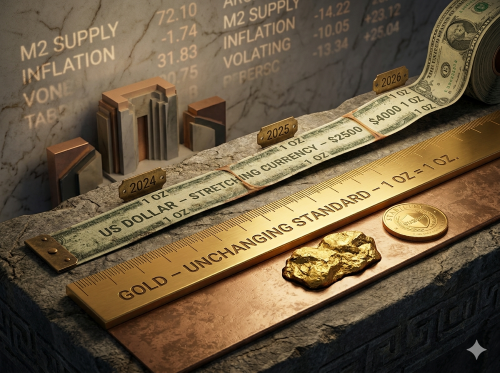
When you open a financial news app and see a headline screaming that gold has surged to record highs, what is your immediate reaction? If you are like most people, you probably think: "Wow, gold is getting incredibly expensive."
It is a perfectly natural conclusion to reach. We are conditioned to look at price tags as absolute markers of value. If the number of pounds or dollars required to buy an item goes up, we assume the item itself has become more valuable.
However, when it comes to precious metals, that interpretation is completely backward. Once you flip your perspective on this concept, you will never look at money, inflation, or your savings account the same way again.
The truth is that gold’s fundamental role as a stable store of value has not changed for thousands of years. An ounce of gold today is physically identical to an ounce of gold dug out of the ground during the Roman Empire. It does not grow, it does not shrink, and it does not magically alter its intrinsic worth. Therefore, when the headline says gold is hitting new highs, it isn't telling you that gold has changed. It is telling you that the currency used to measure it has weakened.
The gold is not moving. The measuring stick is.
To understand why we read this dynamic backward, we have to look at how we perceive wealth. We measure everything in our local currency. Our salaries, our mortgages, our pension pots, and our net worth are all calculated in pounds or dollars. Because our daily lives revolve around these fiat currencies, we treat them as fixed, unchanging units of measurement—like a rigid wooden ruler.
But fiat currency is not a wooden ruler; it is a rubber band.
When central banks expand the money supply, they stretch that rubber band. Because there are suddenly vastly more units of currency chasing a relatively fixed amount of real-world goods and hard assets, the purchasing power of each individual unit shrinks. This process is known as monetary debasement.
The tricky part is that this erosion is almost invisible in daily life because a ten-pound note still says "£10" on it. The number on the paper does not change, but what that paper can actually buy does. Because gold is a finite, physical asset that cannot be printed out of thin air, it acts as a mirror to this currency dilution. When gold's price climbs, you are not watching gold gain value in real terms; you are simply watching the market calculate the ongoing loss of your currency's purchasing power.
Let us look at a stark, real-world example of how this hidden erosion impacts everyday savers. Consider the period between mid-2024 and mid-2026.
Imagine you had a significant sum of cash sitting in a high-yield savings account, comfortably earning a seemingly attractive 4% to 5% annual interest. Over those two years, your balance would have grown. If you started with £10,000, you might have generated around £800 to £1,000 in nominal interest. Looking at your bank statement, you would feel like you were successfully building wealth.
Now, let us look at what happened to gold over that identical two-year window. In mid-2024, spot gold was trading at roughly $2,325 per ounce. By mid-2026, it had surged to around $4,350 per ounce—an astonishing rise of approximately 87%.
When you cross-reference your cash savings with the gold market, the illusion of your growing wealth quickly evaporates. While your bank balance grew by a few percentage points in nominal terms, the currency's ability to purchase hard assets was effectively cut in half. Your bank statement showed more numbers, but your real-world purchasing power had severely degraded.
This is the ultimate danger of relying solely on fiat currency for long-term wealth preservation. You can win the battle of nominal interest rates while losing the war of actual purchasing power.
To understand why gold exposes the flaws of fiat currency so effectively, we must look at the concept of "sound money." Sound money is defined as any medium of exchange that maintains its purchasing power over long periods and whose supply cannot be arbitrarily expanded by governments, banks, or institutions.
Gold has naturally filled this role across millennia and civilisations. This is not due to mere sentimentality or tradition; it is due to unique physical characteristics that no political entity can alter:
Compare this to the trajectory of modern fiat currencies. For instance, in the four years following 2020, the United States M2 money supply expanded by roughly 36%, skyrocketing from around $15.4 trillion to over $21 trillion. When the supply of money grows at a pace that far outstrips the production of real goods and services, the mathematical consequence is a devaluation of that money. Gold's rising price is simply a continuous, honest reflection of that ongoing dilution.
If you look at history through a long-term lens, the contrast becomes even more profound. Consider a simple commodity like a standard loaf of bread. In 1920, a loaf of bread cost roughly 10 cents in the United States. Today, due to a century of compounding currency devaluation, that same loaf costs several dollars. If you had saved a physical paper dime in a drawer in 1920 and took it out today, you could not even buy a single crumb.
However, if you took the exact weight of gold that was worth 10 cents in 1920, you would find that its value today has adjusted to easily cover the cost of that loaf of bread—and likely quite a bit more.
Gold does not provide an yield, and it does not pay dividends. What it does, with remarkable consistency across decades, wars, recessions, and completely rewritten monetary systems, is protect your purchasing power. It ensures that the work you do today can still buy an equivalent amount of real-world value far into the future.
In the spirit of complete financial honesty, it is crucial to clarify that gold is not a magical asset that moves upward in a straight line. There are frequently periods—sometimes lasting for many consecutive years—where gold prices stagnate, trend sideways, or drop significantly.
For example, during the 2010s, gold underwent a major multi-year correction. After peaking near $1,900 per ounce in August 2011, it steadily declined to under $1,100 per ounce by late 2015, representing a loss of roughly 40%.
Why did this happen? Because those were years characterised by positive real interest rates, a strongly recovering stock market, and low perceived systemic risk. When traditional financial assets are delivering robust, reliable returns above the rate of inflation, holding a non-yielding asset like physical gold becomes less attractive to investors.
Gold acts as an insurance policy. You do not buy home insurance with the hope that your house catches fire tomorrow just so you can collect a payout; you buy it to protect yourself against a catastrophic event. Similarly, you do not hold gold as a short-term speculative trade to get rich quick. You hold it as a strategic foundation to ensure you do not get poor slowly through the quiet, constant erosion of your cash.
When you fully digest this paradigm shift, the fundamental financial questions you ask yourself will change. The question is no longer a speculative one, such as: "Is gold going to go up this year?"
Instead, the question becomes deeply practical: "How much of my hard-earned savings am I willing to leave in a currency system that is systematically designed to dilute my purchasing power, and how much should I place in a tangible asset that cannot be devalued?"
Allocating a portion of your wealth to physical gold, held safely outside of the traditional banking mechanism, is not about panicking or predicting the collapse of the financial system. It is simply about recognising how money actually works. It is an act of financial sovereignty—taking control of your wealth by opting out of a system where the rules can be rewritten at any moment, and stepping into one governed by the unalterable laws of physical scarcity.
GoldSilver - The Dollar Lost Half Its Gold Buying Power
"The purchasing power of the U.S. dollar to buy gold got cut in half in a year. In this Short, GoldSilver breaks down one of the clearest warnings in the whole video — and what it says about fiat purchasing power right now."
To read the full analysis and explore this monetary reframe in greater detail, view the original report on GoldSilver:
👉 When Gold’s Price “Goes Up,” You’re Reading It Backward
Disclaimer: This article is provided for informational purposes only, mistakes may be made, and it's not offered or intended to be used as legal, tax, investment, financial, or any other advice.