x




Artificial intelligence has completely dominated global headlines and stock market trends over the last few years. At the absolute centre of this technological revolution stands OpenAI. The creators of ChatGPT turned the tech world upside down, quickly achieving the fastest-growing consumer product launch in history. However, behind the grand public announcements and staggering private valuations, significant structural challenges are beginning to emerge.
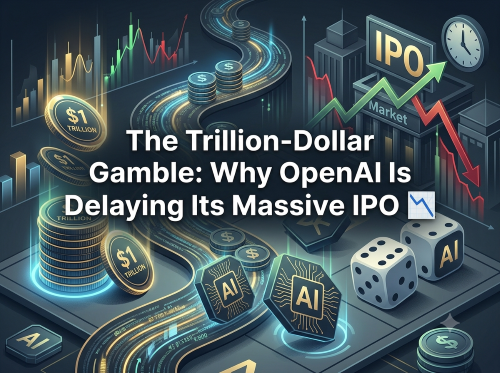
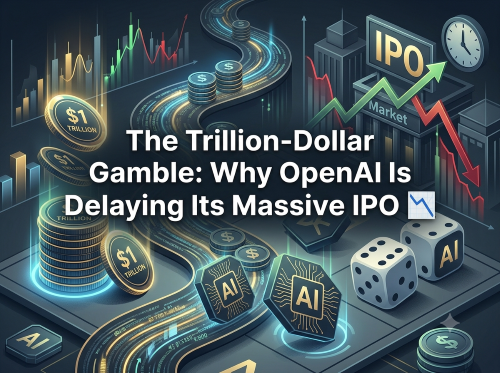
OpenAI has reportedly pushed its highly anticipated stock market debut back from 2026 into 2027. This decision is not due to a sudden lack of public interest in artificial intelligence, but rather because chief executive Sam Altman is holding out for a monumental one trillion dollar valuation. It is a massive financial gamble, and the broader market may simply refuse to pay such a high premium.
To understand why OpenAI is seeking such a massive valuation, one must look at the company's truly astronomical operating costs. In March 2026, the firm completed a massive one hundred and twenty-two billion dollar funding round backed by tech heavyweights like SoftBank, Amazon, and Nvidia, establishing a private valuation of eight hundred and fifty-two billion dollars. Moving from that figure to a one trillion dollar public listing requires convincing the public market to hand over an additional one hundred and forty-eight billion dollars in value before trading even begins.
While the company brought in an impressive thirteen point zero seven billion dollars in revenue over 2025, it simultaneously burned through roughly thirty-four billion dollars in total costs. This means the organisation spent over two and a half dollars for every single dollar it earned. The primary culprit for this severe cash burn is the sheer amount of computing power required to train and run frontier large language models. OpenAI paid its primary investor, Microsoft, a staggering eleven billion dollars in 2025 alone just for server infrastructure.
With future commitments to spend six hundred and sixty-five billion dollars on computing infrastructure through 2030, OpenAI is on a relentless capital treadmill. Chief financial officer Sarah Frier reportedly pushed for the IPO delay because the firm is simply not ready for the intense scrutiny of the public markets while burning through billions of dollars every quarter. True profitability is not projected to arrive until 2029 at the earliest.
A high cash burn can be justified if a company maintains an absolute, untouchable monopoly on the most profitable sectors of the market. Yet, OpenAI is facing an incredibly aggressive challenge from its primary Western rival, Anthropic.
While ChatGPT remains a dominant consumer household name, consumer attention is a notoriously low-margin layer of the business. The real money is made in the enterprise sector, where large corporations wire complex workflows into an AI system. Once an enterprise integrates a specific AI provider into its software engineering and long-term multi-step tasks, swapping to a competitor becomes incredibly expensive and disruptive.
Anthropic has quietly capitalised on this. Reports indicate that Anthropic captured over thirty-one percent of global large language model revenue in the first quarter of 2026, edging ahead of OpenAI's twenty-nine percent. In the highly lucrative enterprise spending market, Anthropic managed to secure forty percent of the market compared to OpenAI's twenty-seven percent. Anthropic’s specialised coding tools are winning the vast majority of head-to-head enterprise deals with new business clients, creating a defensive moat right where it hurts OpenAI the most.
The strategic pressure intensifies when looking at the lower end of the market. Over the last eighteen months, the tech landscape has seen a massive surge in advanced, open-source models originating from China, such as DeepSeek, Alibaba's Qwen, and Moonshot's Kimi.
There is a widespread assumption that cheaper models must inherently deliver lower quality performance, but recent industry benchmarks suggest the performance gap has narrowed to single digits. In certain specialised software engineering tests, some of these alternative models have actually outperformed Western frontier equivalents. For routine, everyday corporate tasks, the minor differences in capability are virtually invisible to the end user.
The real differentiator is the pricing architecture. These open-source alternative models are anywhere from five to twenty times cheaper per task than premium Western options. This massive pricing gap has triggered an immediate migration of business traffic. Data from open routing platforms reveals that the combined usage share of OpenAI, Anthropic, and Google has collapsed from seventy-two percent down to roughly thirty-three percent over the span of a year. Major tech firms and cryptocurrency exchanges are actively moving routine engineering workloads to these hyper-efficient models to slash their operating expenses. Strikingly, even Microsoft has explored using these alternative models to manage the soaring costs of running its own corporate AI features.
The unfolding drama surrounding OpenAI's valuation is far more than a simple corporate rivalry between Silicon Valley executives. The modern global stock market rally has built an enormous amount of momentum on the core narrative that artificial intelligence is an unstoppable, winner-takes-all gold mine. OpenAI serves as the absolute keystone of that foundational belief.
If OpenAI attempts a public listing at a one trillion dollar valuation based heavily on future promises rather than a balanced, profitable balance sheet, a failure to meet expectations could trigger a massive market correction. A downward repricing would not be contained to OpenAI alone; it would ripple aggressively through major infrastructure providers like Nvidia, primary backers like Microsoft, and every tech-heavy index fund or pension scheme across the globe.
Early institutional backers and venture capital funds invested at a tiny fraction of current prices, giving them plenty of flexibility to exit with substantial profits. However, everyday savers who hold passive index funds or workplace retirement accounts could find themselves exposed to highly stretched valuations if the broader market momentum begins to cool. There is an immense amount of financial weight resting on OpenAI's eventual public debut, and the ultimate outcome will shape the investment landscape for years to come.
Coin Bureau - OpenAI's SHOCKING Move: It's Over
"OpenAI’s trillion-dollar dream is cracking. The IPO has stalled, top enterprise clients are switching to cheaper competitors, and soaring costs are eroding profits.
This video exposes why OpenAI is losing its lead and what the tech shift means for everyone with money in major funds or retirement accounts. Don’t miss the real story behind the headlines."
~ TIMESTAMPS ~
0:00 — OpenAI’s $1 Trillion Dream Starts Cracking
1:47 — Altman Delays IPO Over A Giant Valuation
3:34 — Investors Are Turning On AI Hype
5:22 — Anthropic Is Beating OpenAI Where It Matters
7:09 — OpenAI’s Real Cash Burn Problem
8:56 — Why OpenAI Needs Endless New Money
10:44 — Cheap Chinese AI Models Catch Up Fast
12:31 — OpenAI’s Moat Is Being Commoditised
14:18 — Who Wins If OpenAI’s IPO Flops
16:06 — The Biggest Risk For Ordinary Investors
Source 👉 https://www.youtube.com/watch?v=Mm46lsziCEk
Disclaimer: This article is provided for informational purposes only, mistakes may be made, and it's not offered or intended to be used as legal, tax, investment, financial, or any other advice.