x




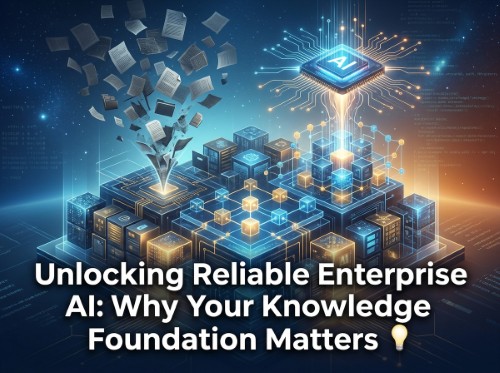
As organisations rush to deploy autonomous AI agents to automate workflows, streamline customer support, and generate code, a critical hurdle is emerging. While modern large language models (LLMs) possess impressive reasoning capabilities, their outputs remain fundamentally constrained by the quality, consistency, and structure of the underlying data fed to them.
For the past few years, context engineering—connecting enterprise systems, chunking text, generating vector embeddings, and building Retrieval-Augmented Generation (RAG) pipelines—has been the default approach to powering AI tools. However, treating context as an application-specific patch rather than a shared enterprise asset creates severe structural bottlenecks. Modern enterprise AI agents are only ever as reliable as the messiest documents behind them.
Building bespoke context pipelines for individual AI tools works reasonably well when an organisation relies on a single virtual assistant. But as teams deploy multiple specialised agents across finance, product, engineering, and customer support, this isolated approach falls apart for three primary reasons:
To solve these challenges, enterprise AI requires the same architectural discipline that data engineering applied to structured data: a unified enterprise knowledge platform that manages information once and serves it to every application.
Rather than treating documents, code repositories, tickets, and emails as isolated inputs for specific prompts, a modern knowledge platform manages them as governed, shared infrastructure. This architecture relies on four distinct layers:
1. The Raw Layer (Preserving Source Integrity)
The foundation captures data directly from original enterprise sources—PDFs, database change events, source code, Jira tickets, and emails—without altering their original form. Preserving this unaltered state ensures that if extraction logic improves or downstream models need re-indexing, the platform can rebuild knowledge without relying on corrupted, application-specific copies.
2. The Refined Layer (Normalising Knowledge Objects)
Heterogeneous content is transformed into structured, managed knowledge objects. Here, every document or record receives a standardised schema containing crucial metadata—such as source system, author, version history, access permissions, tags, and timestamps. This layer normalises content while maintaining security and lineage, regardless of whether the source was a Slack thread or an API response.
3. The Integrated Layer (Building the Enterprise Knowledge Model)
Independent knowledge objects are linked together to construct a holistic business model. This layer maps explicit connections (like cross-referenced Git commits and Jira tickets) and resolves implicit entities (such as linking a release note to a product requirement document via semantic entity resolution). Crucially, it models real business relationships—like depends_on, affects, or implemented_by—allowing AI agents to reason accurately across departmental boundaries.
4. The Serving Layer (Publishing Reusable Context)
Built upon the unified knowledge model, the serving layer exposes tailor-made representations to downstream workloads. It provides shared assets like SQL views, graph models, and vector search indexes alongside dynamic, agent-specific context. A Customer Support Agent and a Product Agent consume the exact same underlying truth, but receive tailored context representations specific to their roles.
Traditional enterprise knowledge tools—like wikis, issue trackers, and shared drives—were explicitly built for human consumption. Humans rely on personal experience, intuition, and informal communication to bridge gaps, decipher ambiguous jargon, and ignore outdated files.
AI agents possess no such innate intuition. When machines interact directly with human-centric knowledge repositories, they easily misinterpret stale data or hallucinate false conclusions. A structured knowledge platform bridges this gap by transforming human-oriented documentation into AI-ready infrastructure.
Furthermore, this architecture enables vital operational capabilities:
The landscape of LLMs, vector databases, and multi-agent frameworks has matured rapidly. As advanced AI models become increasingly commoditised, raw model capability is no longer the primary differentiator for enterprise performance.
The new bottleneck is the enterprise data foundation behind the models. Advanced reasoning capabilities cannot compensate for fragmented documentation, conflicting business definitions, or disconnected data pipelines. The organisations that succeed with enterprise AI will not simply be those that build the most agents, but those that establish the cleanest, most integrated knowledge platforms to power them.
Disclaimer: This article is provided for informational purposes only, mistakes may be made, and it's not offered or intended to be used as legal, tax, investment, financial, or any other advice.