x




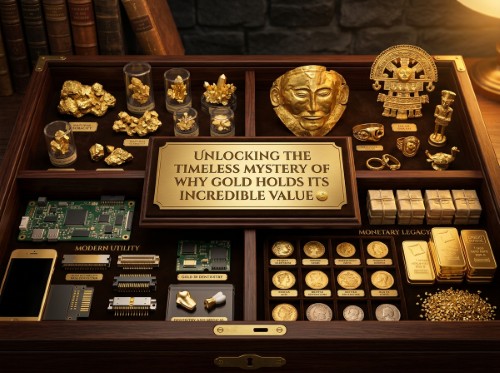
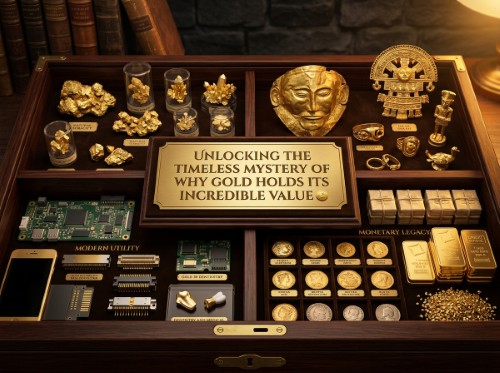
For centuries, gold has captivated human imagination, sitting atop the economic hierarchy as the ultimate symbol of wealth and security. But what actually gives this yellow metal its enduring worth?
Understanding gold's value requires looking beyond a single characteristic. Its worth stems from a rare intersection of natural scarcity, indestructible chemistry, cultural reverence, practical utility, and a multi-millennial legacy as money and a store of value.
Gold does not derive its value from just one source. Instead, it relies on five distinct features that reinforce one another:
This unique convergence is why other materials that are scarce, useful, or decorative rarely command the same universal status. Gold is the rare case where all these traits align on a single element.
Gold’s chemistry reads like an engineer’s wishlist for the ideal material. Because it is chemically inert, a sovereign coin or bar minted today will look and weigh precisely the same in fifty years, entirely protected against rust, tarnish, or decay.
Furthermore, gold possesses unmatched malleability and ductility. A single troy ounce can be hammered into a sheet thin enough to let light pass through, or drawn into a wire stretching roughly 50 miles long without snapping. Combined with its distinct, intrinsic warm yellow colour and high density—which allows a modest, easily transportable handful to represent massive concentrated wealth—gold naturally established itself as an ideal medium for portable value.
Long before global trade routes existed, separate civilisations across different continents independently concluded that gold was sacred and precious.
In the Varna Necropolis of modern-day Bulgaria, dating back to 4600–4200 BC, archaeologists uncovered thousands of gold artefacts predating the pyramids and written history. Ancient Egyptians viewed gold as the literal flesh and bone of the sun-god Ra, gilding royal tombs to help pharaohs transition into the afterlife. Meanwhile, the Inca referred to gold as the "sweat of the sun," reserving it exclusively for temples and royalty.
This deep-rooted trust never vanished. Today, central bank vaults continue accumulating massive reserves, driven by thousands of years of human consensus that gold is worth protecting.
While silver shares gold’s ancient pedigree as a precious metal and monetary asset, the two metals preserve value in fundamentally different ways. Comparing their mechanics reveals why gold remains the unmatched global benchmark for wealth preservation:
Industrial Consumption vs Wealth Preservation:
More than 50% of all mined silver is consumed by heavy industry, technology, and solar panel production, meaning a vast amount of silver is permanently used up. Conversely, roughly 98% of all gold ever mined throughout human history still exists today in vaults, central bank reserves, and fine jewellery. Gold is held, whereas silver is consumed.
Value Density and Practicality:
Gold possesses vastly superior value density. Securing £100,000 worth of physical gold requires a compact stack of bars easily held in one hand, keeping transport and vaulting costs minimal. Storing the equivalent monetary value in physical silver requires hundreds of kilograms of metal, demanding substantial physical space, heavier logistics, and higher insurance premiums.
Volatility and Economic Sensitivity:
Silver trades in a much smaller physical market and carries a dual identity as both a monetary hedge and an industrial commodity. Consequently, silver exhibits two to three times greater price volatility than gold. While rising manufacturing demand can cause silver to surge during economic booms, gold provides far superior price stability and countercyclical protection during financial downturns.
The Gold-Silver Ratio:
Tracking how many ounces of silver are required to purchase a single ounce of gold, this historical metric underscores gold's persistent monetary premium. While silver offers an accessible entry point and potential for cyclical gains, central banks and sovereign institutions rely almost exclusively on gold as their primary non-fiat reserve asset.
While gold no longer backs everyday paper currencies, it remains a premier store of value. Unlike industrial commodities that get consumed during manufacturing, an estimated 98% of all the gold ever mined throughout history still exists today in vaults, jewellery, and reserves.
Investors and central institutions hold physical gold as an independent safeguard that sits outside the traditional banking system. In an era where fiat currencies face inflationary pressures and geopolitical shifts, gold provides a reliable hedge against uncertainty—just as it has for millennia.
Disclaimer: This article is provided for informational purposes only, mistakes may be made, and it's not offered or intended to be used as legal, tax, investment, financial, or any other advice.